
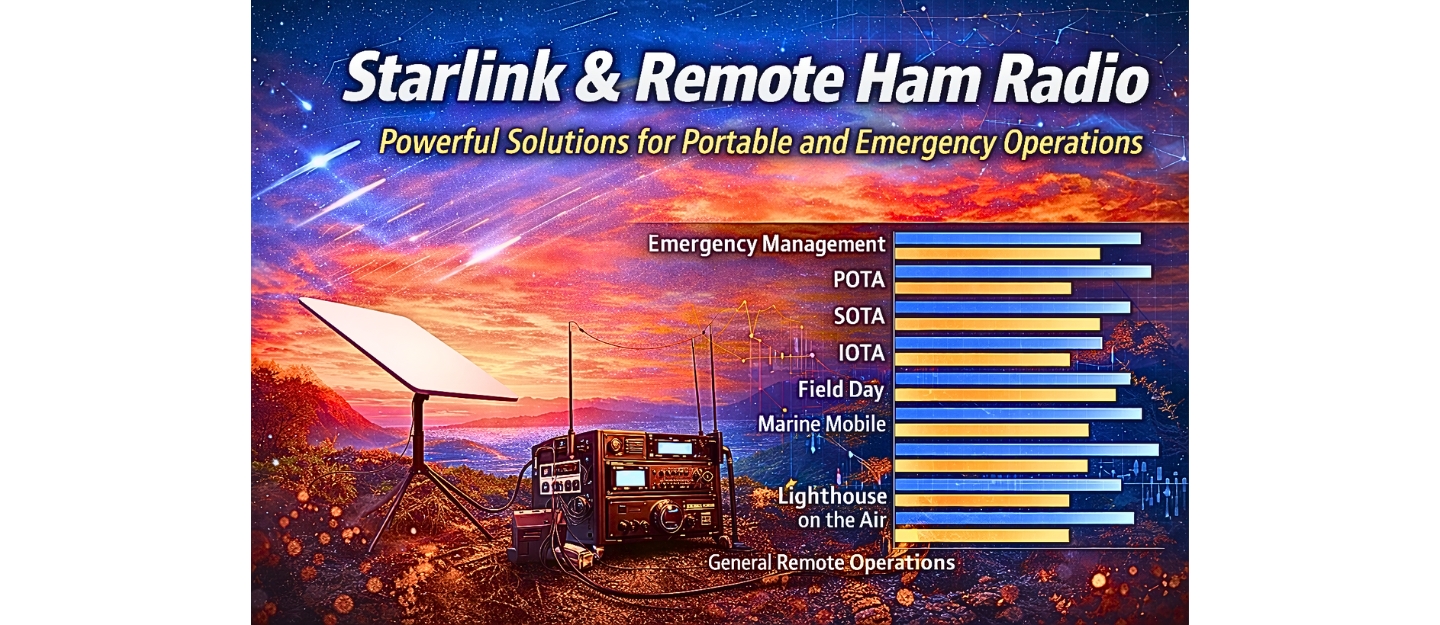
Starlink and remote ham radio together redefine how operators access stations, manage RF resources, and operate reliably from anywhere. Therefore, instead of relying on local internet or fixed infrastructure, operators now place radios in optimal RF locations while controlling them remotely with low latency. Moreover, this combination removes many historical barriers tied to geography, zoning restrictions, and unreliable connectivity.
What Starlink Brings to Remote Ham Radio
Starlink delivers broadband connectivity through low Earth orbit satellites, and that architecture dramatically reduces latency compared to legacy satellite systems. Additionally, Starlink operates independently of terrestrial cables and cellular towers, so it excels in rural, coastal, and disaster-prone regions.
Because Starlink terminals deploy quickly, operators can bring remote control capability online in hours instead of months. Furthermore, uplink stability remains strong even when local infrastructure degrades. As a result, Starlink becomes a practical backbone for continuous remote station access.
Fundamentals of Remote Ham Radio Operation
Remote ham radio separates the operator from the physical radio location. Therefore, the transceiver, amplifiers, antennas, and switching hardware remain at a fixed site while control and audio travel over IP networks. Meanwhile, the operator connects from home, mobile locations, or temporary deployments.
This model allows radios to sit where RF conditions work best. Consequently, operators place antennas on quiet rural land, mount towers at optimal heights, and avoid HOA or noise limitations. In addition, remote control supports shared infrastructure, contesting, DXing, and emergency coordination.
Why Starlink Pairs So Well with Remote Stations
Traditional remote stations depend on wired broadband or cellular data. However, those options fail or disappear in remote locations. Starlink eliminates that dependency, and therefore it unlocks new station placements.
Latency matters greatly in SSB, CW, and digital operation. Because Starlink latency typically stays low and consistent, tuning, PTT control, and audio feedback remain usable and intuitive. Moreover, consistent uplink performance prevents audio dropouts that disrupt operating rhythm.
Starlink Benefits for Remote Ham Radio
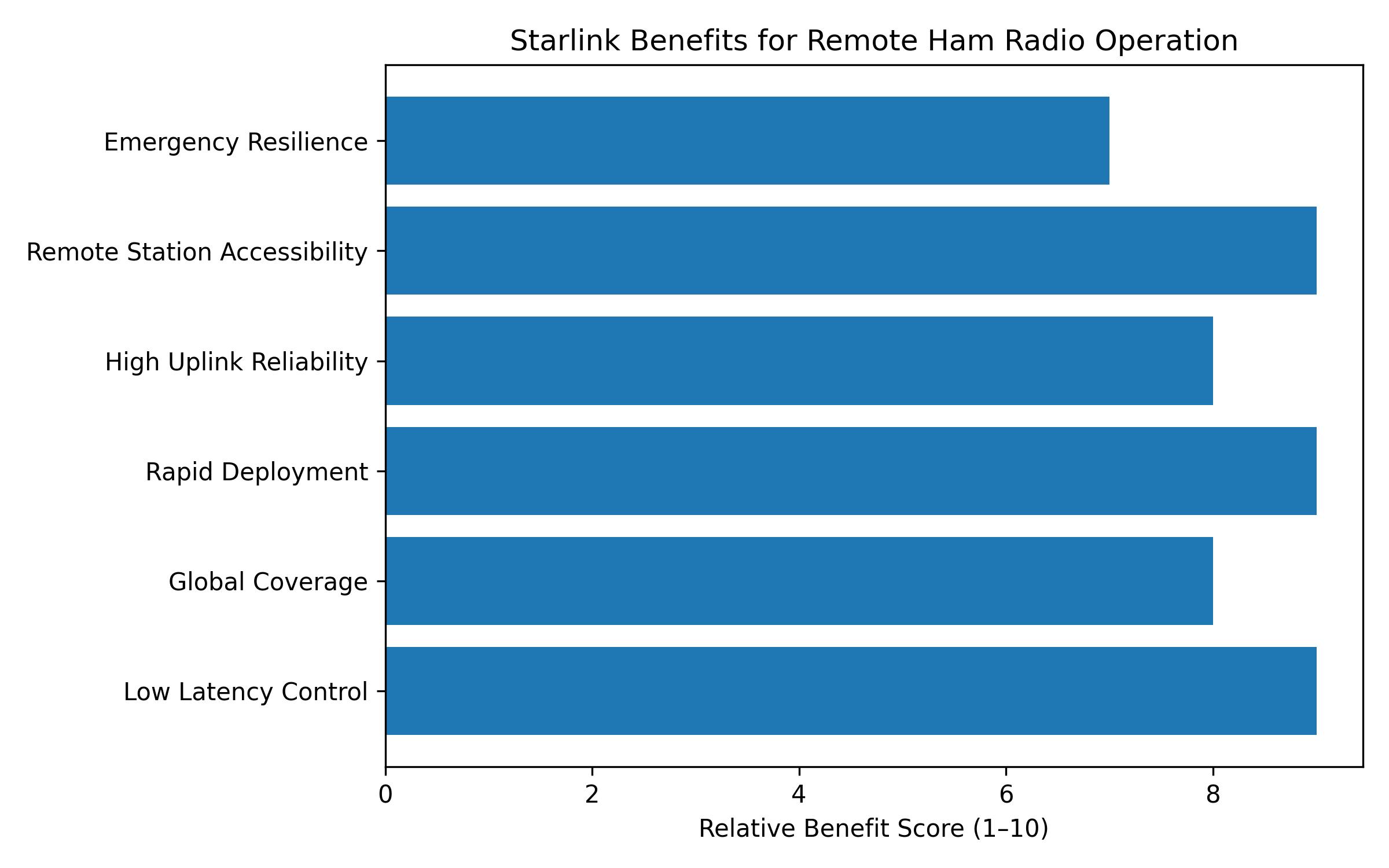
The sideways bar chart below illustrates how Starlink improves remote ham radio operation across key dimensions.
Interpreting the Benefits Chart
First, low latency control ranks highest because it directly affects operator experience. If latency rises, CW timing and SSB turn-taking suffer. Next, global coverage scores highly since Starlink allows stations in isolated RF-quiet zones. Additionally, rapid deployment scores strongly because portable or temporary remote sites become realistic.
Meanwhile, uplink reliability and accessibility reinforce daily usability. Although emergency resilience scores slightly lower, it still outperforms most terrestrial options when infrastructure collapses. Therefore, the overall benefit profile strongly favors Starlink-backed remote operation.
Practical Ways to Use Starlink with Remote Ham Radio
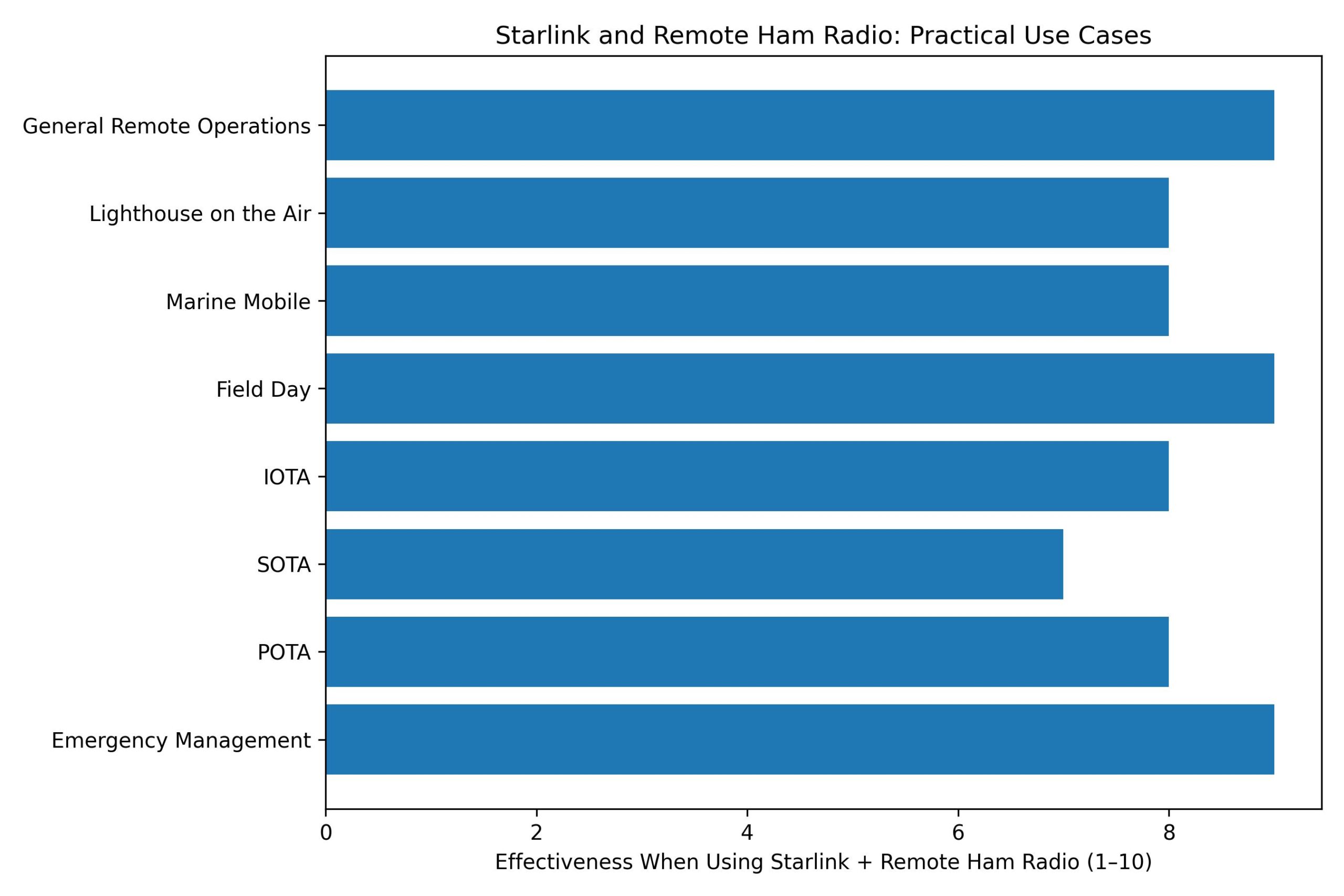
Operators apply Starlink with remote ham radio across a wide range of real-world activities, and each use case highlights a different strength of the combination. First, emergency management, teams place radios and antennas at hardened, RF-quiet sites while command staff operate remotely, and therefore coordination continues even when terrestrial networks fail.
For POTA, operators deploy temporary stations at parks with Starlink backhaul, and as a result they activate multiple bands reliably while logging and spotting in real time. For SOTA and IOTA, groups stage radios at accessible base locations while operators control them from summits or islands, which reduces payload weight and improves safety.
During Field Day, clubs centralize high-performance stations and then allow members to operate remotely, so participation increases without overcrowding the site.
For marine mobile operations, vessels use Starlink to maintain stable control links to onboard or shore-based stations, and consequently operators avoid unreliable coastal cellular coverage.
For Lighthouse on the Air activations, Starlink enables temporary stations at remote or electrically noisy locations, while operators manage radios and logging from controlled environments.
Finally, for general remote operations, individuals place stations where propagation excels and then operate daily from home or while traveling, and thus they achieve consistent performance without local RF limitations.
Unique Integration Scenarios That Improve Performance
Creative integration amplifies the value of both systems. For example, operators run Starlink alongside redundant WAN paths so failover occurs automatically. Meanwhile, smart power distribution allows remote reboot and antenna switching when conditions change.
Another powerful approach uses Starlink to support remote SDR receivers. Therefore, multiple operators can monitor bands simultaneously without local RF noise. In addition, cloud-based logging and spotting tools integrate seamlessly through Starlink connectivity.
Bandwidth, Audio, and Control Considerations
Remote ham radio demands predictable bandwidth more than raw speed. Consequently, Starlink’s consistent throughput supports high-quality audio streams and waterfall data. However, operators must still manage jitter and buffer settings carefully.
Audio compression, packet prioritization, and control channel separation improve reliability. Therefore, advanced setups isolate control traffic from background services. As a result, operators maintain stable sessions even when Starlink load fluctuates.
Power, Reliability, and Backup Planning
Starlink requires more power than traditional modems, so station designers must plan accordingly. Therefore, remote sites often include solar arrays, battery banks, and generators. In addition, smart power controllers enable unattended recovery after outages.
Because remote radios may transmit high duty-cycle modes, thermal management and remote monitoring become critical. Consequently, integrating temperature sensors and automatic shutdown logic protects equipment.
Legal and Operational Responsibilities
Remote operation does not remove regulatory responsibilities. Therefore, operators must ensure control links meet identification requirements and that station access remains secure. Moreover, logging, authentication, and authorization protect shared systems from misuse.
Operators also retain responsibility for emissions and interference. As a result, careful station engineering and antenna management remain essential even when operating remotely.
The Future of Starlink-Enabled Remote Ham Radio
As satellite constellations expand, latency and reliability continue to improve. Therefore, remote ham radio will feel increasingly indistinguishable from local operation. Meanwhile, shared stations, education networks, and emergency systems will grow in importance.
Because spectrum remains finite, efficient remote access reduces redundant stations and improves spectrum stewardship. Consequently, Starlink and remote ham radio together represent a sustainable path forward.
Starlink and Remote Ham Radio
Starlink and Remote Ham Radio work perfectly together. By providing resilient, low-latency connectivity, Starlink enables operators to place radios where RF conditions excel and operate them from anywhere. Therefore, when used together, these technologies unlock flexibility, resilience, and performance that neither can achieve alone.
Please consider Donating to help support this channel