

Superheterodyne Receiver Explained
A superheterodyne receiver is a radio receiver architecture that converts incoming radio signals to a fixed intermediate frequency (IF) to improve selectivity, sensitivity, and signal processing stability. This design allows radios to filter and amplify signals more precisely than earlier receiver types, which is why it remains the dominant architecture in modern communication equipment, including amateur radios, broadcast receivers, aviation radios, and many professional RF systems.
The defining feature of the superheterodyne receiver is frequency conversion. Instead of processing signals directly at their original radio frequency, the receiver shifts them to a constant intermediate frequency where filtering and amplification are easier and more consistent. This approach dramatically improves performance, especially when receiving weak signals or operating in crowded spectrum conditions.
New to the hobby? Start with our Complete Guide to Ham Radio Fundamentals.
Because of its ability to provide stable tuning, excellent signal rejection, and high sensitivity, the superheterodyne architecture has been the foundation of radio receiver design for more than a century.
Quick Answer: What Is a Superheterodyne Receiver?
A superheterodyne receiver converts incoming radio signals to a fixed intermediate frequency using a mixer and local oscillator. This allows consistent filtering and amplification, resulting in better signal clarity, selectivity, and sensitivity.
Quick Answer: Why Is the Superheterodyne Design Important?
It allows radios to isolate weak signals, reject interference, and maintain stable performance across wide frequency ranges. This makes it ideal for amateur radio, broadcast reception, and professional communication systems.
Historical Background of the Superheterodyne Receiver
The superheterodyne receiver was developed during World War I by Edwin Armstrong to improve the ability of radio receivers to detect weak signals. Early receivers struggled with stability and selectivity when tuning across wide frequency ranges. Armstrong’s design solved this by converting all received signals to a common frequency where filtering could be optimized.
This innovation transformed radio technology. Nearly every high-performance analog receiver built since the 1920s has used some form of superheterodyne architecture.
Fundamental Principle of Frequency Conversion
The superheterodyne receiver operates by mixing two signals:
The incoming radio frequency signal
A locally generated oscillator signal
When these signals are combined in a mixer, new frequencies are produced equal to the sum and difference of the original frequencies. The receiver selects one of these, typically the difference and processes it as the intermediate frequency.
This process is called heterodyning, which is where the term superheterodyne originates.
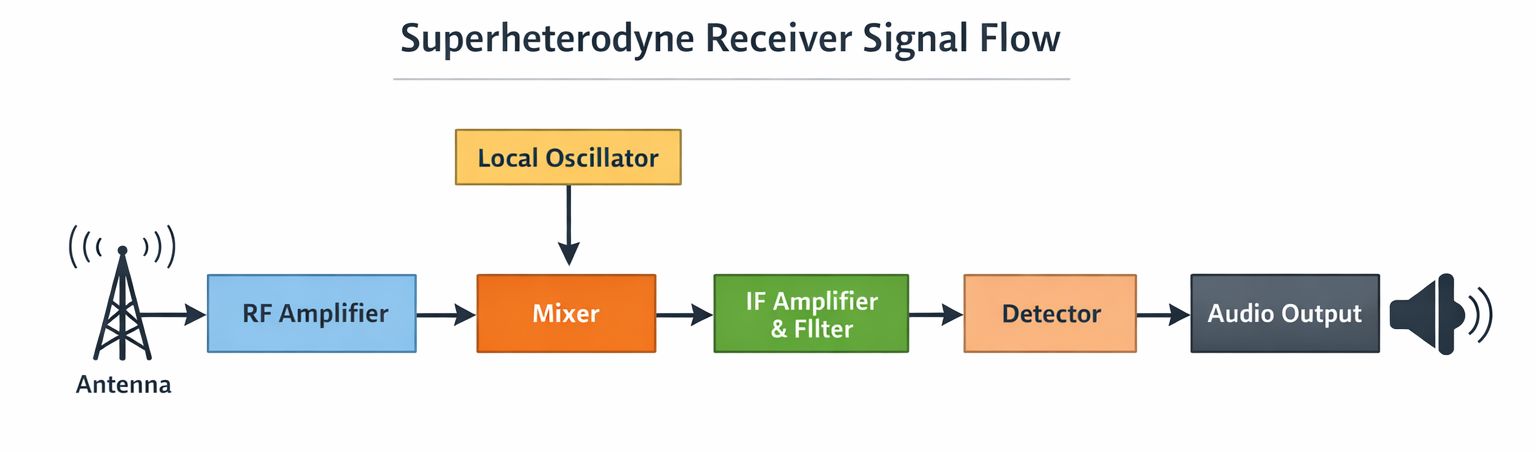
Step-By-Step Signal Path Inside a Superheterodyne Receiver
1 — The antenna captures the incoming RF signal.
2 — The RF amplifier strengthens the signal.
3 — The local oscillator generates a tunable reference frequency.
4 — The mixer combines RF and oscillator signals.
5 — The intermediate frequency is selected and filtered.
6 — The IF amplifier boosts the signal.
7 — The detector or demodulator extracts audio or data.
8 — The audio amplifier drives the speaker or output system.
This controlled signal path allows precise processing at each stage.
What Is Intermediate Frequency (IF)?
Intermediate frequency is the fixed frequency to which all received signals are converted before processing. Because this frequency never changes, the receiver can use highly optimized filters and amplifiers.
Common IF values include:
455 kHz for AM broadcast receivers
10.7 MHz for FM receivers
9 MHz or higher for HF communications receivers
Higher IF frequencies help reduce image interference, while lower IF frequencies enable narrower filtering.
Why Fixed IF Improves Selectivity
Selectivity is the ability to separate one signal from nearby signals. Because the IF stage operates at a constant frequency, designers can build precision filters that sharply define bandwidth.
This allows the receiver to isolate weak signals even when strong signals exist nearby.
Sensitivity and Signal Amplification
Sensitivity describes the receiver’s ability to detect weak signals. The superheterodyne architecture supports multiple amplification stages at the intermediate frequency, where gain can be controlled precisely.
This allows receivers to amplify extremely small signals without excessive noise.
Image Frequency and Signal Rejection
A mixer cannot distinguish between two different RF signals that produce the same intermediate frequency. This unwanted signal is called the image frequency.
Superheterodyne receivers reduce image interference using:
RF preselection filtering
Higher intermediate frequencies
Multiple conversion stages
Image rejection is critical for clean reception.
Single Conversion vs Double Conversion vs Triple Conversion
Some receivers use multiple frequency conversions for improved performance.
Single conversion uses one IF stage.
Double conversion uses two IF stages for better filtering and image rejection.
Triple conversion provides extreme selectivity in high-performance receivers.
Multiple conversion improves signal purity and stability.
Roofing Filters and Front-End Protection
Roofing filters are narrow filters placed early in the IF chain to limit signal bandwidth before amplification. This prevents strong nearby signals from overloading the receiver.
High-end amateur radios rely heavily on roofing filters for contest and DX operation.
Demodulation and Signal Recovery
Once the IF signal is filtered and amplified, it must be converted into usable information. This process is called demodulation.
Different modes require different detectors:
AM envelope detection
SSB product detection
FM frequency detection
Digital signal decoding
The demodulator extracts audio or digital data from the RF carrier.
Superheterodyne vs Direct Conversion Receivers
Direct conversion receivers process signals directly without an intermediate frequency. They are simpler but often suffer from noise and stability limitations.
Superheterodyne receivers provide superior filtering, gain control, and interference rejection.
Superheterodyne vs Software Defined Radio (SDR)
Modern SDR systems often still use superheterodyne front-end conversion before digitization. The analog IF signal is converted to digital form for software processing.
This hybrid approach combines analog filtering with digital precision.
Advantages of Superheterodyne Architecture
High selectivity
High sensitivity
Stable tuning
Wide frequency coverage
Excellent interference rejection
Flexible filtering
Compatibility with digital processing
These advantages explain its long-term dominance.
Limitations and Design Challenges
Image frequency interference
Complex circuitry
Alignment requirements
Multiple conversion noise potential
Despite these challenges, performance benefits outweigh complexity.
Real-World Performance in Amateur Radio
Amateur operators often work weak signals in crowded bands. Superheterodyne receivers allow narrow filtering that isolates signals only a few hundred hertz apart.
During contests or DX operation, this precision is essential.
Receiver Alignment and Maintenance
Superheterodyne receivers require periodic alignment of:
Local oscillator calibration
IF filter response
Mixer balance
Proper alignment ensures optimal sensitivity and selectivity.
Measurement and Performance Specifications
Key receiver performance metrics include:
Sensitivity (minimum detectable signal)
Selectivity (bandwidth control)
Dynamic range
Image rejection ratio
Noise figure
These specifications define receiver quality.
Comparison of Receiver Architectures
| Feature | Superheterodyne | Direct Conversion | SDR Hybrid |
| Selectivity | Excellent | Moderate | Excellent |
| Sensitivity | High | Moderate | High |
| Complexity | Moderate | Low | High |
| Digital processing | Optional | Limited | Extensive |
Common Receiver Problems and Troubleshooting
Image interference
Oscillator drift
Filter misalignment
Front-end overload
Poor grounding
Most issues relate to frequency stability or filtering.
When Superheterodyne Receiver Design Performs Best
Weak signal environments
Crowded spectrum
Long-distance communication
Precision filtering applications
These conditions favor IF-based processing.
Frequently Asked Questions
Why is IF necessary?
It allows consistent filtering and amplification.
Why not process signals directly?
Direct processing reduces selectivity and stability.
Do modern radios still use superheterodyne design?
Yes, often combined with digital signal processing.
Practical Operator Insight
Most high-performance amateur transceivers use multi-conversion superheterodyne front ends with DSP filtering. This combination provides extremely sharp selectivity and excellent weak signal performance.
About the Author
Vince, W2KU, is a licensed Extra class amateur radio operator and the founder of Ham Shack Reviews. He was named Amateur of the Year in 2026 for contributions to practical amateur radio education and equipment evaluation.
He primarily operates HF, knows propagation very well, operates mobile and handhelds daily. Vince exchanges QSL cards for DXCC, contest confirmation, and award tracking and is the club QSL manager. His guidance focuses on practical operating procedures, accurate logging, and real-world amateur radio practices.
Superheterodyne Receiver
The superheterodyne receiver remains the most influential radio receiver architecture ever developed. By converting signals to a fixed intermediate frequency, it provides unmatched selectivity, sensitivity, and stability.
From early radio systems to modern digital transceivers, its principles continue to define how high-performance receivers operate. Understanding how this architecture works gives operators deeper insight into signal behavior and receiver performance across the entire radio spectrum.
Please consider Donating to help support this channel