
Are Switching Power Supplies Bad
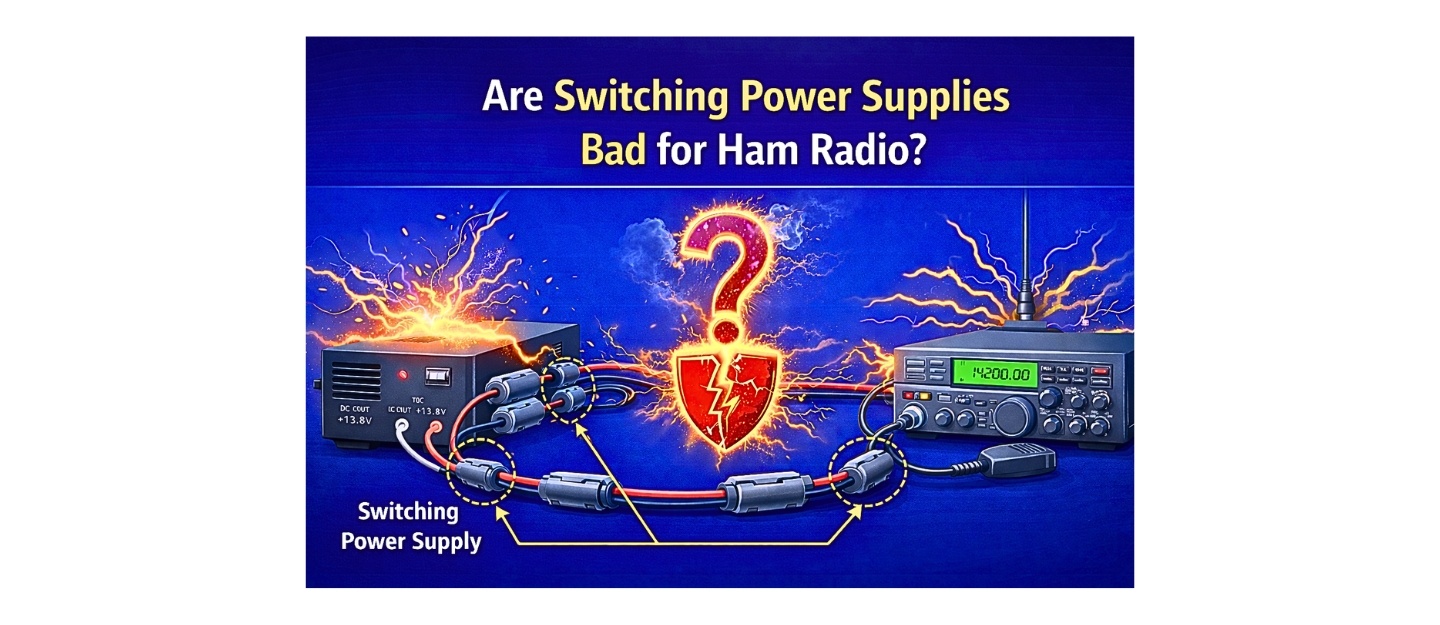
Switching power supplies have become the dominant method of electrical power conversion in modern electronics because they deliver high efficiency, compact size, and reduced heat generation. However, these advantages come with a fundamental tradeoff that directly affects radio communication. The same rapid electrical switching that makes these supplies efficient also produces electromagnetic noise across a wide range of frequencies. For amateur radio operators, that noise is not a minor technical detail but often a serious operational limitation, because receiver sensitivity and signal clarity depend on extremely clean electrical environments.
Unlike linear power supplies, which regulate voltage through continuous analog control, switching supplies regulate power by rapidly turning current on and off. These rapid transitions produce abrupt changes in voltage and current that generate broadband electromagnetic emissions. As a result, switching supplies behave not only as power converters but also as unintended noise sources embedded directly inside the radio operating environment.
This behavior is not a design flaw or manufacturing defect. Instead, it is a predictable and unavoidable byproduct of high-efficiency switching regulation. Understanding why these supplies create interference requires examining how they function internally and how the resulting electrical energy spreads through a radio station.
High-power amplifiers like the Palstar LA-1K are part of a larger category of RF amplification equipment used to increase transmitted signal strength across the amateur bands. Operators comparing different amplifier designs, technologies, and power levels may want to explore the
Complete Guide to Ham Radio Amplifiers, which explains how solid-state and tube amplifiers work, how to choose the right amplifier for a station, and what factors affect real-world performance.
The Fundamental Operating Principle of Switching Regulation
A switching power supply does not reduce voltage by dissipating excess energy as heat. Instead, it converts electrical energy through rapid cycles of storage and release. Incoming AC power is first rectified into DC, after which a high-speed semiconductor switch repeatedly interrupts current flow thousands or millions of times per second. This produces a pulsed waveform rather than continuous electrical delivery.
These pulses pass through inductors or high-frequency transformers that temporarily store magnetic energy. Output voltage is then controlled through pulse width modulation, which regulates how long each switching cycle remains active. Because output voltage depends on duty cycle rather than continuous resistance, efficiency remains high even under varying load conditions.
Although output filtering smooths the pulsed waveform into usable DC, the switching process never actually stops. Therefore ripple voltage, transient spikes, and high-frequency spectral components always remain present to some degree.
Why Rapid Electrical Transitions Produce RF Noise
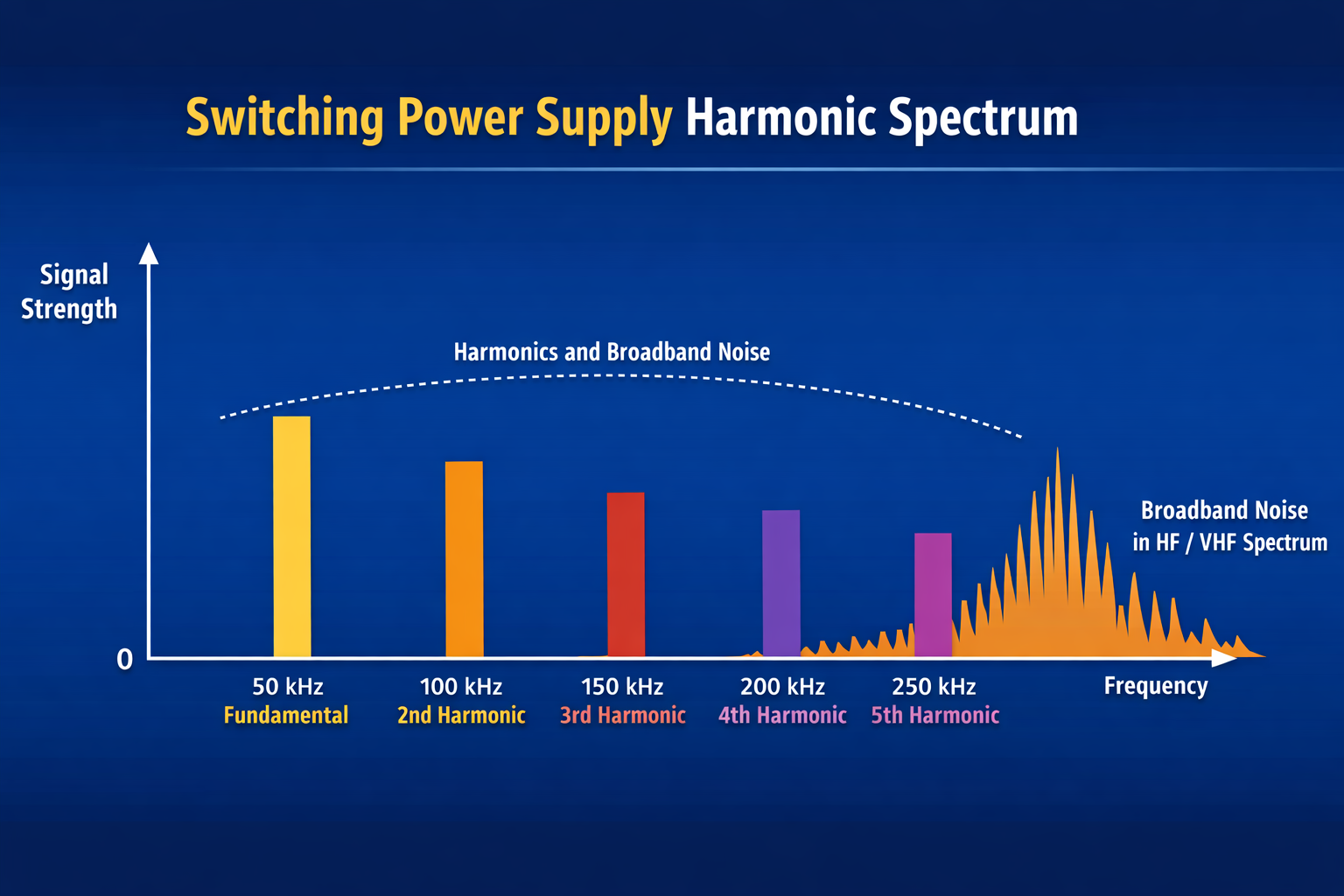
Whenever electrical current changes rapidly, electromagnetic fields form and collapse. The faster the transition, the broader the range of frequencies generated. Switching power supplies create extremely fast voltage and current transitions with rise times measured in nanoseconds. These sharp edges contain significant high-frequency energy.
Even when the switching frequency itself is relatively low, such as 50 kHz or 100 kHz, harmonics extend far above that range. These harmonics propagate throughout HF and sometimes VHF spectrum. Because amateur radio receivers operate across these same frequency ranges, they detect switching energy as interference.
In practical terms, the power supply becomes a continuous broadband noise source operating inside the radio station.
Conducted and Radiated Interference Paths
Switching supply noise enters radio equipment through two primary mechanisms: conducted coupling and radiated coupling.
Conducted noise travels directly along power wiring, ground paths, and interconnected cables. Once noise enters the DC supply line, it flows directly into receiver circuitry and other sensitive electronics.
Radiated noise escapes as electromagnetic fields from transformers, inductors, circuit traces, and power leads. These fields couple into nearby wiring, feedlines, and antennas.
Because both mechanisms operate simultaneously, eliminating interference requires controlling multiple coupling paths rather than addressing a single source.
Common-Mode Versus Differential-Mode Noise
A key concept in understanding switching supply interference is the difference between differential-mode and common-mode noise.
Differential noise appears between the positive and negative conductors of the power line. It flows in opposite directions along the pair and typically originates from switching ripple inside the supply.
Common-mode noise flows in the same direction along both conductors relative to ground. It often develops through stray capacitance between switching components and the chassis. Because both wires carry the same noise voltage, cables behave like antennas and radiate energy efficiently.
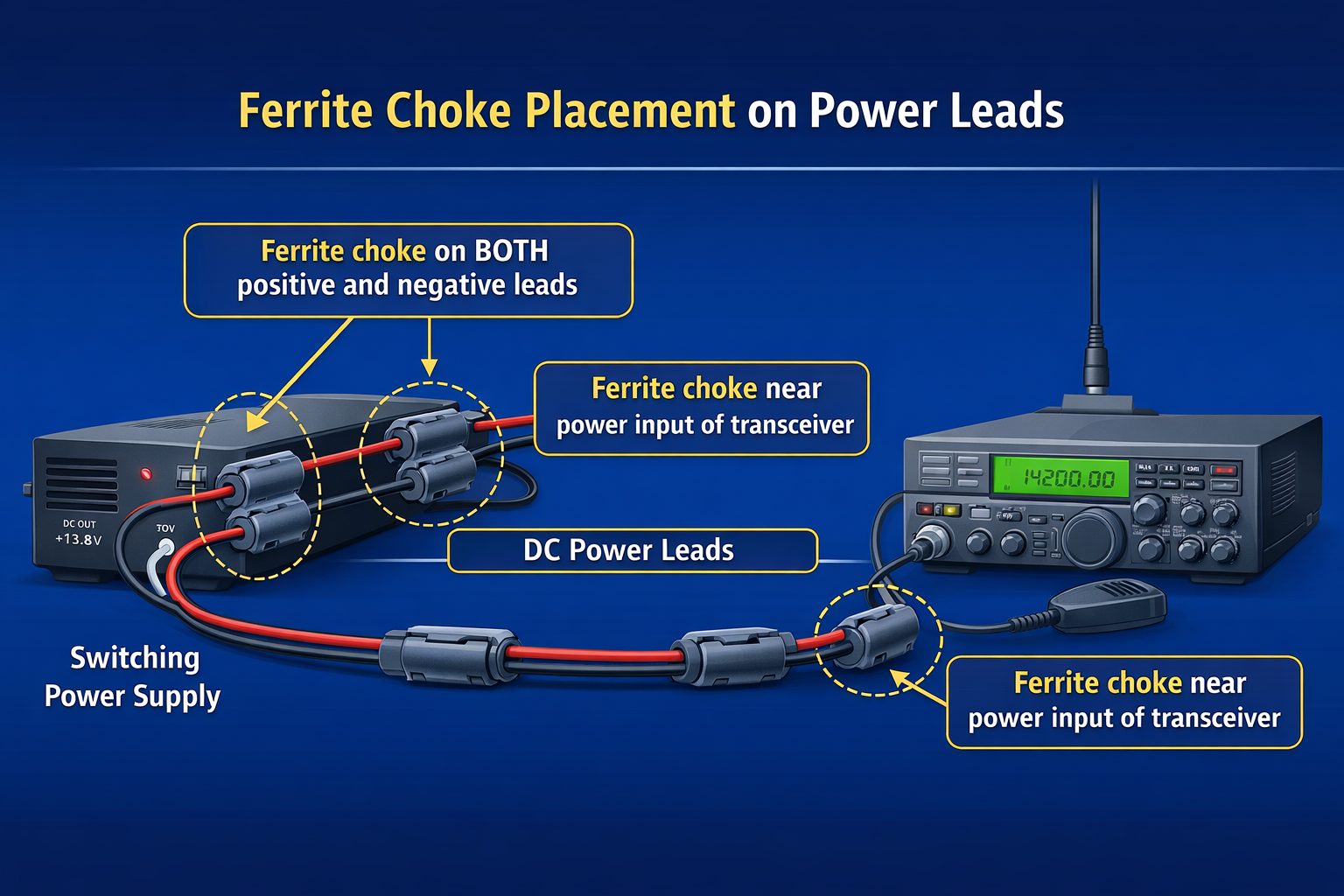
Most radio interference from switching supplies is caused by common-mode currents traveling along DC leads, coax shields, and equipment grounds. This is why ferrite chokes placed around both conductors simultaneously are often necessary for effective suppression.
Internal Components That Act as Noise Sources
The switching transistor produces sharp current transitions that generate broadband spectral energy. Inductors and transformers store and release magnetic energy, radiating fields as they cycle. Rectifier diodes switch conduction states abruptly, creating transient spikes. Control oscillators produce stable interference tones at fundamental switching frequency and harmonics.
Every major energy-handling component participates in noise generation, making the entire supply an electromagnetic emitter.
Output Ripple and Its Effect on RF Equipment
Ripple voltage is not simply a small AC variation. It contains high-frequency components that interact directly with RF circuitry. Receiver oscillators, mixers, and amplifiers depend on stable DC supply voltage. When ripple enters these circuits, it modulates internal signals and produces spurious responses.
In transmitters, supply ripple can mix with RF output and create unwanted sidebands or phase instability. This reduces spectral purity and may increase transmitted interference.
Real-World Ham Shack Field Test Example
Consider a typical operating environment. A receiver connected to a resonant dipole measures an S-meter noise floor of S1 when powered by a linear supply. Replacing that supply with a 30-amp switching unit raises the baseline noise floor to S4 across multiple HF bands. Several evenly spaced carriers appear at harmonic intervals of the switching frequency.
Adding ferrite chokes reduces some discrete tones but does not eliminate broadband noise. Moving the supply farther from the operating position reduces interference slightly, indicating radiated coupling. Returning to a linear supply restores the original low noise floor.
This pattern is common in practical amateur radio stations.
Linear Versus Switching Power Supplies for Radio Use
| Characteristic | Switching Supply | Linear Supply |
|---|---|---|
| Efficiency | Very high | Moderate |
| Heat generation | Low | High |
| Size and weight | Compact | Large and heavy |
| Output ripple | Moderate to high | Very low |
| RF interference risk | High | Minimal |
| Receiver noise impact | Often significant | Negligible |
| Weak signal suitability | Limited | Excellent |
Why Filtering Alone Cannot Solve the Entire Problem
Filters reduce conducted noise but cannot fully eliminate radiated emissions. They also must operate across extremely wide frequency ranges, which limits effectiveness. Cost constraints further restrict filtering capability in many consumer designs.
Once electromagnetic energy leaves the supply enclosure, containment becomes extremely difficult.
Load Variation and Dynamic Noise Behavior
Switching noise intensity varies with load current. When transmitters draw rapidly changing current, switching energy changes as well. This produces fluctuating interference patterns that shift across the band.
Operators often notice noise increasing during transmit peaks or digital mode operation.
RFI Mitigation Engineering Methods
Effective suppression requires multiple coordinated techniques.
Install ferrite chokes on both positive and negative power leads to reduce common-mode current. Use multiple turns through high-permeability cores. Maintain short DC leads to minimize antenna effects. Route power wiring away from RF feedlines. Bond equipment to a common ground reference. Increase physical distance between supply and antenna system whenever possible.
Shack Installation Best Practices
Place switching supplies as far from receivers and feedpoints as practical. Avoid running DC wiring parallel to coaxial cables. Use single-point grounding to prevent circulating currents. Mount ferrite chokes near supply output. Maintain proper ventilation when using linear supplies to manage heat.
Buyer Decision Framework for Amateur Radio Operators
Choose a linear supply for weak-signal HF operation, precision measurement, and low-noise receiving environments. Consider switching supplies when portability, efficiency, or weight are primary concerns and some noise can be tolerated. Evaluate antenna proximity and required sensitivity before selecting a power source.
Efficiency Versus Electrical Purity
Switching power supplies provide outstanding efficiency and compact design, but they inherently generate electromagnetic noise. Linear supplies consume more power and produce heat, yet they deliver exceptionally clean DC output.
For amateur radio operators seeking maximum receiver sensitivity and minimal interference, electrical purity often outweighs efficiency.
About the Author
Vince, W2KU, is a licensed Extra class amateur radio operator and the founder of Ham Shack Reviews. He was named Amateur of the Year in 2026 for contributions to practical amateur radio education and equipment evaluation.
He primarily operates HF, knows propagation very well, operates mobile and handhelds daily. Vince exchanges QSL cards for DXCC, contest confirmation, and award tracking and is the club QSL manager. His guidance focuses on practical operating procedures, accurate logging, and real-world amateur radio practices.
Frequently Asked Questions About Switching Supply Noise
Why do switching power supplies interfere with HF reception?
Rapid current switching generates harmonics that raise the receiver noise floor.
Are expensive switching supplies quieter?
Better filtering and shielding help, but no switching supply is completely noise-free.
Can ferrite chokes eliminate all interference?
They reduce conducted noise but cannot fully suppress radiated emissions.
Should serious HF operators use linear supplies?
Linear supplies provide cleaner power and lower noise for weak-signal work.
Please consider Donating to help support this channel