
What SWR vs Impedance Mean in Radio Systems
Standing Wave Ratio, SWR vs Impedance describe how efficiently radio frequency energy moves from a transmitter into an antenna system. Although many operators treat them as interchangeable ideas, they measure different electrical behaviors. Therefore, understanding both concepts is essential for building efficient and safe radio installations.
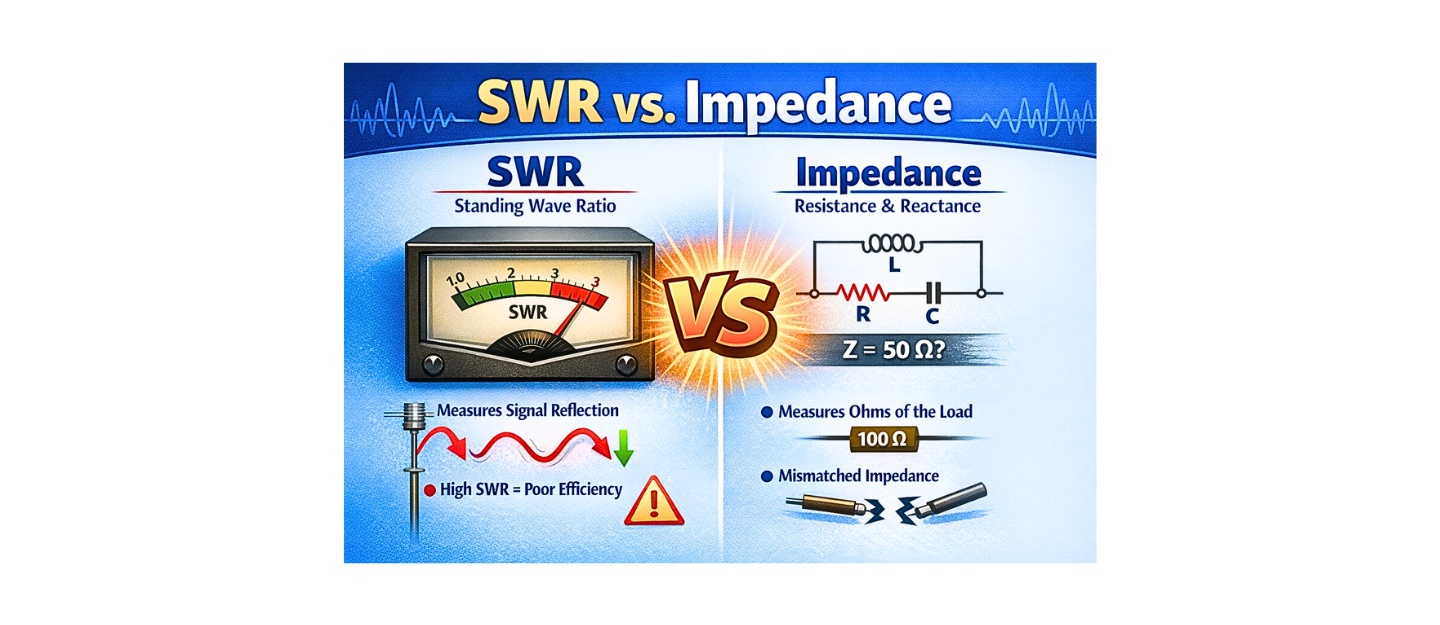
Impedance describes the electrical opposition a circuit presents to alternating current. In RF systems, impedance combines resistance and reactance into a single value measured in ohms. Most amateur radio equipment expects a system impedance of 50 ohms. Consequently, when the antenna system matches that value, power flows smoothly from transmitter to antenna.
SWR, on the other hand, measures how much transmitted power reflects back toward the transmitter instead of radiating outward. When impedance mismatches occur, some energy cannot transfer properly. As a result, that energy travels backward along the feedline and creates standing waves. SWR simply expresses the ratio between forward and reflected energy.
Although SWR and impedance connect closely, they do not describe the same property. Instead, impedance describes the electrical condition, while SWR shows the result of that condition.
Quick Answer: SWR vs Impedance
Impedance describes the electrical resistance and reactance of an antenna system. SWR measures how much transmitted power reflects due to impedance mismatch. Impedance explains the electrical condition, while SWR shows the efficiency of power transfer.
How Impedance Works in an Antenna System
Impedance determines how easily radio frequency current flows through a circuit. Every antenna, feedline, and transmitter stage presents its own impedance. Ideally, these components share the same value. Therefore, maximum power transfer occurs when the entire system maintains a consistent impedance.
Impedance contains two parts. Resistance represents real power that converts into radiated energy or heat. Reactance represents stored energy that shifts phase between voltage and current. Because reactance changes with frequency, antenna impedance varies across the band. Consequently, an antenna tuned perfectly at one frequency may show mismatch at another.
Furthermore, physical design strongly influences impedance. Length, height, environment, and nearby objects all affect electrical behavior. Even small adjustments can change reactance dramatically. For that reason, precise tuning plays a critical role in antenna performance.
When impedance matches the feedline and transmitter, power transfers efficiently. However, when impedance differs, the system cannot absorb all transmitted energy. Therefore, reflection occurs, and SWR rises.
How Standing Wave Ratio Forms
SWR forms when forward energy meets an impedance mismatch and reflects backward along the transmission line. The forward and reflected waves interact with each other. As a result, voltage and current patterns form stationary peaks and valleys along the line. These stationary patterns are called standing waves.
The SWR value expresses how severe that reflection becomes. A perfect match produces an SWR of 1:1, meaning no reflected power exists. However, as mismatch increases, reflection increases as well. Therefore, SWR numbers rise above unity.
For example, an SWR of 2:1 indicates that some power reflects but most still transfers successfully. Higher ratios, however, indicate substantial reflection and reduced efficiency. Eventually, very high SWR can stress transmitter components and cause protective shutdown.
Although SWR reveals reflection behavior, it does not identify the electrical cause. Instead, it only shows that mismatch exists somewhere in the system.
The Mathematical Relationship Between SWR and Impedance
SWR depends entirely on how closely the system impedance matches the transmission line impedance. When the two values differ, reflection occurs in proportion to that difference. Therefore, SWR acts as an indirect indicator of impedance mismatch.
However, identical SWR values can result from different impedance conditions. For example, an antenna with too much inductive reactance and another with too much capacitive reactance may produce the same SWR reading. Nevertheless, their electrical characteristics differ significantly.
Because of this limitation, SWR alone cannot describe whether an antenna is too long, too short, or electrically reactive. Instead, impedance measurements reveal the true electrical state. Consequently, serious system optimization requires both measurements.
SWR vs Impedance Comparison
Measurement type — Electrical property vs efficiency indicator
What it measures — Resistance and reactance vs reflected power ratio
Units — Ohms vs ratio (1:1, 2:1, etc.)
Purpose — Diagnose system behavior vs detect mismatch
Can identify cause — Yes vs no
Used for tuning — Precision tuning vs quick monitoring
SWR vs Reflected Power and Transmission Loss
| SWR Ratio | Reflected Power | Forward Power Delivered | Power Loss |
|---|---|---|---|
| 1.0 : 1 | 0% | 100% | 0.00 dB |
| 1.1 : 1 | 0.2% | 99.8% | 0.01 dB |
| 1.2 : 1 | 0.8% | 99.2% | 0.04 dB |
| 1.3 : 1 | 1.7% | 98.3% | 0.07 dB |
| 1.5 : 1 | 4.0% | 96.0% | 0.18 dB |
| 2.0 : 1 | 11.1% | 88.9% | 0.51 dB |
| 2.5 : 1 | 18.4% | 81.6% | 0.87 dB |
| 3.0 : 1 | 25.0% | 75.0% | 1.25 dB |
| 4.0 : 1 | 36.0% | 64.0% | 1.94 dB |
| 5.0 : 1 | 44.4% | 55.6% | 2.55 dB |
| 10 : 1 | 66.9% | 33.1% | 4.77 dB |
Why Impedance Matters More Than Many Operators Realize
Impedance determines how energy behaves inside the antenna system. Therefore, it directly influences radiation efficiency, bandwidth, and tuning stability. When impedance contains large reactive components, energy stores temporarily instead of radiating. As a result, efficiency declines.
Moreover, reactive mismatch often narrows usable bandwidth. The antenna may tune well at one frequency but drift quickly outside acceptable limits. Consequently, operators experience unstable performance across the band.
Impedance also affects feedline loss. When mismatch occurs, current distribution along the line changes. Therefore, resistive heating increases, and more power dissipates before reaching the antenna. Even moderate mismatch can produce measurable loss on long feedlines.
For these reasons, impedance matching improves far more than transmitter protection. It improves overall system performance.
Why SWR Still Matters in Daily Operation
Although impedance provides deeper insight, SWR remains extremely practical. Most operators monitor SWR because it offers a quick indicator of system health. Therefore, it serves as an early warning tool.
If SWR rises suddenly, something has changed. Perhaps a connection loosened, moisture entered the feedline, or the antenna shifted physically. Because SWR responds immediately to mismatch, operators can detect problems quickly.
Additionally, transmitters monitor reflected power internally. When SWR rises too high, protective circuits reduce output power. Consequently, maintaining reasonable SWR prevents automatic power reduction.
However, SWR does not measure radiation efficiency directly. A system can show acceptable SWR yet still perform poorly if feedline loss absorbs significant power. Therefore, SWR must be interpreted alongside other measurements.
Ideal SWR vs Impedance Values
Most amateur radio systems are designed for a 50-ohm impedance standard. When antenna impedance is close to that value with minimal reactance, power transfer is highly efficient.
In practical operation, an SWR of 1:1 represents a perfect match. However, values below 1.5:1 are typically considered excellent. Many transmitters operate safely at 2:1 or lower, although efficiency begins to decline as SWR increases.
Higher SWR levels indicate growing mismatch. At extreme levels, reflected power can reduce transmitter output or trigger protective shutdown.
The goal is not absolute perfection, but stable impedance with low reactance and consistently low SWR across the intended operating range.
Common Misunderstandings About SWR and Impedance
Many operators assume that low SWR guarantees optimal antenna performance. However, that assumption often proves false. A tuner can reduce SWR seen by the transmitter without correcting the antenna’s actual impedance. Consequently, reflected power decreases at the transmitter while losses remain elsewhere.
Others believe SWR directly measures power output. In reality, SWR measures reflection ratio, not radiated power. Therefore, two systems with identical SWR may radiate very different amounts of energy.
Some also think SWR reveals whether an antenna resonates. While resonance often produces low reactance and low SWR, exceptions exist. Feedline length, transformation effects, and matching networks can mask true resonance conditions.
Understanding these distinctions prevents incorrect troubleshooting.
How Matching Devices Affect SWR and Impedance
Matching devices transform impedance between system components. Therefore, they allow transmitters to operate safely even when antenna impedance differs from feedline impedance.
Antenna tuners adjust reactance and resistance relationships. As a result, they create a condition where the transmitter sees a proper load. However, they do not eliminate mismatch along the feedline. Instead, they only modify what the transmitter experiences.
Consequently, reflected energy may still travel along the feedline. If feedline loss is significant, power dissipates before reaching the antenna. Therefore, matching at the antenna feedpoint often produces better efficiency than matching inside the shack.
Matching improves compatibility, but it does not automatically improve radiation performance.
Troubleshooting High SWR Using Impedance
When SWR rises unexpectedly, impedance measurements help identify the cause. High resistance may indicate poor connections or feedline damage. Excessive inductive reactance often means the antenna is electrically too long. Excessive capacitive reactance usually means the antenna is too short.
Environmental changes can also shift impedance. Nearby metal objects, moisture, or antenna movement may alter electrical characteristics.
Correcting the underlying impedance condition lowers SWR naturally. Therefore, solving the electrical cause is always more effective than masking the symptom with a matching device.
How Frequency Changes Affect Both Measurements
Frequency changes alter antenna reactance continuously. Therefore, impedance shifts across the operating range. As impedance moves away from the feedline value, SWR rises accordingly.
Wideband antennas maintain stable impedance across large frequency ranges. Consequently, SWR remains low throughout the band. Narrowband antennas, however, exhibit rapid impedance change. Therefore, SWR increases quickly outside the design frequency.
Operators who understand this relationship can predict tuning behavior. Moreover, they can choose antenna designs that suit their operating needs.
Measuring SWR Versus Measuring Impedance
SWR meters measure forward and reflected power. Therefore, they provide a simple ratio that indicates mismatch severity. These meters are inexpensive and easy to use. Consequently, they remain standard tools in most stations.
Impedance analyzers, however, measure resistance and reactance directly. Therefore, they reveal whether mismatch arises from inductive or capacitive behavior. With this information, operators can make precise adjustments.
While SWR meters indicate that a problem exists, impedance analyzers show what the problem is. Therefore, serious system optimization benefits greatly from impedance measurement.
Why Understanding Both Improves Station Performance
Operators who understand impedance can tune antennas precisely. As a result, they minimize reactive components and maximize radiation efficiency. Then, by monitoring SWR, they confirm that the system transfers power safely.
Using both measurements together provides complete insight. Impedance explains electrical behavior. SWR confirms energy transfer efficiency. Consequently, operators gain control over both performance and protection.
Practical Situations Where the Difference Matters
When building antennas, impedance reveals how design changes affect resonance and bandwidth. Therefore, builders can adjust element length accurately.
During troubleshooting, SWR reveals whether system conditions have changed. However, impedance reveals why those changes occurred.
When installing long feedlines, impedance matching at the antenna minimizes loss. Meanwhile, SWR monitoring protects equipment.
In contest or emergency operation, maintaining both proper impedance and acceptable SWR ensures consistent performance under demanding conditions.
Real World Example Of SWR And Impedance Interaction
Consider an antenna that measures 75 ohms instead of 50 ohms. The mismatch produces reflected power and raises SWR. Although a tuner can reduce SWR at the transmitter, the feedline still carries reflected energy. If the feedline is long, resistive loss increases and less power reaches the antenna.
When the antenna is physically adjusted to 50 ohms instead, SWR drops and feedline loss decreases. As a result, more transmitted power radiates efficiently.
Final Understanding of SWR Versus Impedance
Impedance describes the electrical condition of the antenna system. SWR describes how efficiently power transfers through that system. Although they relate closely, they answer different questions.
Impedance tells you what the antenna is electrically. SWR tells you how well energy moves through the system. Therefore, both measurements matter, but they serve different purposes.
When operators understand the difference between SWR vs Impedance, they move beyond simple meter readings and gain true control over their station performance. Consequently, they achieve stronger signals, lower losses, and more reliable communication across every operating condition.
Frequently Asked Questions About SWR and Impedance
What is a good SWR reading?
An SWR of 1:1 is ideal, but anything below about 1.5:1 is generally considered excellent for most amateur radio operation.
Can you have low SWR but bad performance?
Yes. A tuner can reduce SWR at the transmitter while losses still occur in the feedline or antenna system.
Does impedance change with frequency?
Yes. Antenna impedance varies continuously with frequency because reactance changes across the band.
Is 50 ohms always required?
Most amateur radio equipment is designed for 50-ohm systems, but antennas themselves may not naturally have that impedance.
Should I measure SWR or impedance when tuning?
Both are useful. SWR shows mismatch severity, while impedance reveals the electrical cause.
Understanding both SWR vs Impedance allows operators to diagnose problems accurately, tune antennas efficiently, and maximize real radiated power instead of relying on meter readings alone.
Please consider Donating to help support this channel