
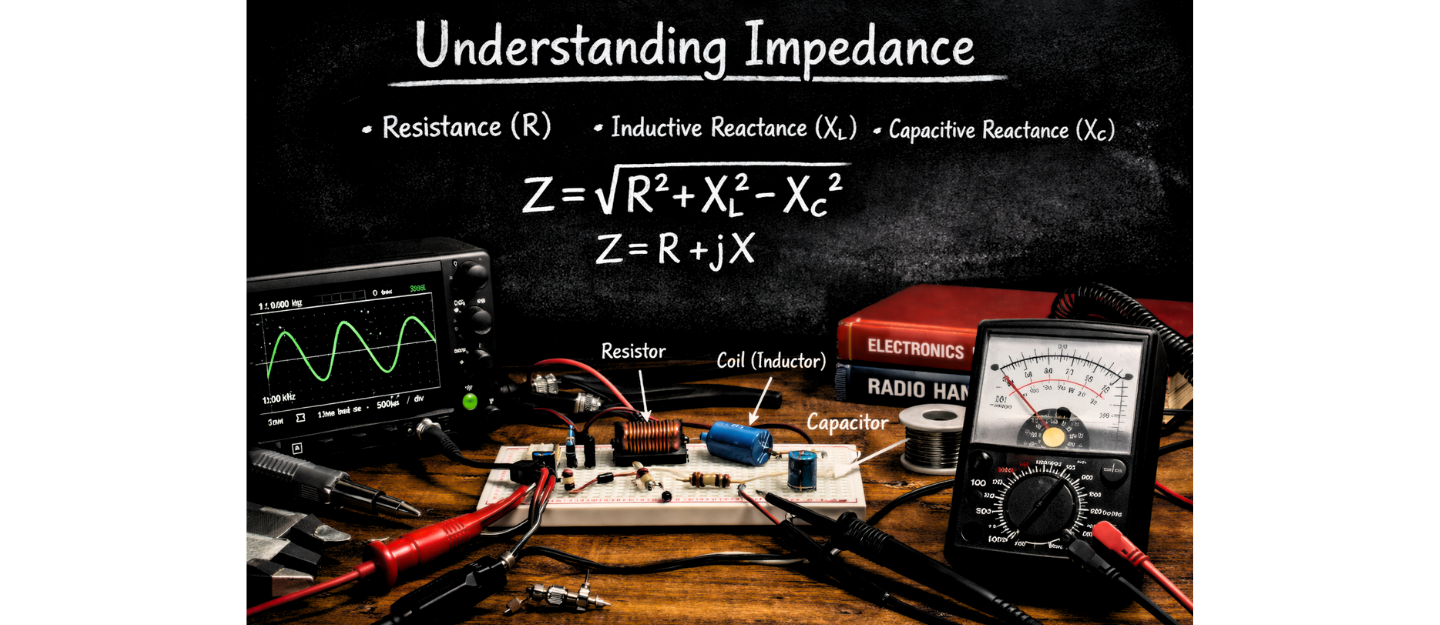
What Is Impedance? (Quick Answer)
Impedance is the total opposition to alternating current (AC), combining resistance and reactance. It determines how efficiently energy moves through circuits, transmission lines, and antennas.
In ham radio, impedance directly affects signal strength, SWR, and overall system performance.
Understanding Impedance
In radio, audio, and electrical engineering, understanding impedance will show how a circuit resists and responds to alternating current. While resistance opposes current flow in direct current systems, impedance expands the concept to alternating current by including both resistance and reactance.
Therefor, impedance determines how efficiently energy moves between components, antennas, and transmission lines. Understanding impedance is essential for anyone working with electronics, since it directly affects performance, efficiency, and signal quality.
Why Impedance Matters in Real-World Ham Radio
If your impedance is wrong, nothing else works properly.
- Poor impedance match = high SWR
- High SWR = reflected power
- Reflected power = weak signal and possible radio damage
Even the best radio cannot overcome a poorly matched antenna system.

Breaking Down the Components
Impedance is a complex quantity that includes resistance and reactance. Resistance represents the part that turns energy into heat. Reactance, on the other hand, represents how capacitors and inductors store and release energy in a circuit. Together, they form a vector relationship, meaning it has both magnitude and phase.
Mathematically, it uses the symbol Z and is measured in ohms. Resistance appears as the real part of impedance, while reactance appears as the imaginary part. Because alternating current constantly changes direction, the balance of inductive and capacitive reactance determines how current leads or lags voltage. Consequently, impedance is not just about magnitude but also about timing between current and voltage.
How Impedance Works in Circuits
When alternating current passes through a resistor, voltage and current remain in phase. However, when it passes through a capacitor, current leads voltage. Conversely, when it passes through an inductor, voltage leads current. The combination of these effects defines total impedance. For this reason, different circuit designs can either cancel or reinforce reactance. By adjusting the balance of capacitance and inductance, engineers create circuits that resonate at specific frequencies.
Transmission Lines
Impedance plays a crucial role in radio systems, especially with transmission lines and antennas. Every coaxial cable or waveguide has a characteristic impedance, usually 50 or 75 ohms. This value represents the balance between capacitance and inductance per unit length of the cable.
When an antenna matches the impedance of the transmission line, energy flows efficiently. However, if it differs, reflections occur. These reflections create standing waves, reduce power transfer, and sometimes damage transmitters. Therefore, impedance matching ensures maximum efficiency.
Matching and Standing Wave Ratio
Operators often measure the Standing Wave Ratio, or SWR, to evaluate how well an antenna matches the transmission line. A perfect match produces an SWR of 1:1. If impedance differs, the SWR rises, and more energy reflects back toward the transmitter. Furthermore, mismatched impedance causes distorted signals and wasted power.
To solve this, operators use tuners, matching networks, or antenna adjustments. Each method works by altering the circuit so that impedances align, allowing smooth energy transfer.
How to Measure and Fix Impedance
To properly manage impedance in a real ham radio setup, you need to measure it and make adjustments based on what you see.
The most common tools are:
- SWR meter for basic measurements
- Antenna analyzer for more precise readings
- NanoVNA for advanced visualization and tuning
A simple process to fix impedance issues:
- Measure your SWR at the operating frequency
- Identify whether the antenna is too long or too short
- Adjust antenna length or position
- Re-test and repeat until SWR is as close to 1:1 as possible
Small adjustments can make a big difference. Even a slight mismatch can reduce efficiency and increase reflected power, so taking the time to measure and tune your system is critical for best performance.
What Happens When Impedance Is Mismatched?
- Power reflects back toward the transmitter
- SWR increases above 1:1
- Signal strength drops
- Heat builds up in components
- Final transistors can fail in extreme cases
👉 This is why impedance matching is not optional — it is critical.
Impedance in Audio Systems
Impedance also affects microphones, speakers, and amplifiers. A low-impedance microphone typically matches professional equipment, while high-impedance microphones work better with consumer devices.
In audio, mismatched impedance can reduce volume, cause distortion, or change tonal quality. Additionally, amplifiers must match the impedance of connected speakers to avoid overheating or failure. Because of this, understanding impedance helps audio engineers maintain both clarity and reliability.
Understanding Impedance in Power Systems
In large power systems, impedance limits current flow during faults. Engineers calculate system impedance to design protective devices that prevent damage. Moreover, impedance affects voltage regulation in transformers and transmission lines. A high impedance in the wrong place leads to voltage drops and reduced efficiency. Consequently, managing impedance is central to stable and safe power distribution.
The Role of Reactance in Impedance
Reactance changes with frequency, which makes impedance frequency-dependent. A capacitor’s reactance decreases as frequency rises, while an inductor’s reactance increases with frequency.
This behavior explains why filters work. By combining inductors and capacitors, engineers design circuits that pass certain frequencies while blocking others. Furthermore, antennas rely on resonance, where inductive and capacitive reactance cancel out, leaving only resistance. At this point, impedance becomes purely resistive, allowing maximum power transfer.
Impedance and Resonance
Resonance occurs when the reactance of a capacitor equals but opposes the reactance of an inductor. As a result, their effects cancel, and impedance drops to a minimum. This property is fundamental in radio tuning, where circuits resonate at a chosen frequency.
At resonance, the antenna or circuit absorbs maximum energy, and signals become strongest. Moreover, resonance makes filters sharp and selective, which is essential for separating signals on crowded bands.
Practical Examples
Consider a simple dipole antenna. At its resonant frequency, the impedance is close to 50 ohms, which matches most coaxial cables. As a result, energy flows efficiently from the transmitter to the antenna. However, if you operate the same antenna outside of resonance, impedance rises, causing reflections.
Another example lies in audio: connecting an 8-ohm speaker to an amplifier rated for 4 ohms creates stress and distortion. These examples show how impedance affects real-world performance.
Improve Your Station Performance
Understanding impedance is just one part of building an efficient station. To go further and improve real-world performance, explore these related topics:
- 👉 Antenna tuning and adjustment techniques
- 👉 Coax cable loss and feedline efficiency
- 👉 Understanding SWR and reflected power
- 👉 Choosing the right antenna for your operating style
These areas work together. Even with perfect impedance, poor coax or a badly placed antenna can still limit your signal. Optimizing your entire system is what separates average performance from excellent results.
Advantages of Understanding Impedance
When operators understand impedance, they gain control over efficiency and reliability. They can design circuits that waste less energy, improve signal clarity, and reduce interference. Furthermore, they can troubleshoot mismatches and avoid equipment damage. Knowledge of impedance also allows experimentation with antennas, filters, and amplifiers to optimize performance.
ethernetChallenges and Misconceptions
Many beginners confuse impedance with simple resistance. While related, they differ in how they handle alternating current. Another common misunderstanding is assuming impedance remains constant across frequencies.
In reality, impedance changes with conditions, components, and environment. Therefore, measuring and adjusting impedance requires both theory and practical tools such as analyzers and bridges.
About This Guide
This guide is based on practical ham radio operation, antenna setup, and RF troubleshooting experience. The concepts explained here are not just theory, they are applied daily by operators to improve signal strength, reduce interference, and protect equipment.
Understanding impedance in real-world conditions often involves trial, measurement, and adjustment. By combining theory with hands-on experience, operators can diagnose problems quickly and build more efficient and reliable stations.
Understanding Impedance Conclusion
Impedance is more than resistance; it represents the complete opposition to alternating current, including both magnitude and phase. Impedance determines how energy flows through circuits, how antennas radiate, and how audio systems sound. Furthermore, impedance matching ensures efficient transfer of energy and prevents damage.
Learning how resistance and reactance combine, operators and engineers can master one of the most fundamental concepts in electronics. Ultimately, understanding impedance opens the door to designing, operating, and troubleshooting systems with greater confidence and success.
Frequently Asked Questions
What is a good impedance for ham radio systems?
Most amateur radio equipment is designed for 50 ohms, which provides the best balance between efficiency and power handling.
What happens if impedance is not matched?
A mismatch causes reflected power, higher SWR, reduced signal strength, and potential damage to your transmitter over time.
Is impedance the same as resistance?
No, impedance includes both resistance and reactance, making it a more complete measurement for alternating current systems.
Can you fix impedance without a tuner?
Yes. Adjusting antenna length, height, or configuration can bring impedance closer to the desired value without using a tuner.
About the Author
Vince, W2KU, is a licensed Extra class amateur radio operator and the founder of Ham Shack Reviews. The club committee named him Amateur of the Year in 2026 for his contributions to amateur radio education and equipment evaluation.
Please consider Donating to help support this channel