
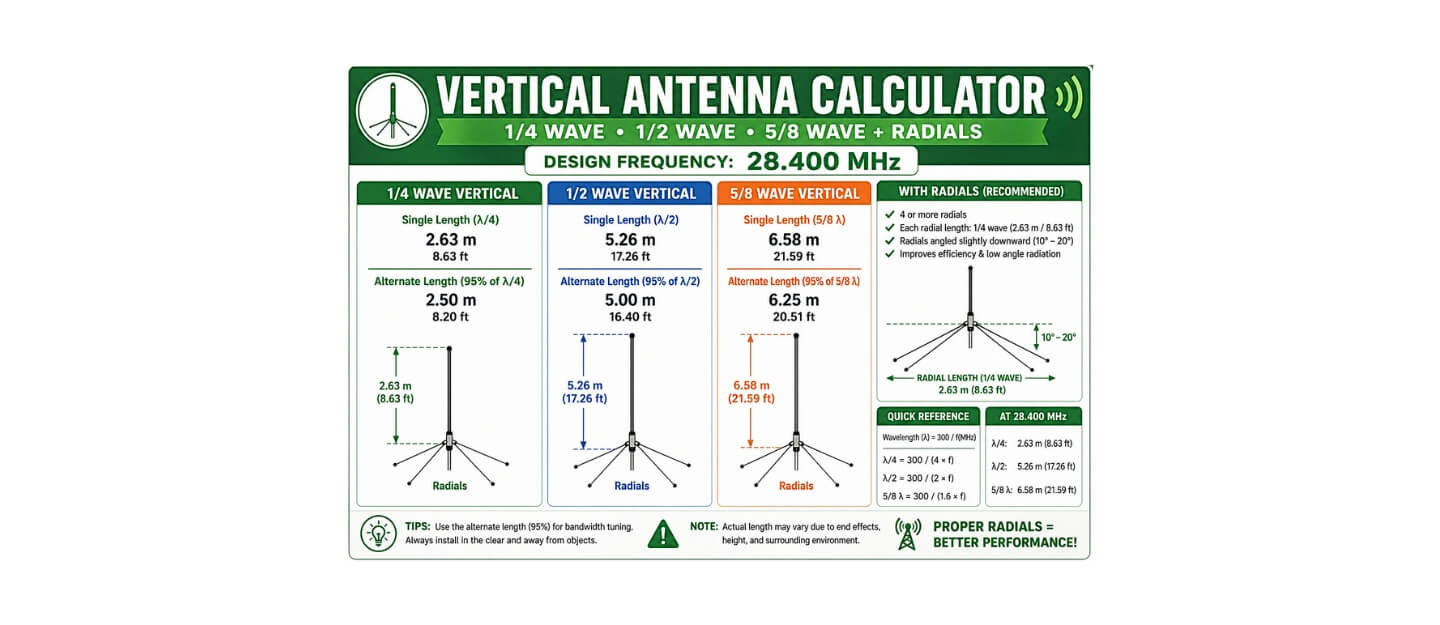
Vertical Antenna Calculator with Radials
Designing a vertical antenna starts with accurate element length, but real-world performance depends just as much on the radial system and ground conditions. This Vertical antenna calculator provides fast, practical values for 1/4 wave, 1/2 wave, and 5/8 wave vertical antennas, along with recommended radial lengths for better efficiency.
Vertical Antenna Calculator
Unlike basic formulas, vertical antennas interact heavily with the ground, which means small adjustments can significantly impact performance. Using a calculator that accounts for real installation conditions helps you start much closer to resonance.
Understanding Vertical Antenna Length
Vertical antennas are typically based on fractions of a wavelength. The most common designs include quarter-wave, half-wave, and 5/8 wave configurations, each with different radiation characteristics and practical use cases.
A quarter-wave vertical is the most widely used design because it is simple, efficient, and works well with a radial system. A half-wave vertical offers higher feedpoint impedance and can sometimes operate without a full ground system. A 5/8 wave vertical is often preferred for low-angle radiation, making it popular for long-distance communication.
The correct electrical length is not always exactly equal to the theoretical wavelength fraction. Factors such as wire diameter, ground conductivity, and nearby objects all influence the final tuned length.
Why Radials Matter in Vertical Antennas
A vertical antenna relies on the ground system to complete the circuit. Without radials, a large portion of your transmitted power is lost as heat in the soil rather than being radiated as RF energy.
A proper radial system reduces ground loss and improves efficiency. Even a small number of radials can make a noticeable difference, while larger radial fields significantly improve performance.
Typical radial guidelines include:
- Minimum: 4 radials for basic operation
- Better: 8–16 radials for improved efficiency
- Optimal: 32+ radials for maximum performance
Radial length is typically close to a quarter wavelength, but shorter radials can still be effective when space is limited.
1/4 Wave vs 1/2 Wave vs 5/8 Wave Vertical
Each vertical antenna type behaves differently, and choosing the right one depends on your operating goals.
A 1/4 wave vertical is compact and efficient when used with a proper ground system. It is the most common choice for HF bands and portable setups.
A 1/2 wave vertical can operate with reduced dependence on radials but often requires a matching network due to higher feedpoint impedance. It is useful where ground systems are limited.
A 5/8 wave vertical provides a lower radiation angle, which can improve DX performance. However, it typically requires impedance matching and careful tuning to perform correctly.
Understanding these differences allows you to choose the right antenna before even cutting wire.
Real-World Adjustment and Tuning
No antenna should be installed exactly at its calculated length without testing. The calculated value is a starting point, not the final tuned dimension.
In practice, antennas are usually cut slightly longer and then trimmed while monitoring SWR. Ground conditions, mounting height, and surrounding objects all influence resonance.
Using an antenna analyzer or SWR meter during installation allows you to fine-tune the antenna for best performance on your target frequency.
Common Vertical Antenna Mistakes
Many performance issues come from simple setup errors rather than poor design.
A common mistake is using no radials or too few radials, which leads to high ground loss and poor efficiency. Another issue is assuming calculated length is exact, without allowing for tuning adjustments.
Incorrect feedpoint matching is also common, especially with 1/2 wave and 5/8 wave antennas, which often require impedance matching to perform properly. Avoiding these mistakes will significantly improve your results, even with a basic antenna design.
When to Use a Vertical Antenna
Vertical antennas are ideal when space is limited or when low-angle radiation is desired. They are commonly used for HF communication, DX operation, and portable setups.
Because they require less horizontal space than dipoles, vertical antennas are often the best choice for smaller properties or restricted installations.
With a proper radial system and correct tuning, a vertical antenna can deliver excellent performance across multiple bands.
Vertical Antenna Calculator
A vertical antenna calculator provides a fast and reliable starting point for antenna design, but real performance depends on proper installation, radial systems, and tuning.
By combining accurate calculations with good construction practices, you can achieve strong, efficient performance from even a simple vertical antenna setup.
Frequently Asked Questions
What is the correct length for a quarter wave vertical antenna?
A quarter wave vertical antenna length is typically calculated using 234 divided by the frequency in MHz. This provides a practical starting point, but final tuning is required for best performance.
How long should radial wires be for a vertical antenna?
Radials are typically close to a quarter wavelength. While full-length radials provide the best efficiency, shorter radials can still improve performance when space is limited.
Do vertical antennas work without radials?
Vertical antennas can operate without radials, but efficiency is significantly reduced. A proper radial system greatly improves radiation efficiency and reduces ground loss.
Is a 5/8 wave vertical better for DX?
A 5/8 wave vertical can provide a lower radiation angle, which may improve long-distance communication. However, it usually requires proper matching and tuning.
How many radials do I need for a vertical antenna?
A minimum of 4 radials will work, but 8 to 16 provides better efficiency. For optimal performance, 32 or more radials are recommended.
Please consider Donating to help support this channel