

Amateur radio operators frequently face the same question when building or upgrading a station: should you use a Vertical vs Dipole Antennas? Both are among the most widely used antenna types in ham radio, and each has strengths depending on operating goals, available space, and band conditions.
For many operators, the decision affects everything from signal coverage and DX performance to installation complexity and noise levels. A dipole antenna is often praised for simplicity and predictable performance, while vertical antennas are popular for low-angle radiation that can improve long-distance contacts.
Understanding the differences between these antenna designs allows you to choose the right antenna for your operating style and location. This guide explains how vertical and dipole antennas work, compares their performance, and provides practical advice for selecting the best option for your station.
New to antenna systems? See our Complete Guide to Ham Radio Antennas.
How Dipole Antennas Work
The dipole antenna is one of the most fundamental antenna designs in radio communications. It consists of two conductive elements, each approximately one-quarter wavelength long, fed at the center.
A half-wave dipole forms a balanced antenna system that radiates radio frequency energy efficiently in broadside directions.
Key characteristics of dipole antennas include:
• Balanced antenna design
• Typically mounted horizontally
• Resonant on a specific band
• Feedpoint impedance around 50–75 ohms
• Simple construction with minimal components
Because of its simplicity and predictable radiation pattern, the dipole antenna is often the first antenna built by new amateur radio operators.
When installed at sufficient height, a dipole provides excellent performance for both regional and long-distance communication depending on its elevation above ground.
Dipoles can be installed between trees, towers, or masts, making them practical for many residential environments.
How Vertical Antennas Work
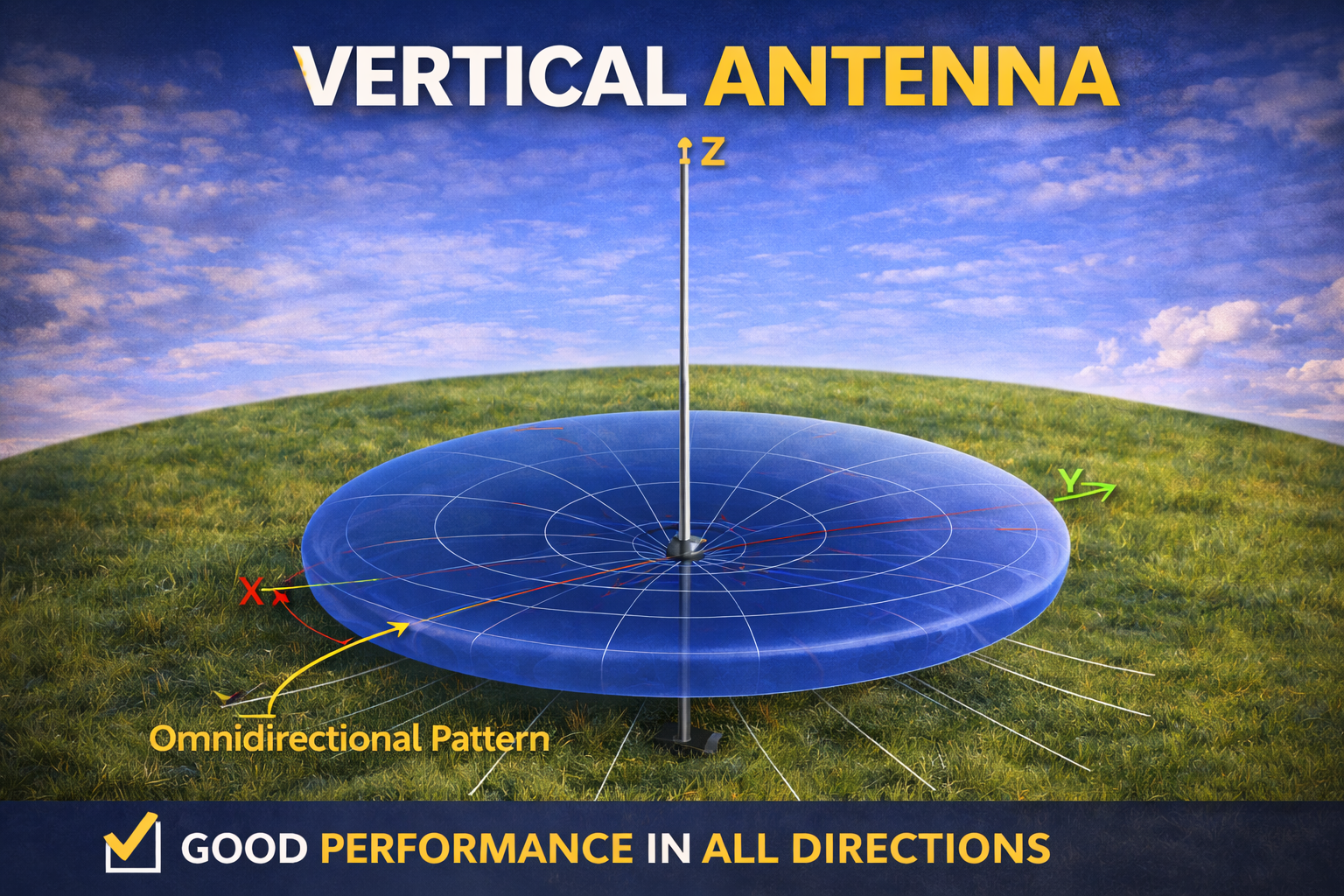
Vertical antennas radiate energy from a single vertical element mounted perpendicular to the ground. Instead of two symmetrical arms like a dipole, the vertical antenna typically uses the earth or a ground radial system as the return path.
Most amateur vertical antennas are either quarter-wave designs or multi-band verticals using traps or matching networks.
Characteristics of vertical antennas include:
• Vertically polarized radiation
• Low radiation angle ideal for DX
• Smaller physical footprint than many dipoles
• Requires ground radials for efficiency
• Often omnidirectional radiation pattern
Vertical antennas are particularly popular among operators who want to maximize long-distance contacts without requiring large horizontal space.
Because they radiate equally in all horizontal directions, vertical antennas also eliminate the need to rotate or aim the antenna.
Radiation Pattern Differences
One of the biggest differences between vertical and dipole antennas lies in their radiation patterns.
Dipole antennas typically produce a figure-eight radiation pattern when installed horizontally. The strongest signals radiate broadside to the wire.
This means the antenna radiates strongest at right angles to the wire and weaker off the ends. Vertical antennas, in contrast, generally produce an omnidirectional pattern. This means the antenna radiates equally in all directions along the horizon.
This difference has practical implications.
| Antenna Type | Radiation Pattern | Directionality |
|---|---|---|
| Dipole | Figure-eight | Strong broadside directions |
| Vertical | Omnidirectional | Equal coverage in all directions |
Dipoles may provide stronger signals toward specific directions, while verticals provide uniform coverage.
Operators who frequently contact specific regions may benefit from orienting dipoles for maximum signal strength in those directions.
Radiation Angle and DX Performance
Radiation angle plays a major role in long-distance communication. Low-angle radiation allows signals to travel farther before reflecting off the ionosphere.
Vertical antennas naturally produce lower radiation angles, which can make them effective for DX contacts. Dipoles installed at lower heights tend to produce higher-angle radiation that favors regional communication.
However, when a dipole is installed at sufficient height, typically around half a wavelength above ground, it can also produce excellent DX performance. This means antenna height often matters more than antenna type when evaluating DX capability.
Installation Requirements
Installation complexity differs significantly between vertical and dipole antennas. Dipoles require horizontal space equal to roughly half the wavelength of the operating band.
For example:
| Band | Approximate Dipole Length |
|---|---|
| 40 meters | ~66 feet |
| 20 meters | ~33 feet |
| 80 meters | ~132 feet |
This length must be supported between two structures such as trees, masts, or towers. Vertical antennas require less horizontal space but demand an effective ground system. A quarter-wave vertical antenna often requires multiple ground radials to perform efficiently.
Typical radial systems include:
• 4 radials (minimum performance)
• 16 radials (good performance)
• 32+ radials (excellent efficiency)
Without sufficient ground radials, vertical antenna efficiency drops significantly.
Noise Levels and Signal Reception
Noise is an often overlooked factor when choosing an antenna.
Vertical antennas typically pick up more man-made noise because of their polarization and proximity to ground-level electrical sources.
Common noise sources include:
• Power lines
• Electrical appliances
• LED lighting
• Switching power supplies
Dipole antennas mounted higher above ground tend to receive less local electrical noise. For this reason, many operators prefer dipoles for receive performance, especially in suburban or urban environments.
Lower noise floors can make weak signals easier to hear.
Multi-Band Operation
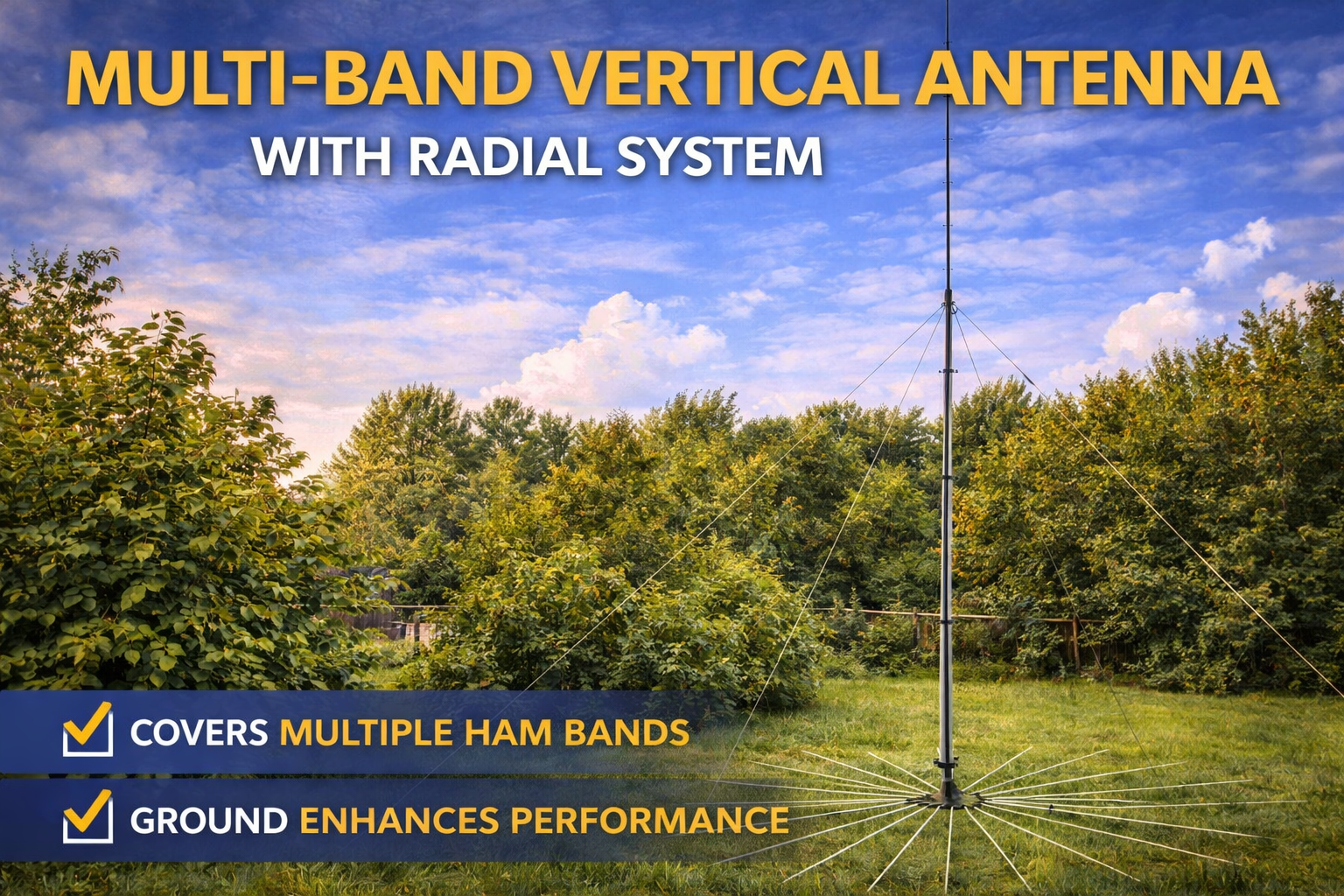
Both Vertical vs Dipole Antennas can operate on multiple bands, but they accomplish this differently. Multi-band dipoles often use traps or fan dipole designs.
Fan dipoles consist of multiple dipole elements connected to a common feedpoint, each resonant on a different band. Vertical antennas commonly use traps or internal matching networks to allow operation on multiple bands.
Commercial vertical antennas may cover bands such as:
• 80 meters
• 40 meters
• 20 meters
• 15 meters
• 10 meters
Multi-band verticals are attractive for operators who want a single antenna covering several bands. However, they often require careful radial installation for optimal performance.
Efficiency and Ground Losses
Ground losses are a major factor affecting vertical antenna efficiency.RF currents flowing through the ground system can lose energy as heat when the radial system is insufficient.
This explains why vertical antennas benefit greatly from extensive radial networks. Dipole antennas generally avoid this problem because they operate as balanced antennas elevated above the ground.
Because of this, dipoles often achieve higher efficiency with simpler installations. However, terrain, soil conductivity, and antenna height still affect performance.
Space and HOA Considerations
Physical space often determines which antenna type is practical. Dipoles require horizontal space for the wire element.
Vertical antennas require less horizontal area but may still require radial wires extending outward. In HOA-restricted environments, stealth dipoles installed in trees can sometimes be less noticeable than vertical antennas mounted on masts.
Portable operators and field-day stations often favor vertical antennas due to compact setups. Each antenna type offers flexibility depending on operating conditions and available property space.
Vertical vs Dipole Antenna Comparison
The following table summarizes the key differences.
| Feature | Vertical Antenna | Dipole Antenna |
|---|---|---|
| Radiation Pattern | Omnidirectional | Figure-eight |
| Polarization | Vertical | Horizontal |
| DX Capability | Excellent low-angle radiation | Good when mounted high |
| Noise Reception | Often higher | Typically lower |
| Installation | Requires radial system | Requires horizontal space |
| Efficiency | Depends on radials | Generally efficient |
Both antennas can perform extremely well when installed properly.
Choosing between them often comes down to available space, operating goals, and installation constraints.
When a Vertical Antenna Is the Better Choice
Vertical antennas are often preferred in several scenarios.
They are especially useful when:
• Space is limited
• DX contacts are the primary goal
• An omnidirectional pattern is desired
• Portable operation is required
• Multi-band operation is needed with one antenna
Vertical antennas also allow communication in all directions without repositioning the antenna.
This can be valuable for operators who frequently contact multiple regions.
When a Dipole Antenna Is the Better Choice
Dipoles are often the better choice when:
• Lower noise reception is important
• Trees or supports are available
• Simplicity is preferred
• Maximum efficiency is desired
• Regional communication is common
Dipoles are also excellent for beginners because they are inexpensive and easy to build.
Many experienced operators continue to use dipoles because of their reliability and predictable performance.
Combining Both Antennas for Maximum Performance
Many advanced amateur radio stations use both vertical and dipole antennas.
This combination provides flexibility depending on operating conditions.
For example:
• Use the dipole for quieter reception
• Use the vertical for low-angle DX transmission
• Switch antennas depending on propagation conditions
Modern antenna switches make it easy to compare antennas during operation.
Using multiple antenna types can dramatically improve station versatility.
Vertical vs Dipole Antennas
Vertical vs dipole antennas remain two of the most effective antenna designs in amateur radio. Each offers distinct advantages depending on installation conditions and operating goals.
Vertical antennas provide low-angle radiation and omnidirectional coverage, making them popular for DX communication and compact installations. Dipole antennas offer simple construction, efficient radiation, and lower noise levels, making them excellent general-purpose antennas.
Ultimately, the best antenna is the one that fits your available space and operating style. When installed correctly, both vertical and dipole antennas can deliver outstanding performance across multiple amateur radio bands.
Understanding their differences helps operators choose the right antenna and maximize station capability.
FAQ
Which is better for DX, a vertical or dipole antenna?
Vertical antennas often perform better for DX because they produce low-angle radiation that travels farther across the ionosphere.
Do dipole antennas have lower noise than vertical antennas?
Yes. Operators usually mount dipoles higher above ground and use horizontal polarization, which often results in lower received noise.
Do vertical antennas require ground radials?
Yes. Most vertical antennas require ground radials to provide an effective return path and improve efficiency.
Can a dipole antenna work multiple bands?
Yes. Multi-band dipoles can be built using traps or fan dipole designs that allow operation on several amateur radio bands.
Are vertical antennas easier to install than dipoles?
Vertical antennas require less horizontal space but often need a radial ground system, which can increase installation complexity.
Which antenna is better for small yards?
Vertical antennas are often more practical for small yards because they require less horizontal space than full-size dipoles.
About the Author
Vince, W2KU, is a licensed Extra class amateur radio operator and the founder of Ham Shack Reviews. He was named Amateur of the Year in 2026 for contributions to practical amateur radio education and equipment evaluation.
He primarily operates HF, knows propagation very well, operates mobile and handhelds daily. Vince exchanges QSL cards for DXCC, contest confirmation, and award tracking and is the club QSL manager. His guidance focuses on practical operating procedures, accurate logging, and real-world amateur radio practices.
Please consider Donating to help support this channel