
If you use a handheld ham radio, the stock antenna is often the weakest part of the setup. A better antenna can improve receive clarity, extend usable range, and make your HT feel much more capable in real-world use. But not every upgrade is worth buying, and the best choice depends on how you actually operate.
This guide is written for operators who want real-world results, not marketing claims. We will look at how handheld antennas work, what affects performance, which antenna styles make the most sense, and how to choose the right one for your radio and use case. If you are trying to get more range, clearer receive audio, or a better everyday carry setup, this will help you narrow it down.
New to antenna systems? See our Complete Guide to Ham Radio Antennas.
How Handheld Antennas Work
A handheld antenna is always a compromise between size, efficiency, durability, and convenience. The short rubber duck antennas that come with many HT radios are popular because they are light, flexible, and easy to carry. The downside is that they are usually not very efficient, especially compared with an antenna that is closer to a proper resonant length for the band.
On VHF and UHF, antenna design matters a lot. A well-matched antenna tuned for the frequency you actually use can improve both transmit and receive performance. But a physically longer antenna is not automatically better. If the design is poor, the antenna is tuned badly, or it is awkward to carry and use, the practical benefit may disappear.
That is why handheld antenna shopping can be frustrating. The market is full of products that promise big gains, but the best antenna is usually the one that gives you the right balance of performance and usability. For many operators, the ideal choice is not the absolute strongest performer on paper. It is the antenna that works best in the real situations where they actually use the radio.
What Really Affects Performance
The first thing that matters is frequency match. An antenna designed for 2 meters may perform differently from one designed for 70 centimeters, and dual-band antennas always involve some compromise. If you mainly operate on one band, a single-band antenna can sometimes outperform a dual-band version because it is optimized for a narrower range.
Antenna length matters too, but only when it is paired with a good design. A longer radiating element can improve efficiency, yet extra length can also make the radio awkward to carry. If the antenna is too stiff, too heavy, or too long, you may find yourself using the radio less often, which defeats the purpose of upgrading in the first place.
Build quality is another major factor. Cheap antennas often have weak connectors, poor coil construction, or inconsistent tuning. That can lead to disappointing performance even if the antenna looks impressive. For handheld use, durability is especially important because the antenna gets bumped, bent, stored, and carried all the time.
Your operating environment matters as well. An antenna that works well outdoors may behave differently inside a building, inside a vehicle, or near metal objects. Your own body also affects the antenna more than many operators expect. With an HT, you are part of the antenna system, so your hand position, posture, and nearby surroundings can all change the result.
Rubber Duck Antennas
The stock rubber duck antenna is the easiest antenna to live with because it is compact and flexible. For casual use, especially if you mainly monitor local repeaters, it can be acceptable. Its biggest advantage is convenience. You can clip the radio to a belt, toss it in a bag, or carry it around the house without worrying about breaking a long whip.
Its biggest weakness is efficiency. The short, loaded design that makes it compact also limits performance. In weak-signal situations, a rubber duck often struggles compared with a better aftermarket option. That does not mean it is useless, but it does mean it is usually the first thing people should replace if they want a meaningful improvement from an HT.
If your operating area is strong-signal and repeater-rich, the stock antenna may still be serviceable. But if you have trouble reaching repeaters, or if receive audio is noisy and inconsistent, a better antenna is often the simplest upgrade to try first.
Flexible Aftermarket Whips
For most operators, a good flexible aftermarket whip is the best first upgrade. It is still portable, but it usually performs better than the stock antenna. This is the sweet spot for everyday carry because it improves range without making the radio feel awkward or fragile.
A good flexible whip works well for repeater access, local simplex, and general ham radio use. It is especially useful if you want one antenna that stays on the radio most of the time. You get a real performance increase without giving up the convenience that makes a handheld radio useful in the first place.
This type of antenna is usually the easiest recommendation because it offers the best balance of performance and convenience. It may not be the absolute strongest performer in every test, but in real-world use it is often the most practical. For many HT users, that practical balance matters more than chasing the last bit of theoretical gain.
Diamond Antenna SRH77CA
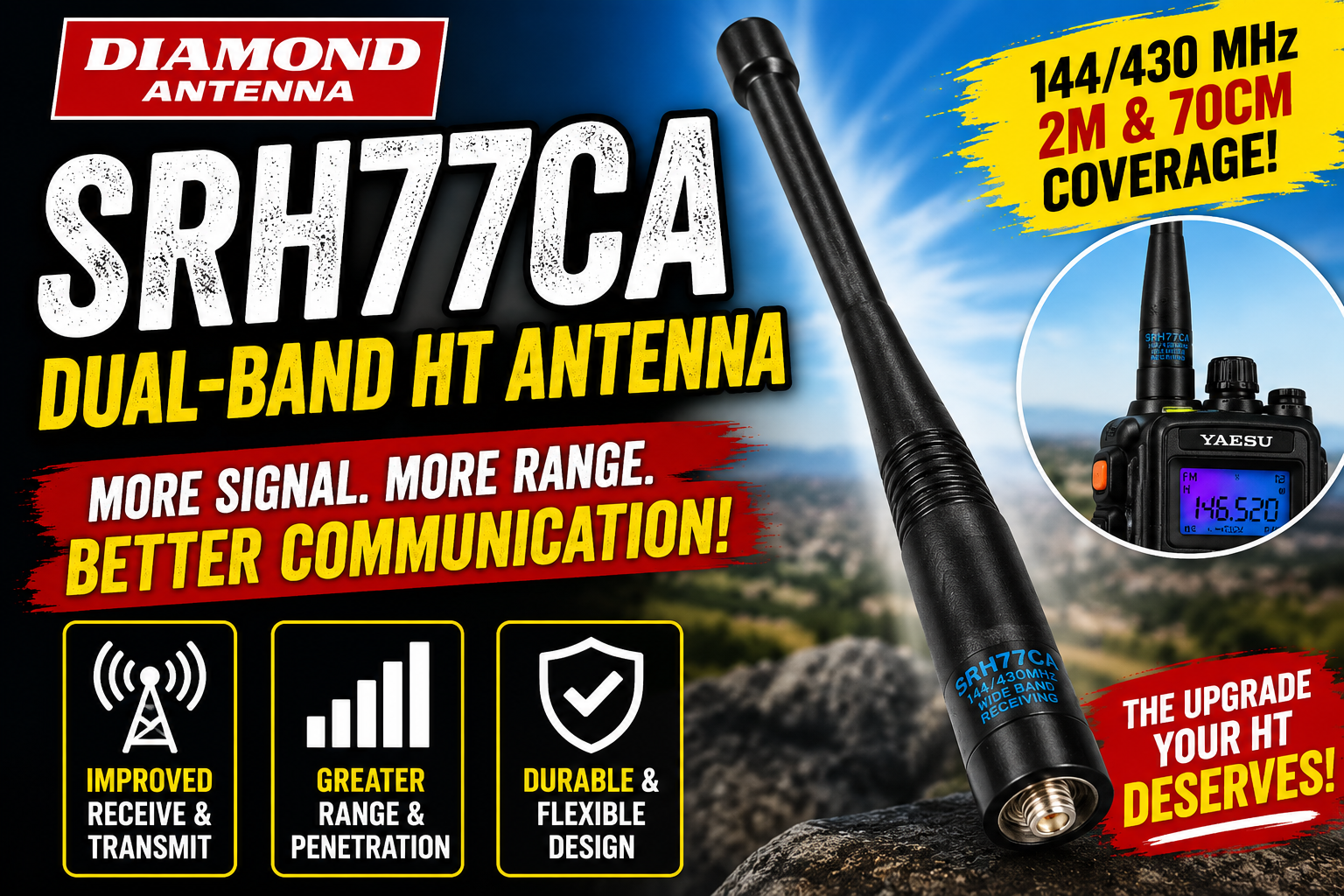
The Diamond Antenna Dual-Band HT Antenna SRH77CA is a popular aftermarket upgrade for handheld amateur radios, offering improved transmit and receive performance on the 2-meter (144–148 MHz) and 70-centimeter (430–450 MHz) bands.
Telescoping Antennas
Telescoping antennas can perform very well because they let you extend the radiator closer to the ideal length for the band. That makes them attractive for operators who care more about signal performance than pocketability. When fully extended, they can often outperform shorter flexible antennas, especially in favorable conditions.
The tradeoff is convenience. A telescoping antenna is less comfortable for everyday carry and can be more fragile than a solid flexible whip. It also requires a little more attention when you deploy and store it, which makes it less attractive for casual “grab and go” use.
If you are active in the field or want a stronger receive and transmit option without stepping up to a larger portable station, a telescoping antenna can be a very good choice. It is especially useful when you can set up, use the radio for a while, and then store everything carefully afterward.
Loaded and Compact Designs
Some antennas stay short by using loading coils or other compact design tricks. These are useful when size matters more than absolute efficiency. If you want a low-profile antenna that does not get in the way, this style can make sense.
The tradeoff is that compact antennas often give up some performance to stay small. That does not mean they are bad, but it does mean they are usually chosen for convenience rather than maximum range. They can be a good fit for a handheld that you carry often and use in fairly strong-signal environments.
If you operate mostly in repeater-rich areas, a compact antenna may be good enough. If you need every bit of performance you can get, a longer and better-tuned antenna will usually be the better option. In other words, compact designs are about solving a carry problem first and a signal problem second.
Field and Portable Antennas
For portable operations, the best antenna is often not mounted directly on the handheld at all. Roll-up J-poles, portable whips, and other field antennas can dramatically outperform the tiny antennas that stay on an HT. If you are operating from a park, campsite, hilltop, or emergency setup, this is where you can get the biggest improvement.
These antennas usually require a bit of setup, but the performance gain is often worth it. A properly deployed portable antenna can make weak signals easier to hear and can improve transmit reports significantly. That matters when you are trying to make contacts from a location that is not ideal or when you need reliable communication more than convenience.
This is the point where the conversation shifts from “best HT antenna” to “best portable antenna system.” If your radio spends a lot of time sitting on a table, in a go-kit, or at a temporary operating position, a deployable antenna deserves serious attention. It may not be the thing you leave on the radio all day, but it can be the most effective tool when range really matters.
How to Choose The Right One
The best antenna for you depends on how you use your radio. If you carry the HT all day, a flexible aftermarket whip is probably the most practical choice. It gives you a real performance boost without turning the radio into a hassle to carry or use.
If you care most about signal performance and do not mind extra length, a telescoping antenna or another longer design may be the better choice. If you operate mainly from a portable setup, a field antenna will usually beat any handheld-mounted antenna by a wide margin.
The biggest mistake people make is buying based on marketing claims instead of actual use. A good antenna should fit your operating habits, your bands, and your tolerance for size and weight. The “best” antenna is not the one with the loudest claims. It is the one you will actually use.
What to Expect in Real use
A better antenna will not magically turn a weak handheld into a mobile rig, but it can absolutely improve results. In many cases, the improvement is enough to make repeaters easier to access, simplex contacts clearer, and receive audio more consistent. That is especially true when the stock antenna is very basic.
The difference is often most obvious in difficult conditions. If you are indoors, in a car, behind buildings, or operating from a weak-signal location, the right antenna can help more than people expect. On the other hand, if you already have a strong local signal, the improvement may be less dramatic.
This is why testing matters. Two antennas can look similar but behave very differently once they are used on your specific radio in your normal environment. If possible, compare them on the same repeater, at the same location, using the same radio settings.

Common Mistakes
A lot of people assume that the longest antenna is always the best one. That is not true. A badly designed long antenna can still underperform a shorter but better-engineered one.
Another common mistake is buying an antenna that is too inconvenient to carry. If it makes the radio awkward, heavy, or annoying, you may stop using it. That is a real loss, because the best antenna is the one you keep on the radio.
People also ignore the operating band. An antenna that is a great fit for 2 meters may not be the best choice for 70 centimeters. If you use both bands regularly, dual-band convenience may matter more than squeezing out a little extra performance on one band.
Final Recommendation
If you want the best all-around handheld antenna, start with a quality flexible aftermarket whip. It is usually the best mix of performance, durability, and convenience. For most ham radio operators, that is the first upgrade that actually feels worthwhile.
If you want the strongest possible handheld performance, move up to a telescoping or longer tuned antenna. If you operate portable, use a separate field antenna when you can. That gives you much better results than trying to force a tiny HT antenna to do too much.
The bottom line is simple: match the antenna to the way you operate. The right choice can make your handheld radio more useful, more reliable, and more enjoyable to use every day.
Please consider Donating to help support this channel