
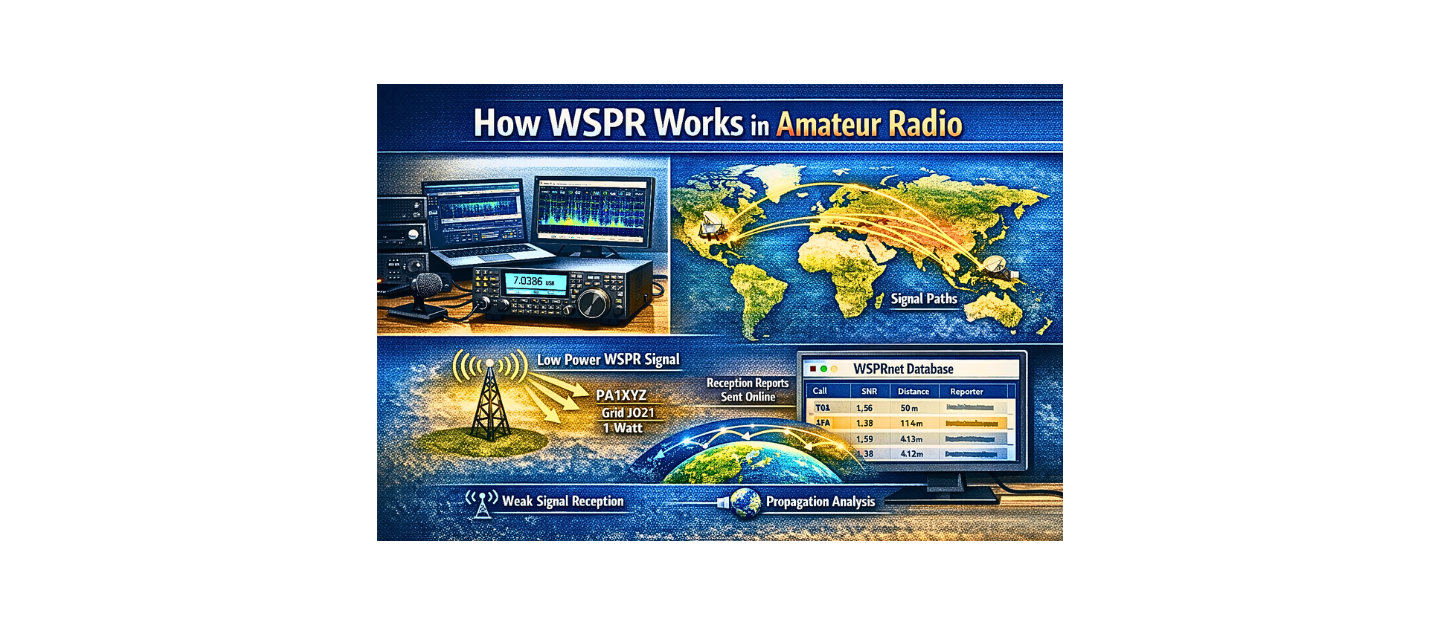
WSPR (Weak Signal Propagation Reporter) is one of the most powerful tools available to amateur radio operators for observing real-world HF propagation. WSPR detects extremely weak signals and reports the stations that receive those signals worldwide.
Instead of holding a conversation, WSPR stations transmit small beacon-like signals that contain basic information about the station. Receiving stations decode these signals and automatically upload reception reports to a global database. The result is a constantly updating network of propagation observations that reveal how radio signals travel through the ionosphere.
Because WSPR decodes signals at extremely low levels far below the noise floor, operators widely use it for antenna testing, propagation research, and ultra-low-power radio experiments.
Want to learn more about propagation? Try Complete Guide to Ham Radio Propagation
What WSPR Is
WSPR stands for Weak Signal Propagation Reporter. Joe Taylor, K1JT, created the WSPR digital communication protocol, and he also developed FT8 and several other weak-signal digital modes.
Unlike conversational digital modes, WSPR functions more like a beacon network. Stations periodically transmit short signals that encode a small amount of information. Receiving stations around the world detect these transmissions.
Receiving stations record each successful reception and upload it to a central database, allowing operators to see which stations received the signal and how strong it was.
This network creates an enormous dataset that reveals real-time propagation conditions across the globe.
How The Signals Work
The signals use a very narrow digital modulation technique known as four-frequency shift keying (4-FSK). The signal occupies only about six hertz of bandwidth, which is far narrower than most digital modes.
Because the signal bandwidth is extremely small, the transmitter concentrates power into a very narrow frequency range. This allows receiving stations to decode WSPR signals even when background noise buries them.
A typical transmission lasts about two minutes and contains a compressed message consisting of three pieces of information:
- Callsign
- Grid locator
- Transmit power level
Once transmitted, receiving stations decode the signal and automatically upload reception reports to the database.
Key Technical Characteristics of WSPR
| Parameter | Value |
|---|---|
| Modulation | -FSK |
| Bandwidth | ~6 Hz |
| Symbol rate | 1.4648 baud |
| Transmission length | 110.6 seconds |
| Minimum decode level | approximately −28 dB |
The extremely low decoding threshold allows WSPR to detect signals that are invisible to most other modes.
Why WSPR Is Useful for Propagation Monitoring
HF propagation changes constantly due to solar radiation, ionospheric conditions, and geomagnetic activity. Predicting these changes is difficult, and propagation models do not always match real conditions.
WSPR provides direct evidence of actual radio signal paths rather than relying solely on prediction models.
Some of the ways operators use WSPR include:
• Monitoring which HF bands are open
• Studying long-distance propagation paths
• Tracking grayline propagation effects
• Measuring antenna performance
• Running ultra-low-power experiments
Because thousands of receiving stations are active worldwide, even very small signals can be detected across long distances.
Understanding WSPR Power Levels
The messages include the transmitter’s power level encoded in dBm. This allows receiving stations to estimate signal path loss and compare results between stations.
Common power levels used in WSPR experiments include:
| Power Level | Output Power |
|---|---|
| 0 dBm | milliwatt |
| 10 dBm | 10 milliwatts |
| 20 dBm | 100 milliwatts |
| 30 dBm | 1 watt |
| 37 dBm | 5 watts |
Many operators intentionally run very low power to study how far signals can travel with minimal energy.
Equipment Needed to Run WSPR
A station can be built using typical amateur radio equipment.
Basic station components include:
• HF transceiver capable of stable digital operation
• Computer running digital mode software
• Audio interface or built-in USB sound interface
• Internet connection for reporting data
• Accurate time synchronization
Many modern radios already include USB digital interfaces, which simplifies setup significantly.
Even simple stations running a few watts can produce useful propagation data.
Software Used for WSPR Operation
The most common software used for WSPR is WSJT-X, which supports multiple weak-signal digital modes.
WSJT-X provides:
• WSPR transmit and receive functions
• Automatic reporting to the WSPRnet database
• Frequency control and decoding
• Signal analysis tools
Once configured, the software automatically transmits and receives signals during synchronized two-minute cycles.
Time Synchronization Requirements
Accurate time synchronization is critical for WSPR operation. All transmissions occur at specific two-minute intervals.
Typical transmission start times include:
00:00
02:00
04:00
06:00
Because decoding depends on precise timing, computer clocks must be accurate within approximately one second.
Most stations maintain accurate time using internet time servers or GPS synchronization.
Common WSPR Frequencies
The transmissions occur in narrow segments of each amateur radio band.
Typical frequencies include:
| Band | Frequency |
|---|---|
| 160 meters | 1.8366 MHz |
| 80 meters | 3.5686 MHz |
| 40 meters | 7.0386 MHz |
| 30 meters | 10.1387 MHz |
| 20 meters | 14.0956 MHz |
| 17 meters | 18.1046 MHz |
| 15 meters | 21.0946 MHz |
| 12 meters | 24.9246 MHz |
| 10 meters | 28.1246 MHz |
Because The signals are extremely narrow, accurate frequency control is important.
Using WSPR to Study Propagation
One of the main advantages is the ability to visualize signal paths across the world. When a transmission is received, the database records both stations’ locations and calculates the distance between them.
Operators can then examine reception reports to see:
• Where their signals were heard
• How strong those signals were
• Which propagation paths were active
This information reveals how radio waves travel through the ionosphere under real conditions.
Using WSPR for Antenna Testing
It is widely used for antenna comparisons because it provides objective signal measurements from many receiving stations.
A simple antenna experiment might involve transmitting WSPR signals using two different antennas and comparing reception reports.
Example comparison:
| Antenna | Average Signal | Distance |
|---|---|---|
| Dipole | −20 dB | 1500 km |
| Vertical | −17 dB | 2100 km |
Because hundreds of receivers may detect the signal, results are often far more reliable than single-station signal reports.
WSPR Propagation Mapping
Several websites generate maps showing where WSPR signals have been received. These visualizations reveal global propagation patterns.
Typical propagation paths observed include:
• F-layer ionospheric propagation
• Grayline propagation along sunrise and sunset zones
• Multi-hop long-distance propagation
• Polar signal paths
Researchers often use these maps to study how propagation changes throughout the day.
Best Times to Observe WSPR Propagation
HF propagation varies with solar radiation and ionospheric conditions. Some of the most interesting observations occur during transitional periods.
Key times to monitor WSPR include:
• Sunrise
• Sunset
• Grayline periods
• Geomagnetic disturbances
• Solar flare events
During these periods, unusual long-distance signal paths often appear.
Common Problems When Running WSPR
Several common issues can prevent WSPR signals from decoding correctly.
Frequent problems include:
• Incorrect system time
• Frequency calibration errors
• Overdriven audio levels
• Unstable transmitters
• Incorrect dial frequency
Ensuring accurate time synchronization and stable frequency control is essential for successful operation.
Why WSPR Is Valuable to Amateur Radio
WSPR has become one of the most important propagation research tools available to amateur radio operators. By combining extremely sensitive digital decoding with a global network of receivers, it allows operators to observe radio propagation in ways that were previously impossible.
From studying ionospheric behavior to testing antennas and exploring ultra-low-power communication, WSPR provides a unique window into how radio signals travel across the Earth.
FAQ
What does WSPR stand for?
It stands for Weak Signal Propagation Reporter, a digital mode designed to measure HF radio propagation using extremely weak signals.
How weak are WSPR signals?
The signals can be decoded at levels approaching −28 dB below the noise floor in a 2.5 kHz bandwidth.
How much power is needed for WSPR?
Many operators run between 1 watt and 5 watts, although milliwatt-level transmissions can still travel thousands of miles under good propagation conditions.
What software is used for WSPR?
Most operators use WSJT-X, which includes built-in support for WSPR transmit and receive functions.
Do I need special equipment for WSPR?
Any stable HF transceiver capable of digital operation can be used, along with a computer and digital interface.
How accurate must time be for WSPR?
Computer clocks should be accurate within about one second so transmissions occur during the correct two-minute time slot.
About the Author
Vince, W2KU, is a licensed Extra class amateur radio operator and the founder of Ham Shack Reviews. The committee named him Amateur of the Year in 2026 for his contributions to amateur radio education and equipment evaluation.
He knows propagation very well, operates mobile and handhelds daily. Vince exchanges QSL cards for DXCC, contest confirmation, and award tracking and is the club QSL manager. His guidance focuses on practical operating procedures, accurate logging, and real-world amateur radio practices.
Please consider Donating to help support this channel