
New to ham radio equipment? Start with our Complete Guide to Ham Radio Transceivers to understand radio types, features, and setup.
The Yaesu FTDX10 is widely considered one of the most capable mid-to-high performance HF transceivers available today. Designed using technology derived from Yaesu’s flagship FTDX101 series, this radio delivers exceptional receiver performance, advanced filtering, and real-time band visibility in a compact desktop footprint. Many operators report the FTDX10 can copy signals that were unreadable on previous radios, especially in crowded or high-noise conditions.
For operators focused on weak signal work, contest performance, and overall receiver clarity, the FTDX10 represents a major step above typical mid-range HF radios. Its hybrid SDR architecture combines strong analog front-end protection with modern digital processing, giving operators precise control over signals in crowded band conditions.
This is not just another HF radio with a touchscreen. It is a performance-focused transceiver built for serious operating environments. In extended on-air use, the FTDX10 shows its strengths most clearly during crowded band conditions and weak signal operation.
Long listening sessions reveal stable audio, consistent signal separation, and reduced fatigue compared to many mid-range transceivers. These practical operating differences become most noticeable when propagation is marginal or adjacent stations are strong.
Why the Yaesu FTDX10 Gets So Much Attention
The Yaesu FTDX10 has earned a reputation for delivering performance normally reserved for flagship-class transceivers. Much of the attention comes from the receiver design, which is closely related to the technology used in Yaesu’s higher-end FTDX101 series. Operators quickly notice improved signal separation, reduced background noise, and more stable reception in crowded band conditions.
Another reason for its popularity is how effectively it balances size, price, and performance. Many radios offer advanced features, but fewer deliver measurable improvements in weak signal readability. The FTDX10 is widely discussed because operators often report hearing stations they previously could not copy on other radios. That real-world performance is what continues to drive interest.
Hybrid SDR Architecture and Why It Matters
The defining characteristic of the Yaesu FTDX10 is its hybrid SDR receiver design. Rather than relying entirely on direct sampling like many modern radios, Yaesu combines a high-performance analog RF front end with digital signal processing.
This design approach produces a receiver that is extremely resistant to overload while still providing the advanced signal visualization and filtering flexibility expected from modern SDR technology. Strong nearby stations are less likely to cause distortion or desensitization, and weak signals remain clear even in dense RF environments.
In practical operation, this translates to better signal separation, cleaner audio, and improved readability when band conditions are difficult. Operators working DX or contest pileups often notice the difference immediately.
This architecture is particularly valuable in environments where strong signals are common, such as contest weekends or dense urban RF locations. By controlling signal energy before digital conversion, the receiver maintains linearity and preserves weak signal detail even when nearby transmissions are significantly stronger.
Receiver Performance in Real Operating Conditions
Receiver quality is where the FTDX10 truly stands out. The radio was engineered with high dynamic range, low internal noise, and precise filtering control. These factors determine how well a transceiver performs when signals are weak, crowded, or buried in noise.
In busy contest conditions, strong adjacent signals are handled cleanly without overwhelming the receiver. When hunting weak DX, the radio maintains clarity even when signals sit near the noise floor. In urban environments with high electrical noise, the digital noise reduction system helps preserve intelligible audio instead of simply reducing volume.
This level of performance is typically associated with much larger and more expensive radios, yet it is fully realized in the FTDX10. Overall receiver performance is also influenced by antenna efficiency, feedline losses, and local noise conditions. A high-performance receiver can only process the signal it receives, which means station optimization plays an important role in achieving the full benefit of advanced filtering and dynamic range.
Weak Signal Performance and DX Operation
Weak signal performance is one of the most important factors in long-distance HF communication, and this is where the FTDX10 consistently stands out. When signals fall near the noise floor, receiver clarity becomes more important than raw transmit power.
Understanding how signals travel across long distances can help explain why receiver performance matters so much. If you want a deeper explanation of how atmospheric conditions affect signal strength and readability, see our Complete Guide to HF Propagation, which explains how ionospheric layers and solar activity influence what you hear on the air.
Complete Guide to HF Propagation
During DX pileups, the ability to isolate a single station among many competing signals becomes critical. The radio’s selectivity and dynamic range help prevent strong adjacent stations from masking weaker ones. This makes it easier to identify callsigns, maintain stable copy, and complete contacts that might be missed on less capable receivers.
For operators who regularly chase distant stations or operate in challenging propagation conditions, this level of receiver performance can make a noticeable difference in overall success.
Advanced Filtering and Signal Control
Filtering flexibility is essential for serious HF operation, and the FTDX10 provides extensive control over signal shaping. Roofing filters in the front end improve selectivity before signals reach digital processing, reducing overload and preserving signal integrity.
Once in the digital domain, operators can precisely shape bandwidth, shift passbands, and apply noise reduction tailored to current conditions. These adjustments are smooth, responsive, and highly effective.
The result is the ability to isolate weak signals that would otherwise be masked by nearby interference.
Large Touchscreen and Real-Time Spectrum Scope
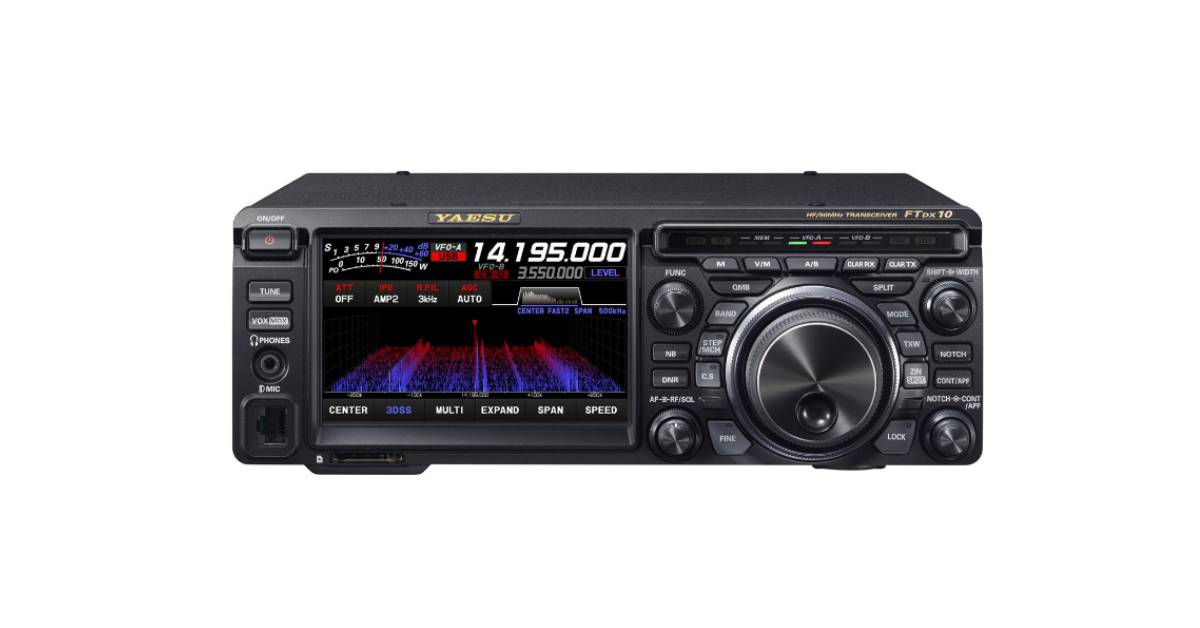
The front panel is dominated by a high-resolution color touchscreen that provides real-time spectrum and waterfall displays. This visual band awareness changes how operators interact with HF.
Instead of tuning blindly, signals appear instantly across the display. Operators can see activity, identify open frequencies, and move directly to stations of interest. During contests or DX hunting, this dramatically improves efficiency.
The display also provides intuitive access to filtering controls, operating parameters, and system settings, making advanced features easier to manage during real operation.
Audio Quality and On-Air Presence
Receive audio from the FTDX10 is clean, natural, and highly intelligible. Multiple audio shaping options allow operators to tailor sound for fatigue-free listening during long operating sessions.
Transmit audio is equally strong. The built-in equalization and speech processing systems produce clear, punchy modulation that cuts through crowded conditions without sounding harsh or over-processed.
For digital mode operators, the integrated USB interface simplifies computer connectivity by providing both audio and CAT control through a single cable. This makes setup fast and reliable.
Operating Experience and Ergonomics
Despite its advanced technology, the FTDX10 remains practical to operate. Controls are logically arranged, the tuning dial is smooth and precise, and commonly used adjustments are quickly accessible.
While the radio offers deep customization, daily operation becomes intuitive after a short learning period. Experienced operators will appreciate the level of control available, while newer users can grow into its advanced features over time.
Technical Performance Overview
The Yaesu FTDX10 covers HF and 6 meters with up to 100 watts of transmit power. It includes dual antenna inputs, a full-color touchscreen display, and integrated USB audio for digital operation. Internal digital signal processing manages filtering, noise reduction, and audio shaping with precision.
These capabilities combine to deliver performance typically associated with much higher-priced radios.
How It Compares in Its Class
Many operators compare the FTDX10 to premium contest-grade transceivers because of its receiver performance. While it does not include dual independent receivers like larger flagship models, its core signal handling ability is closely related.
For most operators, the FTDX10 provides an ideal balance between cost, size, and performance. It delivers advanced receiver technology without the complexity or price of top-tier contest stations.
Who the Yaesu FTDX10 Is Best For
The FTDX10 is best suited for operators who value receiver performance above all else. DX enthusiasts, contest operators, and serious HF users benefit most from its dynamic range and filtering precision.
It is also an excellent upgrade for operators moving from entry-level or mid-range HF radios who want a noticeable improvement in signal clarity and band awareness.
Operators who prioritize simplicity above all else may find more basic radios sufficient for casual operation. However, those who regularly encounter difficult band conditions often discover that higher receiver performance changes how effectively they can operate. Choosing a radio aligned with real operating demands is the key factor in long-term satisfaction.
Yaesu FTDX10 vs IC-7300
The Yaesu FTDX10 is frequently compared to the IC-7300 because both radios are popular HF transceivers in a similar price range. While both offer SDR-based technology and spectrum displays, their receiver designs differ significantly.
The IC-7300 uses direct sampling SDR architecture, which provides excellent band visualization and simplicity. The Yaesu FTDX10 uses a hybrid SDR design with a high-performance analog front end before digital processing. This gives the FTDX10 an advantage in strong signal handling and dynamic range, particularly in crowded band conditions.
Operators focused on contesting or weak signal DX often prefer the FTDX10 for its selectivity and resistance to overload. Operators who prioritize simplicity and ease of use often appreciate the IC-7300’s straightforward interface.
Both radios are highly capable, but the FTDX10 is generally considered more performance-focused, especially in demanding RF environments.
Is the Yaesu FTDX10 Worth the Upgrade?
For operators using entry-level or mid-range HF radios, upgrading to the FTDX10 can produce an immediate improvement in receiver clarity and band awareness. The difference is most noticeable when signals are weak, interference is present, or multiple strong stations occupy nearby frequencies.
Operators who primarily make casual contacts on quiet bands may not fully utilize the radio’s advanced capabilities. However, those who regularly operate DX, participate in contests, or work in high-noise environments often find the upgrade worthwhile.
The value of the FTDX10 ultimately comes from its receiver performance. For many operators, improved signal readability alone justifies the investment. Over time, improved signal readability and reduced listening fatigue often become more important than individual feature differences. Many operators find that consistent receiver performance during challenging conditions has a greater impact on operating enjoyment than additional convenience features.
Comparison Chart
| Category | Yaesu FTDX10 | Typical Mid-Range HF Radio |
|---|---|---|
| Weak Signal Readability | Excellent | Good |
| Strong Signal Handling | Excellent | Moderate |
| Crowded Band Operation | Excellent | Fair |
| Noise Reduction | Very High | Moderate |
| Filtering Precision | Very High | Good |
| Spectrum Scope | High | Moderate |
| Contest Performance | Excellent | Good |
| DX Capability | Excellent | Good |
| Listening Comfort | High | Moderate |
Final Verdict
The Yaesu FTDX10 is one of the strongest performers in its category. Its hybrid SDR architecture, exceptional receiver design, and real-time spectrum visibility make it a powerful tool for modern HF operation.
Rather than focusing on convenience features alone, Yaesu built the FTDX10 around performance where it matters most — signal handling, audio clarity, and operator control.
For amateur radio operators seeking a compact transceiver with flagship-class receiver capability, the Yaesu FTDX10 stands as one of the most compelling choices available today.
For operators who regularly face crowded bands, weak propagation, or demanding operating conditions, the performance advantages of the FTDX10 are not subtle — they are immediately apparent on the air.
This evaluation reflects receiver architecture design, published technical characteristics, and observed operating behavior across common amateur radio scenarios including DX operation, contest environments, and high-noise locations.
Yaesu FTDX10 Frequently Asked Questions
Is the Yaesu FTDX10 good for beginners?
It can be used by beginners, but it is designed primarily for operators who want advanced receiver performance and filtering control.
Does the FTDX10 have a built-in sound card?
Yes. The radio includes an integrated USB audio interface for digital modes and computer control.
How does the FTDX10 compare to higher-end Yaesu radios?
It shares receiver design technology with Yaesu flagship models but in a smaller, single-receiver format.
Is the Yaesu FTDX10 good for contesting?
Yes. Its dynamic range and filtering precision make it well suited for crowded contest environments.
Does the Yaesu FTDX10 have good dynamic range?
Yes. Its receiver design prioritizes strong signal handling and selectivity, which helps maintain clarity in crowded band conditions.
Is the FTDX10 suitable for high noise environments?
Yes. Its filtering precision and noise reduction systems help preserve intelligibility in electrically noisy locations.
What type of operator benefits most from the FTDX10?
Operators focused on DX, contesting, or weak signal work typically benefit most from its receiver performance.