

A 5/8 wave antenna stands out as one of the most efficient radiator designs used in HF, VHF, and especially CB and 2-meter/440-MHz applications. It offers higher performance than a standard 1/4 wave radiator.
It remains simple enough for mobile and base installations. Although it looks like a slightly longer vertical whip, its electrical behavior is what makes it powerful. Because of this, many operators choose it when they need stronger ground-wave coverage and improved signal penetration.
What a 5/8 Wave Antenna Is
A 5/8 wave antenna is a vertical radiator whose electrical length equals five-eighths of the operating wavelength. This length places it between the common 1/2-wave and 3/4-wave sizes.
Since its geometry shifts the current distribution upward from the feed-point, the antenna creates a more compressed radiation pattern. Consequently, it drives more RF energy toward the horizon instead of wasting power at high angles.
How a 5/8 Wave Antenna Works
The 5/8 wave design relies on a current peak located slightly above the feed-point. This peak encourages stronger low-angle radiation, which extends the ground-wave footprint. Although the antenna is slightly longer than a resonant 1/2 wave element, it still needs a matching network at its base.
Since its feed-point impedance sits far below 50 ohms, operators often use a coil, matching capacitor, or LC network to bring it to a usable value. As the matching network transforms the impedance upward, the antenna becomes stable, efficient, and easier to feed with coax. Furthermore, the extended radiator length increases current over a greater portion of the antenna, boosting overall field strength.
Gain and Radiation Performance
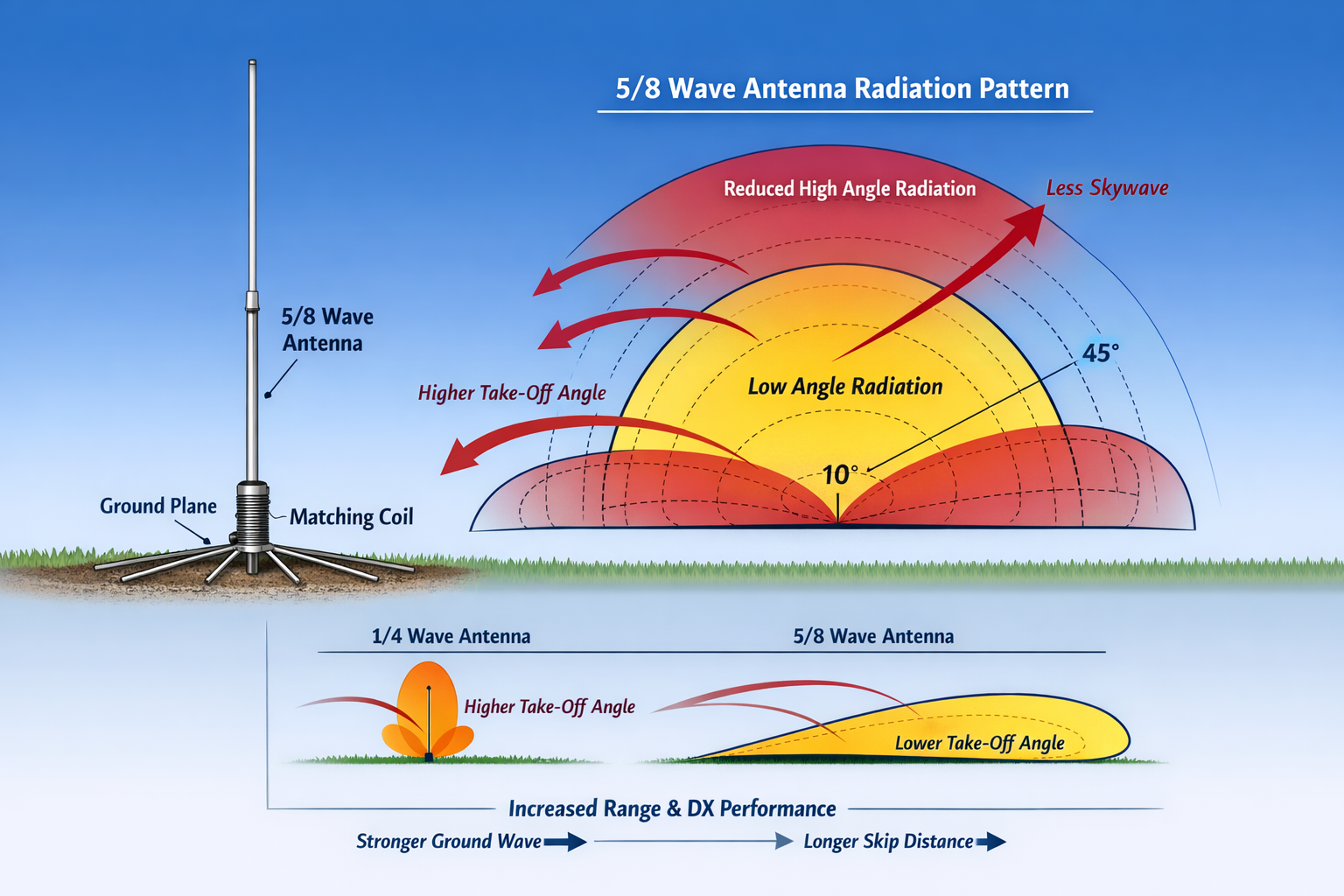
A properly tuned 5/8 wave antenna commonly achieves around 1 to 3 dB of gain over a typical 1/4 wave radiator. While this might seem small, it translates into noticeably stronger signals at distant points. Moreover, the design pushes most of its RF energy at low angles near the horizon.
Because of this feature, operators often see improved mobile range, better coverage in flat terrain, and more reliable local-to-regional communication. Although the antenna does not dramatically enhance high-angle radiation, it excels in point-to-point and repeater-style communication paths.
Specific Characteristics of the 5/8 Wave Design
A 5/8 wave antenna features several unique attributes that distinguish it from shorter verticals. First, it exhibits a feed-point impedance that typically ranges between 30 and 40 ohms before matching. Second, its physical length is about 0.625 wavelengths, though many practical versions include loading coils or top-hat capacitive elements to reduce size while maintaining electrical length.
Third, the antenna demands a proper ground plane or radials to perform at its best. Since current extends further up the radiator, inadequate grounding will cause loss, instability, or excessive SWR. Additionally, its radiation pattern stays narrow, enabling efficient signal launch toward the horizon.
Advantages of Using a 5/8 Wave Antenna
A 5/8 wave antenna provides several compelling advantages. For example, it offers increased gain without requiring bulky structures, making it ideal for mobile operations. Also, it handles moderate power levels while staying mechanically simple. As operators adjust its matching coil and ensure proper ground setup, the antenna produces stable SWR and reliable everyday performance.
Moreover, its low-angle radiation enhances DX potential on VHF and improves clarity on HF ground-wave paths. Even in urban environments, it often outperforms shorter antennas because it throws more energy through street-level reflections rather than upward into the sky.
Why a 5/8 Wave Is Good for DX
| Antenna Type | Typical Gain | Takeoff Angle | Best Use | | ———— | ————— | ————- | ————– | | 1/4 wave | baseline | medium | general mobile | | 1/2 wave | slightly higher | moderate | base stations | | 5/8 wave | +1–3 dB | very low | DX and range |A 5/8-wave vertical naturally produces very low takeoff angles often lower than a 1/4-wave. Low angles (5°–15°) are ideal for long-distance skip because they send more RF energy toward the horizon, allowing the ionosphere to bend that energy farther across the globe.
Because of this, a 5/8-wave vertical can outperform shorter verticals on DX paths, especially when mounted properly with a good ground system.
When It Helps Most
A 5/8-wave antenna performs well for DX under these conditions:
- You are operating on bands where verticals already perform well for DX, such as 10m, 11m (CB), 6m, and even 20m if built large enough.
- You have a good ground plane or radial system, since poor grounding will cancel most of the DX advantage.
- You’re working low-noise environments (rural or elevated locations), because verticals pick up more ground noise.
When a 5/8 Doesn’t Help Much
- If ground conductivity is poor and radials are insufficient, its low-angle advantage weakens.
- If noise levels are high, a vertical might hear worse than a horizontal antenna, reducing the real-world DX advantage.
- On NVIS bands (40m, 80m) where high-angle radiation is desired, the 5/8 wave is not useful for local or regional skip.
Real-World DX Performance
For CB and 10 meters, a well-built 5/8-wave base antenna often achieves:
- A stronger ground-wave signal
- Lower takeoff angles for better long-haul skip
- About 1–3 dB gain over a quarter-wave
That’s enough to make a noticeable difference on DX contacts.
Bottom Line
A 5/8 wave is one of the best vertical designs for DX, as long as it’s installed correctly with proper matching and grounding. Many operators choose it specifically because it pushes more RF along the horizon, where DX lives.
Why Many Operators Choose the 5/8 Wave Antenna
A 5/8 wave antenna strikes an excellent balance between size, efficiency, and directional performance. Although other antenna types offer more gain or broader bandwidth, few match its combination of simplicity and low-angle strength.
Therefore, it remains a go-to choice for CB users, mobile VHF operators, and hams who want dependable range with minimal complexity. As long as it is tuned correctly and mounted with a proper ground plane, the 5/8 wave antenna consistently delivers solid results and an extended communication footprint.
Please consider Donating to help support this channel