

A 5/8 wave antenna is a popular vertical antenna design used in amateur radio, CB, VHF, and other radio applications where low-angle radiation and extended horizontal coverage are desirable. Its electrical length is approximately five-eighths of a wavelength, giving it a different current distribution and radiation pattern from a conventional 1/4-wave vertical.
The 5/8 wave design is especially well known for producing a lower-angle radiation pattern than a shorter vertical when it is properly designed and installed. This can make it an effective choice for ground-wave coverage and, under suitable propagation conditions, longer-distance communication.
Although a 5/8 wave antenna is physically longer than a 1/4-wave antenna, the additional electrical length can provide useful radiation-pattern characteristics without requiring the more complicated construction associated with some high-gain vertical antenna designs.
New to antenna systems? See our Complete Guide to Ham Radio Antennas.
What Is a 5/8 Wave Antenna?
A 5/8 wave antenna is a vertical radiator with an electrical length of approximately five-eighths of the operating wavelength. The electrical length is about 0.625 wavelength, although practical antennas can use loading, matching networks, or other design techniques to achieve the required electrical characteristics without having a physically full 5/8-wavelength radiator.
The 5/8 wave design is commonly compared with 1/4-wave and 1/2-wave vertical antennas because each has a different current distribution and radiation pattern. The 5/8-wave configuration is particularly valued for its tendency to concentrate more radiation at lower elevation angles.
That characteristic is important when the objective is to send more of the transmitted signal toward the horizon rather than concentrating as much energy at higher elevation angles.
How Does It Work?
The performance of a 5/8-wave antenna comes largely from its current distribution and resulting radiation pattern. As the electrical length increases beyond a conventional 1/2-wave radiator, the current distribution changes and can produce stronger low-angle radiation when the antenna is properly designed.
The result is a radiation pattern that can place more energy toward the horizon than a typical 1/4-wave vertical. This is one reason 5/8-wave vertical antennas are popular for applications where horizontal coverage and lower takeoff angles are important.
A practical 5/8-wave antenna also requires an appropriate feed-point impedance and matching arrangement. Depending on the design, the feed-point impedance can be considerably different from the 50-ohm impedance expected by most coaxial feed lines, so a matching network may be required.
Antenna Radiation Pattern
The radiation pattern is one of the most important reasons operators choose a 5/8-wave vertical antenna. Compared with a typical 1/4-wave vertical, a properly designed 5/8-wave antenna can produce a flatter radiation pattern with more energy concentrated at lower elevation angles.
Lower-angle radiation can be useful for longer-distance communication because more of the radiated energy is directed toward the horizon. However, the actual radiation pattern depends on the antenna design, mounting height, ground system, surrounding objects, and installation environment.
A 5/8-wave antenna should therefore not be considered automatically superior simply because it is longer. Its advantage comes from how the electrical length, current distribution, ground system, and installation work together.
Antenna Gain
A 5/8-wave antenna can provide useful gain compared with a basic 1/4-wave vertical when the antennas are properly designed and compared under equivalent conditions. The exact amount of gain depends on the antenna construction, ground system, installation, losses, and the reference antenna used for the comparison.
Claims of a specific 1–3 dB gain should therefore be treated as typical design or comparison figures rather than a guaranteed performance increase. Two antennas with the same nominal electrical length can produce different results because their matching systems, conductors, ground systems, and installation environments are different.
The practical advantage of a 5/8-wave vertical is often its radiation pattern rather than simply a larger number on a gain specification. Concentrating more radiation toward the horizon can improve signal strength in the desired direction and may produce a useful coverage advantage.
Antenna Takeoff Angle
A lower takeoff angle means that more of the antenna’s radiation is directed closer to the horizon. This can be advantageous for longer-distance communication because the signal begins its path at a lower elevation angle.
A 5/8-wave vertical is commonly selected when low-angle radiation is desired. However, it is not accurate to assign one universal takeoff angle to every 5/8-wave antenna because the actual pattern changes with the antenna design, ground system, mounting height, nearby objects, and operating frequency.
The important point is that a properly designed 5/8-wave vertical can produce a lower-angle radiation pattern than a typical shorter vertical, making the design attractive for extended horizontal coverage.
5/8 Wave Antenna Feed-Point Impedance
The feed-point impedance of a 5/8-wave vertical can be significantly different from 50 ohms. Consequently, many practical designs use a matching network between the radiator and the coaxial feed line.
Depending on the antenna design, matching can involve a coil, capacitor, LC network, or another impedance-matching arrangement. The purpose of the matching network is to transform the antenna’s feed-point impedance into a value that can be efficiently transferred through the feed line.
A low SWR reading by itself does not prove that an antenna is highly efficient. Matching can reduce the apparent SWR while losses remain elsewhere in the antenna system. The radiator, matching network, ground system, and feed line all contribute to the overall performance of the installation.
Antenna Ground Plane
A proper ground plane or radial system can be extremely important when using a 5/8-wave vertical. The antenna and its return-current system work together, so an inadequate ground system can affect radiation efficiency, impedance, SWR, and the overall radiation pattern.
For a ground-mounted vertical, an appropriate radial system can provide the return path needed by the antenna. For mobile installations, the vehicle body provides much of the RF counterpoise.
This is why comparing two 5/8-wave antennas solely by the length of their radiators can be misleading. The ground system and installation can have a substantial effect on the results.
5/8 Wave vs 1/4 Wave
A 1/4-wave vertical is one of the simplest vertical antenna designs and is widely used for mobile and base applications. A 5/8-wave vertical uses a longer electrical radiator and can produce a lower-angle radiation pattern.
The 1/4-wave design is generally simpler, while the 5/8-wave design often requires additional matching because its feed-point characteristics are different.
For applications where low-angle radiation and extended horizontal coverage are priorities, the 5/8-wave design can provide an advantage. However, a properly installed 1/4-wave antenna can still perform extremely well, particularly when it has an effective ground plane and low-loss installation.
5/8 Wave vs 1/2 Wave
A 1/2-wave vertical and a 5/8-wave vertical have different current distributions and radiation patterns. A 1/2-wave design can have useful efficiency and may be easier to match depending on the particular construction.
The 5/8-wave design is often selected when the objective is to produce a lower-angle radiation pattern. However, the real-world difference depends heavily on installation conditions.
A well-installed 1/2-wave antenna can outperform a poorly installed 5/8-wave antenna. Antenna height, ground system, feed-line loss, nearby structures, and matching losses can all influence the final result.
Antenna for HF
A 5/8-wave can be used on HF, but its physical size increases rapidly as the wavelength becomes longer. For example, a true 5/8-wavelength radiator becomes considerably larger on the lower HF bands.
This makes the design more practical on higher-frequency HF bands such as 10 meters than on lower bands such as 40 or 80 meters, where a full 5/8-wave radiator can become physically large.
Loading and other antenna-design techniques can reduce the physical size, but electrically shortening an antenna can introduce additional losses and change its performance.
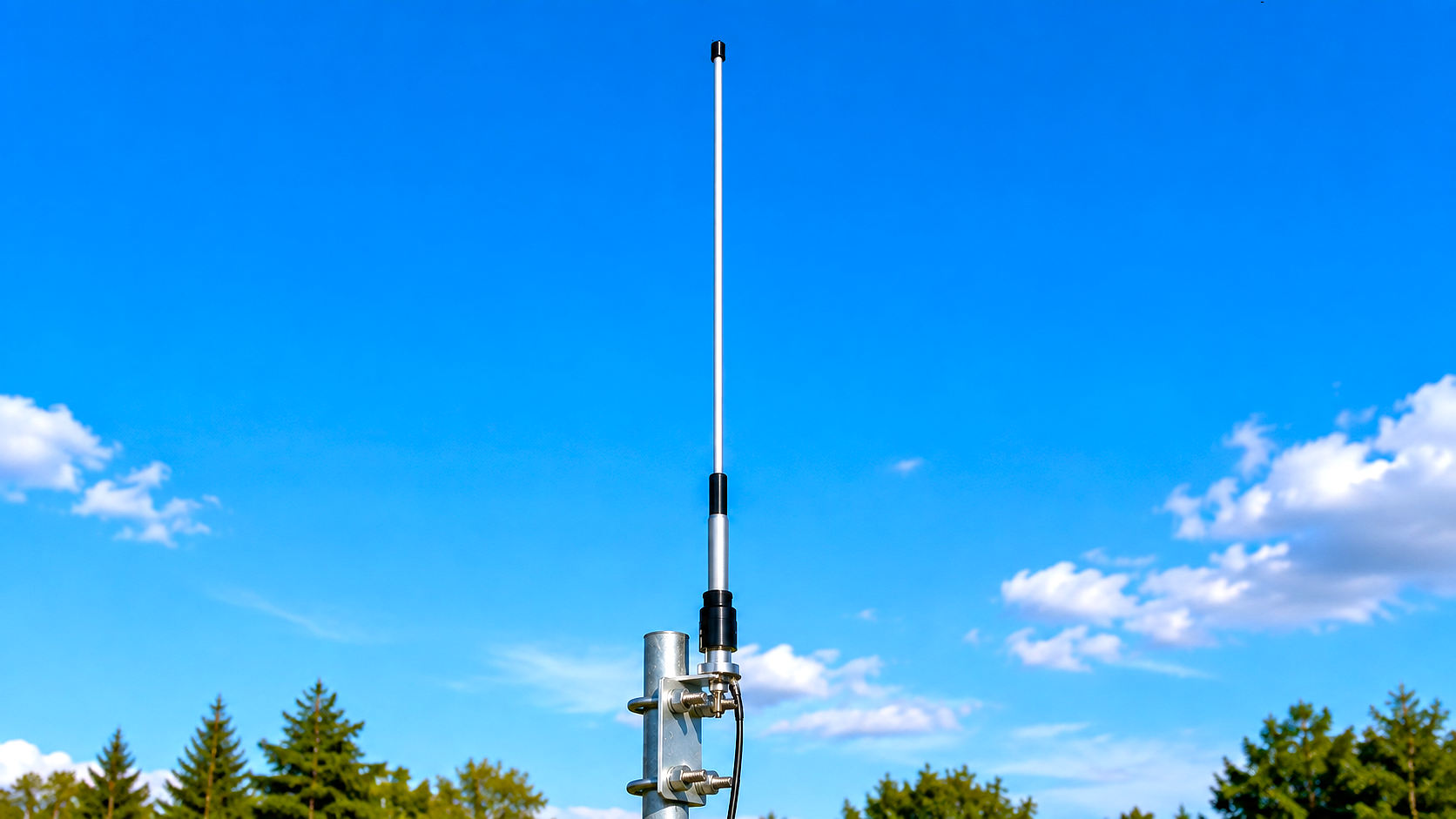
5/8 Wave for 10 Meters
The 10-meter band is particularly well suited to practical 5/8-wave vertical designs because the physical wavelength is short enough for the antenna to remain manageable.
A properly installed 5/8-wave vertical on 10 meters can provide a useful low-angle radiation pattern. When 10-meter propagation opens, this radiation pattern can be advantageous for longer-distance contacts.
However, 10-meter performance depends heavily on propagation. A highly efficient antenna cannot create propagation where none exists, so operators should consider solar activity, ionospheric conditions, time of day, and the desired path when evaluating performance.
5/8 Wave Antenna for 2 Meters
A 5/8-wave vertical is also commonly associated with the 2-meter band. At 144 MHz, the physical size of a 5/8-wave radiator is much more manageable than on the lower HF bands.
The lower-angle radiation characteristics can make the design useful for mobile and fixed-station applications where extended horizontal coverage is desired.
As with other antenna designs, installation height, ground-plane characteristics, coaxial feed-line loss, nearby structures, and the surrounding environment can have a major effect on actual performance.
5/8 Wave Antenna for 440 MHz
A 5/8-wave design can also be constructed for the 70-centimeter amateur radio band around 440 MHz. Because the wavelength is much shorter at this frequency, the physical radiator is relatively small.
At VHF and UHF, however, installation details become increasingly important. Nearby structures, mounting hardware, feed-line routing, and the antenna’s surrounding environment can influence the radiation pattern.
For repeater and mobile operation, the desired coverage pattern should be considered along with antenna gain and physical installation.
Why a 5/8 Wave Antenna Is Good for DX
A 5/8-wave vertical can be useful for DX because its radiation pattern can concentrate more energy at lower elevation angles. Lower-angle radiation can be advantageous for long-distance paths, particularly when the propagation path favors low-angle radiation.
However, a 5/8-wave antenna does not automatically guarantee better DX performance than every other antenna. DX performance depends on propagation, antenna efficiency, radiation pattern, height, ground system, polarization, feed-line loss, and the receiving station.
The primary reason to consider a 5/8-wave vertical for DX is therefore its radiation pattern and efficient use of the available RF energy toward the horizon.
5/8 Wave Antenna Comparison
| Antenna Type | General Radiation Characteristic | Typical Application |
|---|---|---|
| 1/4 wave | Broad vertical coverage with moderate elevation angles | Mobile and base |
| 1/2 wave | Useful vertical radiation with different current distribution | Base and fixed stations |
| 5/8 wave | Strong low-angle radiation when properly designed | Extended coverage and DX |
These descriptions are general. Actual performance depends on antenna construction, ground system, mounting height, surroundings, and operating frequency.
Advantages of a 5/8 Wave Antenna
A 5/8-wave antenna offers several potential advantages when properly designed and installed. Its longer electrical length can produce a favorable low-angle radiation pattern, which can be useful for extended ground-wave coverage and longer-distance communication.
The design can also provide a practical compromise between physical size and performance on bands where a 5/8-wave radiator remains manageable. This is one reason the design appears in mobile, base, CB, VHF, and amateur radio antenna applications.
Another advantage is that the design remains relatively straightforward compared with some more complex high-gain vertical antenna systems.
Limitations of a 5/8 Wave Antenna
This antenna is not automatically the best antenna for every installation. Its physical length can become impractical on lower-frequency HF bands, and the feed-point impedance can require a matching network.
The antenna also depends on an effective ground or radial system when the design requires one. Poor grounding, excessive feed-line loss, nearby structures, and incorrect tuning can reduce the expected performance.
A low takeoff angle is not always desirable either. For short-range or regional communication where high-angle radiation is useful, another antenna design may provide better results.
When a 5/8 Wave Helps Most
Its most attractive when low-angle radiation and extended horizontal coverage are important. It can be particularly useful on bands where the physical size remains practical and where the propagation conditions support the desired communication path.
A good ground plane or radial system is also important. The antenna should be properly matched, the feed line should have low loss, and the installation should be kept as clear of nearby conductive objects as practical.
For DX operation, the combination of low-angle radiation and favorable propagation can make a 5/8-wave vertical an effective antenna choice.
When a 5/8 Wave Does Not Help Much
A 5/8-wave may provide little practical advantage when the installation has a poor ground system, excessive feed-line loss, severe local noise, or significant nearby obstructions.
It is also not necessarily the ideal choice for NVIS operation. NVIS relies on high-angle radiation, while the primary advantage of a properly designed 5/8-wave vertical is its tendency toward lower-angle radiation.
The antenna must therefore be matched to the operating objective. More electrical length does not automatically mean better performance in every situation.
Real-World 5/8 Wave Performance
The real-world performance of a 5/8-wave depends on much more than its advertised electrical length. The radiator, matching system, ground plane, radial system, feed line, mounting height, surrounding objects, and propagation conditions all contribute to what an operator hears and how well the station is heard.
A well-built and properly installed 5/8-wave vertical can provide strong horizontal coverage and useful low-angle radiation. However, an inefficient installation can erase much of the potential advantage.
This is why antenna comparisons should be made under similar conditions whenever possible. Comparing antennas at different heights, with different ground systems, or under different propagation conditions can produce misleading conclusions.
How to Tune a 5/8 Wave Antenna
Tuning a 5/8-wave involves more than simply adjusting the radiator until the SWR reaches a low value. The matching network and radiator must work together to present a suitable impedance to the feed line.
Start by following the antenna manufacturer’s or design-specific tuning procedure. Use an SWR meter or antenna analyzer to determine how the antenna behaves across the intended operating frequency range.
A low SWR is useful because it indicates that the antenna system is reasonably matched to the feed line, but it should not be treated as a direct measurement of radiation efficiency. An antenna can show low SWR while still having losses in the matching network, conductors, ground system, or feed line.
5/8 Wave Antenna and SWR
SWR is an important measurement when installing and tuning a 5/8-wave antenna. The goal is to provide an appropriate impedance match between the antenna system and the coaxial feed line.
A high SWR can indicate incorrect tuning, an unsuitable matching network, damaged feed line, poor connections, or another problem in the antenna system. Correcting the underlying problem is more useful than simply attempting to force the SWR lower.
When testing a 5/8-wave antenna, measure the system across the intended operating frequency range rather than checking only one frequency.
5/8 Wave Antenna and Ground Radials
Ground radials can have a significant effect on the performance of a vertical 5/8-wave antenna. They provide an RF return path and help establish the electrical environment in which the radiator operates.
The number, length, arrangement, and installation of radials can affect the antenna system. Consequently, a 5/8-wave radiator should not be evaluated independently of its ground system.
For a mobile antenna, the vehicle body serves as an important part of the RF counterpoise. For a base installation, the ground system may consist of radials or another appropriate counterpoise arrangement.
Is a 5/8 Wave Antenna Better Than a 1/4 Wave?
A 5/8-wave antenna can provide a lower-angle radiation pattern than a typical 1/4-wave vertical, which can be useful for extended coverage and DX. However, “better” depends on the application and installation.
A 1/4-wave antenna is simpler and can be extremely effective when installed with a good ground system. A 5/8-wave antenna may provide an advantage when its lower-angle radiation pattern matches the desired communication path.
The best antenna is therefore the one that produces the radiation pattern, efficiency, physical size, and installation characteristics required for the specific application.
5/8 Wave Antenna: Final Assessment
A 5/8-wave antenna remains a popular vertical design because it can combine a practical physical structure with a favorable low-angle radiation pattern. It is especially useful on bands where the physical length remains manageable and where extended horizontal coverage or DX operation is important.
Its performance should not be judged by electrical length alone. Proper matching, an effective ground system, low-loss feed line, installation height, surrounding objects, and propagation conditions all determine how much of the antenna’s potential performance reaches the real world.
For operators who want a vertical antenna with a strong low-angle radiation characteristic, the 5/8-wave design is an option worth considering. When properly designed, tuned, and installed, it can provide an effective combination of coverage, efficiency, and practical construction.
Frequently Asked Questions About 5/8 Wave Antennas
What Is a 5/8 Wave Antenna?
A 5/8-wave antenna is a radiator with an electrical length of approximately five-eighths of a wavelength. The design is commonly used as a vertical antenna because it can produce a favorable low-angle radiation pattern.
How Long Is a 5/8 Wave Antenna?
A 5/8-wave antenna has an electrical length of approximately 0.625 wavelength. The physical length can differ from this because practical antennas may use loading, matching networks, or other techniques to achieve the desired electrical characteristics.
Does a 5/8 Wave Have More Gain Than a 1/4 Wave?
A properly designed 5/8-wave vertical can provide useful gain compared with a 1/4-wave vertical under comparable conditions. The actual difference depends on the antenna design, ground system, installation, and reference used for the comparison.
Is a 5/8 Wave Good for DX?
A 5/8-wave vertical can be useful for DX because its radiation pattern can concentrate more energy at lower elevation angles. Actual DX performance still depends heavily on propagation and the complete antenna installation.
Yes. Ten meters is well suited to practical 5/8-wave vertical designs because the wavelength is short enough to make the physical antenna manageable. When 10-meter propagation is favorable, the low-angle radiation can be useful for long-distance communication.
Is a 5/8 Wave Antenna Good for 2 Meters?
A 5/8-wave vertical can be useful on 2 meters, particularly for applications where extended horizontal coverage is desired. Installation height, ground-plane characteristics, and the surrounding environment affect the actual radiation pattern.
Does a 5/8 Wave Antenna Need a Ground Plane?
Many vertical 5/8-wave designs benefit from an effective ground plane or radial system. The exact requirement depends on the antenna design and installation.
Does a 5/8 Wave Antenna Need a Matching Network?
Many practical 5/8-wave verticals require impedance matching because the feed-point impedance may not be close to 50 ohms. The specific matching arrangement depends on the antenna design.
What Is the Takeoff Angle of a 5/8 Wave Antenna?
There is no single takeoff angle that applies to every 5/8-wave antenna. The actual radiation pattern depends on the antenna design, ground system, mounting height, surroundings, and operating frequency.
Is a 5/8 Wave Antenna Good for NVIS?
A 5/8-wave vertical is generally not the first choice when high-angle NVIS radiation is the objective. Its primary advantage is lower-angle radiation, while NVIS depends on high-angle radiation toward the ionosphere.
Please consider Donating to help support this channel