
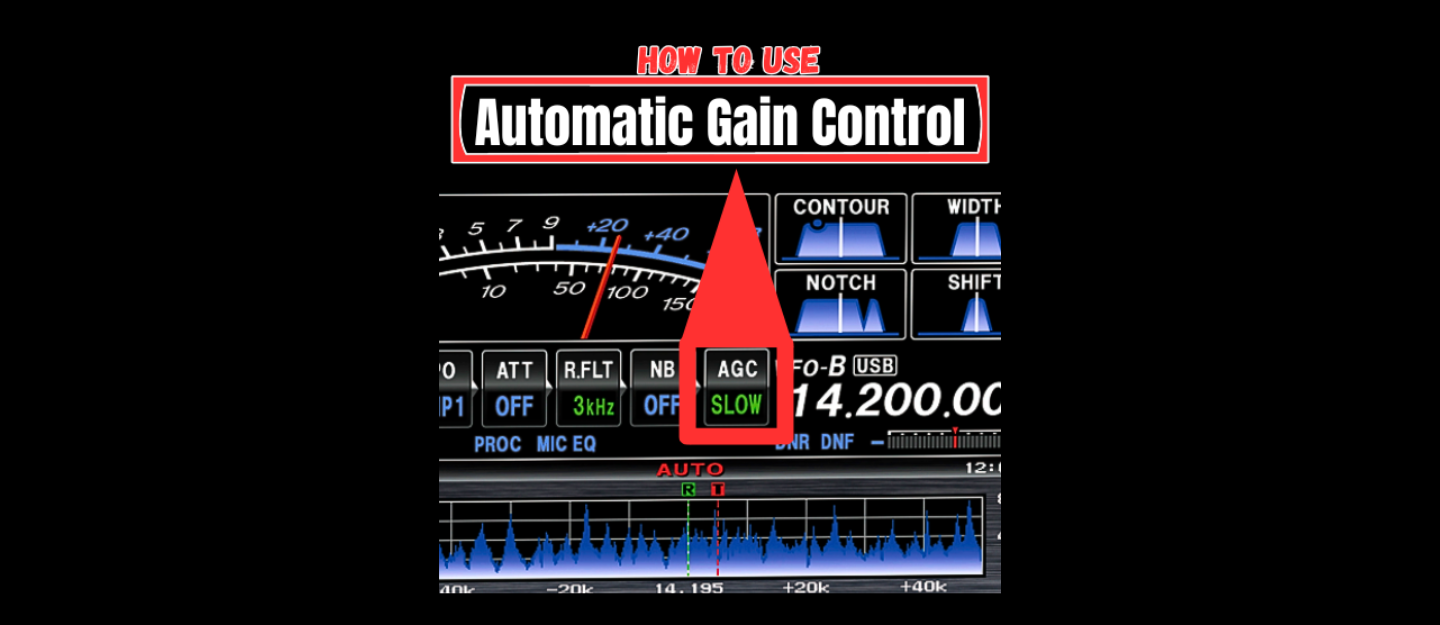
Automatic Gain Control, commonly abbreviated as AGC, is a critical function in modern ham radio receivers. Radio signals received on amateur bands are rarely stable. Signal strength can change rapidly due to atmospheric conditions, ionospheric propagation, fading, interference, and differences in transmitter power between stations. Without some form of automatic gain regulation, strong signals could overload the receiver’s audio stages while weak signals might become difficult or impossible to hear.
To solve this problem, radio designers incorporate Automatic Gain Control circuits that constantly monitor incoming signal strength and adjust receiver amplification accordingly. The purpose of AGC is to maintain consistent audio output even when signals vary dramatically. When configured properly, AGC allows the operator to listen comfortably without constantly adjusting receiver controls. Understanding how AGC works and how to optimize its behavior is an important skill for amateur radio operators who want the best possible receiver performance.
Understanding how to properly adjust receiver settings can dramatically improve signal clarity and reduce interference. If you want a deeper explanation of controls like RF gain, squelch, AGC, and bandwidth filters, see the
Complete Guide to Receiver Controls, where each control is explained in detail with practical tuning examples.
What Is Automatic Gain Control
Automatic Gain Control is an electronic feedback system used in radio receivers to regulate amplification levels based on signal strength. The goal of AGC is to maintain a relatively stable audio output even when incoming signals vary widely in amplitude. This automatic regulation prevents very strong signals from overwhelming the receiver while simultaneously allowing weak signals to remain audible.
In a typical receiver design, the AGC system monitors the amplitude of the detected signal and generates a control voltage that adjusts the gain of earlier amplifier stages. When a strong signal is received, the AGC circuit reduces gain so that the audio output does not become excessively loud or distorted. When the signal becomes weak, the AGC increases the receiver’s amplification so that the signal remains readable.
AGC circuits are used not only in amateur radio equipment but also in broadcast receivers, shortwave radios, communication receivers, and professional monitoring equipment. In all of these systems, the purpose is the same: stabilize signal levels so the operator or listener experiences consistent audio output regardless of variations in signal strength.
Why AGC Is Important in Ham Radio
Signal strength variations are extremely common in amateur radio communication. HF signals often travel thousands of miles by reflecting from the ionosphere, and during this process the signal may weaken, strengthen, or fade unpredictably. Nearby stations may also transmit with significantly higher power levels, which can cause sudden increases in signal strength at the receiver.
Automatic Gain Control helps the receiver handle these fluctuations smoothly. Without AGC, operators would need to constantly adjust RF gain or audio gain controls to keep signals at a comfortable listening level. This manual adjustment would be difficult during busy operating conditions such as contests, pileups, or DX operations.
AGC also protects receiver circuits from overload. Very strong signals can drive amplifier stages into distortion if gain is not reduced quickly enough. By automatically reducing gain when strong signals appear, AGC preserves signal quality and prevents harsh audio spikes.
In practical operating conditions, AGC allows amateur radio operators to concentrate on communication rather than constantly adjusting receiver controls. This improves overall operating efficiency and reduces listening fatigue during long operating sessions.
How Automatic Gain Control Works
The operation of AGC involves several stages of signal monitoring and feedback within the receiver. First, the radio detects the amplitude of the incoming signal after the detection stage of the receiver. This signal measurement allows the AGC system to determine whether the received signal is weak, moderate, or strong.
Once the signal level is measured, the AGC circuit generates a control voltage proportional to the strength of the detected signal. This voltage is then fed back into earlier amplifier stages, typically within the intermediate frequency (IF) amplifier or radio frequency (RF) amplifier stages of the receiver.
If the incoming signal is strong, the AGC voltage reduces the gain of these amplifiers, preventing overload and maintaining stable audio output. If the signal becomes weak, the AGC system reduces the control voltage and allows the receiver gain to increase. This ensures that weak signals remain audible even when propagation conditions are poor.
The entire process occurs continuously and automatically while the receiver operates. Because AGC operates as a feedback system, it can respond rapidly to changes in signal strength and stabilize audio levels in real time.
AGC Speed Settings: Fast, Medium, and Slow
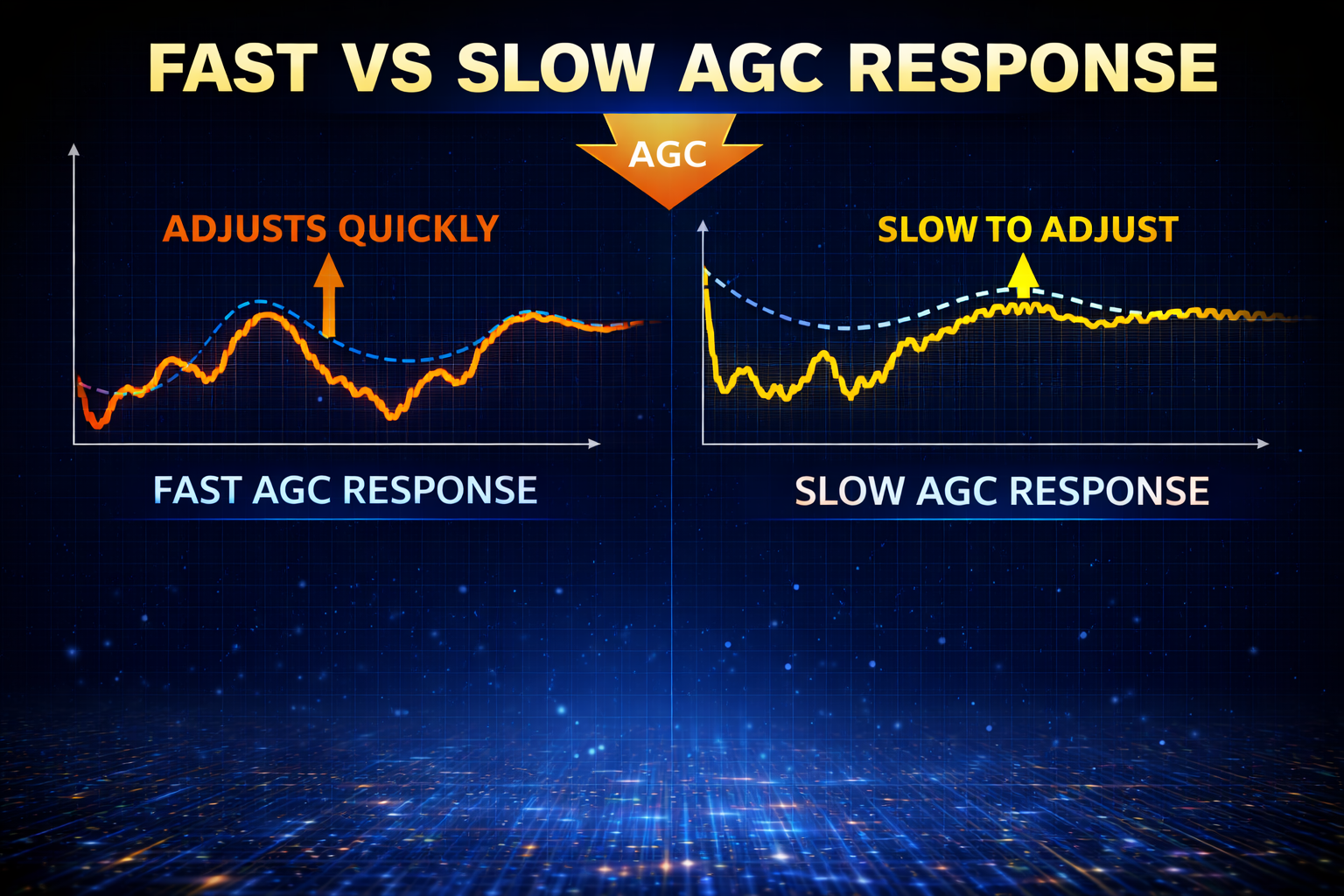
Most modern amateur radio transceivers provide selectable AGC speed settings that determine how quickly the receiver responds to changes in signal strength. These settings typically include fast, medium, and slow AGC options. Each setting affects how quickly the AGC system reacts to sudden signal increases and how gradually it restores gain after signals disappear.
Fast AGC reacts almost immediately when a strong signal appears. This prevents sudden loud bursts of audio from reaching the speaker. Fast AGC is particularly useful for Morse code (CW) and certain digital modes where signal levels can change rapidly between transmissions. The quick response helps protect the operator from sharp audio spikes and keeps the receiver stable in fast-paced operating environments.
Slow AGC responds more gradually to signal changes. This means that the receiver gain does not immediately increase or decrease with every minor fluctuation in signal strength. Slow AGC is often preferred for single sideband (SSB) voice communication because it provides smoother audio levels and prevents background noise from rapidly rising during pauses in speech.
Medium AGC represents a compromise between the two extremes. Many operators use medium AGC as a general-purpose setting when band conditions are moderate and both voice and CW signals may be present.
AGC Attack Time and Decay Time
Two important parameters influence the behavior of Automatic Gain Control systems: attack time and decay time. These parameters determine how quickly the AGC system reacts to signal changes and how long the gain remains reduced after a strong signal disappears.
Attack time refers to how quickly the AGC system reduces receiver gain when a strong signal suddenly appears. Short attack times allow the receiver to react quickly and prevent overload or loud audio bursts. This is especially important when strong stations suddenly appear on frequency.
Decay time refers to how quickly the receiver restores gain after a strong signal disappears. If the decay time is too short, background noise may increase rapidly between transmissions, creating a pumping effect where the noise level rises and falls abruptly. If the decay time is too long, weak signals may remain suppressed for longer than necessary.
Well-designed AGC systems balance attack and decay times so that the receiver responds quickly to strong signals while still maintaining stable audio levels during normal operation.
Improvements in Modern Radios
Modern amateur radio equipment has greatly improved AGC performance through the use of digital signal processing (DSP). Earlier analog receivers relied on relatively simple AGC circuits that sometimes introduced distortion or reacted too slowly to sudden signal changes.
DSP-based receivers can analyze signal levels more accurately and apply sophisticated algorithms to regulate gain. These digital systems allow manufacturers to design AGC responses that adapt more intelligently to varying signal environments.
Many DSP receivers also incorporate noise reduction, dynamic filtering, and adaptive gain control techniques that work alongside AGC to improve signal clarity. These improvements allow modern radios to maintain stable audio output even in extremely crowded band conditions.
As digital signal processing technology continues to evolve, AGC performance in amateur radio receivers will likely continue improving, providing better weak-signal readability and greater resistance to interference.
AGC in Software Defined Radios
Software Defined Radios, commonly known as SDRs, provide some of the most flexible AGC systems available in modern radio equipment. Because SDR receivers process signals entirely in software, AGC behavior can be adjusted with far greater precision than in traditional hardware-based receivers.
Many SDR programs allow operators to modify parameters such as attack time, decay time, threshold levels, and maximum gain limits. These adjustments allow the user to tailor the receiver response to specific operating conditions or personal listening preferences.
Some SDR software also provides graphical displays showing real-time AGC activity. These visual indicators help operators understand how the receiver is responding to signal variations and make it easier to fine-tune AGC performance.
This level of customization allows experienced operators to optimize reception for weak signals, crowded bands, or digital communication modes where precise gain control is especially important.
AGC Versus RF Gain
AGC and RF gain are closely related receiver controls, but they perform different functions. It operates automatically to regulate receiver gain based on signal strength, while RF gain allows the operator to manually limit receiver sensitivity.
In certain situations, strong nearby signals may trigger the AGC system and reduce gain so much that weaker stations become difficult to hear. By reducing RF gain manually, operators can prevent extremely strong signals from dominating the receiver.
This technique is particularly useful during contests or pileups where many strong stations may be transmitting simultaneously. By adjusting RF gain in combination with AGC settings, operators can often improve weak-signal reception and reduce interference from nearby stations.
Understanding how AGC and RF gain interact allows operators to achieve better receiver performance under challenging band conditions.
Using AGC During DX Operation
DX operation often involves attempting to copy extremely weak signals from distant stations. These signals may fade rapidly due to propagation effects, making consistent audio levels difficult to maintain.
Slow AGC settings are often preferred for DX operation because they allow the receiver to maintain stable gain during fading conditions. When signals fade briefly due to ionospheric changes, slow AGC prevents the receiver from rapidly increasing noise levels during those short fades.
Many experienced DX operators also adjust RF gain slightly when working weak signals. By limiting the receiver’s sensitivity to very strong nearby signals, they prevent AGC from overreacting and suppressing weak DX stations.
Careful adjustment of AGC settings can make the difference between copying a marginal signal and losing it completely during weak propagation conditions.
AGC Performance During Contests and Pileups
Contesting and pileup conditions create extremely challenging environments for radio receivers. Dozens or even hundreds of stations may transmit on or near the same frequency, producing rapidly changing signal levels.
Fast AGC settings are often preferred in these situations because they allow the receiver to react quickly when strong signals appear. This prevents sudden loud bursts of audio from overwhelming the operator and helps maintain a more controlled listening environment.
However, excessive AGC action can sometimes suppress weaker signals when strong stations transmit nearby. Operators may need to experiment with AGC speed and RF gain adjustments to maintain the best balance between overload protection and weak-signal sensitivity.
Experienced contest operators often develop preferred AGC configurations that work well for their specific radios and operating styles.
How AGC Handles Signal Fading
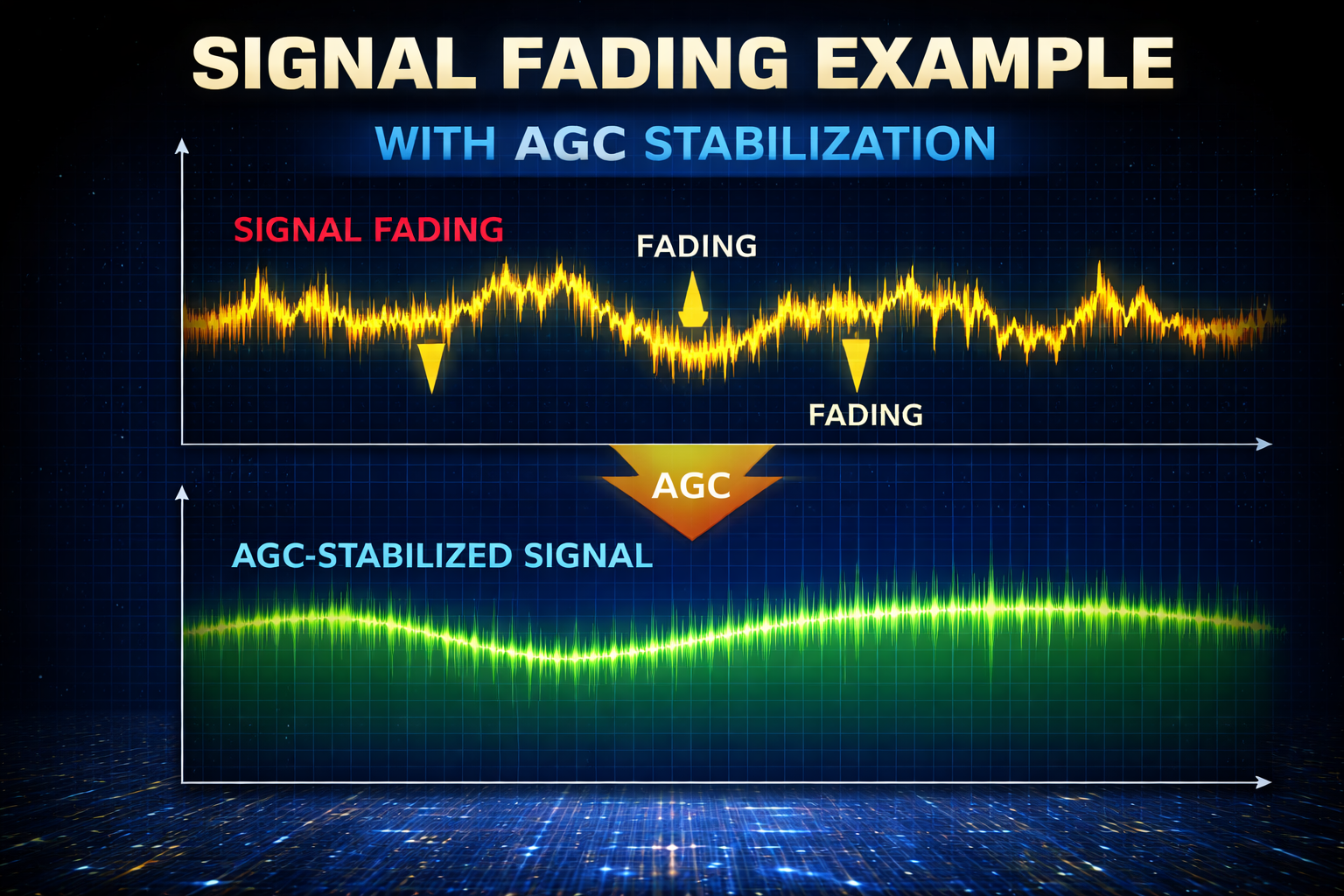
One of the most important tasks performed by AGC is compensating for signal fading, commonly known as QSB. This phenomenon occurs when ionospheric propagation causes signal strength to fluctuate over time.
Without AGC, fading signals would cause dramatic variations in audio level, making communication difficult and uncomfortable to listen to. AGC helps smooth out these variations by increasing gain when signals weaken and reducing gain when signals strengthen.
Proper AGC operation can significantly improve signal readability during fading conditions. By maintaining stable audio levels, AGC allows operators to continue copying signals even when propagation conditions are unstable.
Tips for Optimizing AGC Settings
Optimizing AGC settings can greatly improve receiver performance and listening comfort. Operators should experiment with different AGC speeds and RF gain levels to determine which settings work best under various band conditions.
Choosing the correct AGC speed for the operating mode is an important first step. Fast AGC is generally preferred for CW and digital modes, while slower settings often provide smoother audio for SSB voice communication.
Operators should also monitor how the receiver responds to strong nearby signals. If strong stations repeatedly trigger excessive AGC reduction, adjusting RF gain or AGC threshold settings may improve weak-signal reception.
Careful observation of receiver behavior allows operators to fine-tune AGC performance for optimal results.
Limitations of Automatic Gain Control
Although AGC provides many benefits, it also has limitations. In some situations, strong nearby signals may cause the AGC system to reduce gain so much that weak stations become difficult to hear.
Another potential issue is noise pumping, where background noise increases rapidly during pauses between transmissions. This effect occurs when AGC restores gain too quickly after a signal disappears.
Modern DSP-based receivers have reduced many of these problems, but no AGC system can completely eliminate the challenges of crowded band conditions and rapidly varying signal strengths.
Understanding these limitations helps operators make better use of receiver controls and maintain optimal listening conditions.
The Future of AGC Technology
Advances in digital signal processing continue to improve AGC performance in modern radio receivers. New algorithms allow radios to analyze signal characteristics more intelligently and adjust gain in ways that minimize distortion and improve weak-signal readability.
Future radios may incorporate adaptive AGC systems that automatically analyze band conditions and adjust response characteristics in real time. Machine learning techniques could eventually allow receivers to identify specific signal types and optimize AGC parameters accordingly.
These technological developments will likely continue improving receiver performance and making weak-signal communication easier for amateur radio operators.
About the Author
Vince, W2KU, is a licensed Extra class amateur radio operator and the founder of Ham Shack Reviews. He was named Amateur of the Year in 2026 for contributions to practical amateur radio education and equipment evaluation.
He primarily operates HF, knows propagation very well, operates mobile and handhelds daily. Vince exchanges QSL cards for DXCC, contest confirmation, and award tracking and is the club QSL manager. His guidance focuses on practical operating procedures, accurate logging, and real-world amateur radio practices.
Frequently Asked Questions
What does AGC stand for in ham radio?
AGC stands for Automatic Gain Control. It is a receiver system that automatically adjusts amplification levels to maintain consistent audio output despite variations in signal strength.
Should AGC be set to fast or slow?
Fast AGC is generally better for CW and digital modes where signals change rapidly, while slow AGC is often preferred for SSB voice communication because it provides smoother audio levels.
Does AGC improve weak signal reception?
AGC helps maintain consistent audio levels, but improper AGC settings can sometimes reduce receiver sensitivity if strong nearby signals trigger excessive gain reduction.
What is AGC attack time?
Attack time refers to how quickly the AGC system reduces receiver gain when a strong signal suddenly appears.
What is AGC decay time?
Decay time determines how quickly the receiver restores gain after a strong signal disappears.
Can AGC settings be adjusted in SDR radios?
Yes. Many Software Defined Radios allow detailed adjustment of AGC parameters such as attack time, decay time, gain limits, and threshold levels. These settings allow operators to fine-tune receiver performance for specific operating conditions.
Please consider Donating to help support this channel