
Complete Guide to Ham Radio Accessories
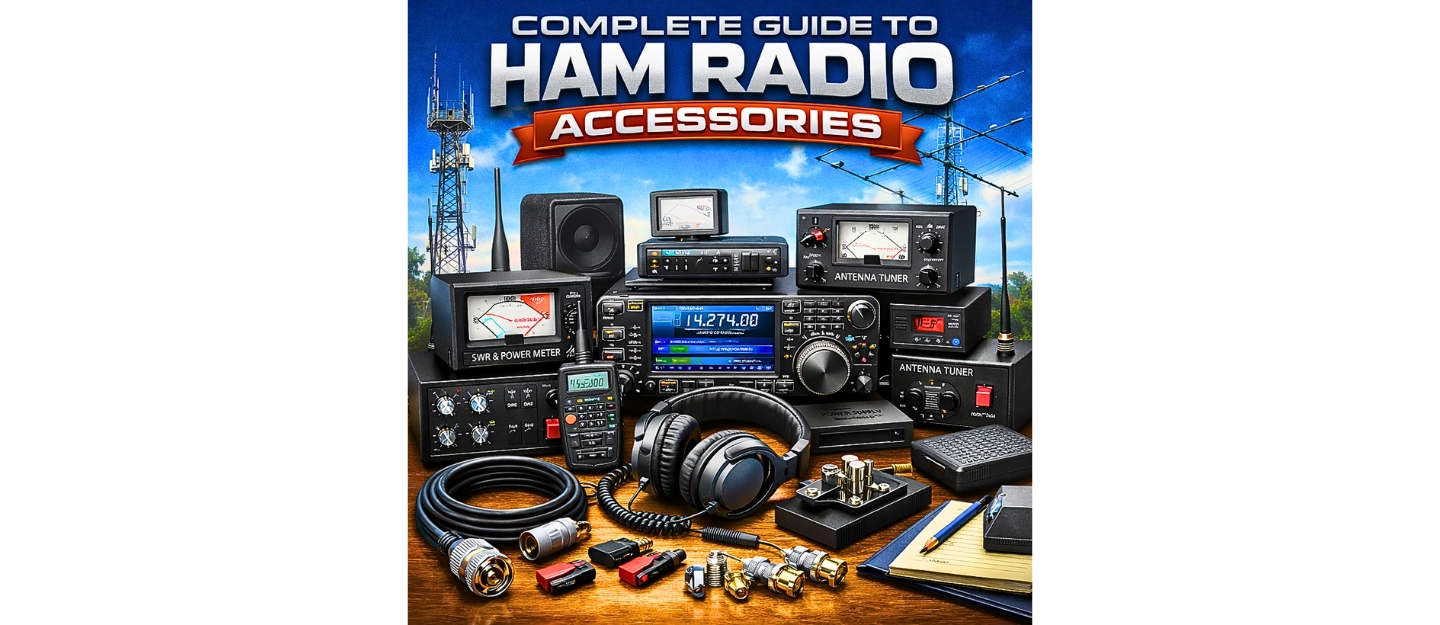
Complete Guide to Ham Radio Accessories, they are the supporting components that make a station practical, efficient, and comfortable to operate. While transceivers generate signals and antennas radiate them, accessories enhance usability, improve performance, and expand station capability. Many operating improvements come not from major equipment upgrades but from the right supporting accessories.
Accessories include power supplies, coaxial cables, connectors, mounting hardware, audio equipment, control interfaces, and operating aids. These components help deliver clean power, maintain signal integrity, improve ergonomics, and simplify everyday operation. Understanding what accessories do and how they integrate into a station allows operators to build systems that are reliable, flexible, and easy to maintain.
(adsbygoogle = window.adsbygoogle || []).push({});Complete Guide to Ham Radio Accessories: Why Accessories Matter
A radio station is a complete system. Performance depends on how well each part connects and operates with the others. Poor cables, unstable power, or inadequate mounting hardware can reduce signal quality or cause intermittent failures. Well-selected accessories ensure dependable operation and consistent results.
Accessories improve:
- power stability
- signal transfer efficiency
- operator comfort
- equipment protection
- installation reliability
Small improvements in these areas often produce noticeable gains in station performance.
Power Supplies
Power supplies provide stable DC voltage to transceivers and other equipment. Clean, regulated power prevents noise, protects electronics, and ensures consistent transmitter output.
Linear power supplies offer low noise and excellent stability, while switching supplies are compact and efficient. Choosing the correct power capacity and regulation quality is essential for safe operation.
Coaxial Cable and Feedline Components
Coaxial cable carries RF energy between the transmitter and antenna. Cable type, length, and quality affect signal loss and efficiency. Connectors, adapters, and grounding components are equally important for maintaining reliable electrical contact.
Proper feedline selection minimizes loss, reduces interference, and supports long-term reliability.
Connectors and Adapters
Different equipment uses different connector types. Adapters allow compatibility between components, while high-quality connectors ensure secure electrical connections.
Reliable connectors reduce signal loss and prevent intermittent faults that are difficult to diagnose.
Microphone and Audio Accessories
Audio accessories improve transmit clarity and operating comfort. These include headsets, external speakers, audio processors, and foot switches. Proper audio equipment enhances communication quality and reduces operator fatigue during long sessions.
Mounting and Installation Hardware
Antennas, radios, and accessories require stable physical installation. Mounts, brackets, cable supports, and weatherproofing materials ensure safe and durable placement.
Proper mechanical support protects equipment and maintains consistent electrical performance.
Power Distribution and Protection

Multiple devices often share a single power source. Distribution panels organize connections and provide fused protection. Surge protectors and grounding systems protect equipment from electrical faults and environmental hazards.
SWR Meter
An SWR meter is one of the most important diagnostic tools in any ham radio station. It measures Standing Wave Ratio (SWR), which tells you how efficiently RF power is being transferred from your transmitter into the antenna system. When power flows cleanly into the antenna and radiates outward, SWR is low. When power reflects back toward the radio due to mismatch or system problems, SWR rises.
In simple terms, the SWR meter shows whether your transmitter and antenna are properly matched. A perfect match is 1:1, meaning all power moves forward with no reflection. In real operation, anything around 1.5:1 or lower is considered excellent, and most modern radios operate safely up to about 2:1. Higher readings indicate wasted power, reduced signal strength, and potential stress on your transmitter’s output stage.
SWR meters are typically installed in line between the radio and the feedline, allowing you to monitor performance while transmitting. Some radios include built-in SWR metering, but external meters often provide more precise readings and easier monitoring during antenna tuning. Many operators use them when installing new antennas, adjusting antenna length, checking feedline integrity, or troubleshooting sudden performance changes.
High SWR can result from several common issues, including incorrect antenna length, poor feedline connections, damaged coax, water intrusion, or operating an antenna outside its designed frequency range. By watching the SWR meter while making adjustments, you can quickly identify problems and tune the system for maximum efficiency.
Antenna Switches
An antenna switch allows you to connect multiple antennas to a single radio, or route one antenna to different radios, without constantly disconnecting coax cables. It provides a fast, convenient, and safe way to select the antenna best suited for the band, mode, or operating conditions you’re using at the moment.
Most antenna switches are installed between the radio and your antenna feedlines, using a simple selector knob or lever to choose the active antenna. For example, you might switch between a dipole for HF, a vertical for DX work, and a beam for directional gain. Instead of physically reconnecting cables, you just turn the switch to the desired position.
Antenna switches also help protect your equipment and simplify station management. Quality switches are designed to handle specific power levels and frequencies, maintaining proper impedance while minimizing signal loss. Many models include grounding positions or isolation between ports, which can reduce interference and improve safety when antennas are not in use.
There are several common types of antenna switches. Manual coax switches are the most widely used and are reliable, simple, and affordable. Remote switches allow you to select antennas located outside or at tower height without leaving the operating position. Automatic switching systems are often used in more complex stations where multiple radios or operating positions share antenna resources.
CW Keys
Continuous Wave (CW) communication remains one of the most efficient and reliable operating modes in amateur radio. At the heart of CW operation is the CW key, the device used by an operator to manually generate Morse code signals. Even though modern radios include advanced digital modes and voice communication capabilities, operators continue to use CW widely because it communicates effectively with very low power and weak signals. A well-chosen CW key can significantly improve sending accuracy, comfort, and operating speed.
Amateur radio operators use several types of CW keys, each offering a different sending technique and learning curve. Instructors often recommend traditional straight keys for beginners because they reinforce proper timing and rhythm when learning Morse code.However, many experienced operators prefer paddle keys used with electronic keyers, which allow faster and more precise sending.
Common types of CW keys include:
• Straight Keys – The traditional Morse code key design that uses a single vertical lever. When the operator presses the lever downward, it closes an electrical contact and sends a signal. Dots and dashes are created entirely through the operator’s timing and rhythm, which gives straight-key Morse a distinctive sound and requires precise manual control.
• Single-Lever Paddles – These paddles are designed to be used with an electronic keyer and typically move left or right from a central position. Depending on the direction the paddle is pushed, the keyer automatically generates either a series of dots or a series of dashes. This allows operators to send Morse code more consistently and with less physical effort than a straight key.
• Dual-Lever Paddles (Iambic Keys) – These keys use two separate paddles, one for dots and one for dashes, and are designed to work with an electronic keyer. By squeezing both paddles together, operators can generate alternating dot-dash patterns automatically, allowing for smoother rhythm and faster Morse code sending.
• Sideswipers (Cootie Keys) – A sideswiper is a horizontal mechanical key that is moved left and right to make contact. Each direction produces either a dot or a dash depending on the operator’s timing. Unlike iambic paddles, sideswipers do not require an electronic keyer and rely entirely on manual timing and technique.
• Bug Keys (Semi-Automatic Keys) – Bug keys use a mechanical pendulum system that automatically generates a rapid series of dots when pressed in one direction. The operator manually forms dashes by moving the lever the opposite way. This semi-automatic design allows for faster sending than straight keys while still maintaining a distinctive hand-sent Morse code style.
Many To Choose From
The choice of CW key often comes down to personal preference and operating goals. Straight keys emphasize traditional skill and control, while paddles and electronic keyers allow much higher sending speeds with less physical effort. Many CW operators eventually own multiple keys and select the one that best fits their operating style.
Key construction also plays an important role in sending quality. Precision bearings, adjustable contact spacing, and stable bases help produce consistent Morse characters. High-quality keys often use heavy metal bases, gold-plated contacts, and smooth tension adjustments to ensure reliable performance during long operating sessions.
Operators typically connect CW keys to the key input jack on a transceiver. Most modern radios support both straight keys and paddles through configurable keyer settings. Built-in electronic keyers generate precisely timed dots and dashes when operators use paddles, which reduces fatigue and improves accuracy at higher sending speeds.
Despite advances in digital communication, CW keys remain an essential part of amateur radio operating culture. They enable efficient communication with minimal bandwidth and power while preserving the traditional skill of Morse code. For many operators, sending CW with a well-built key provides a uniquely satisfying operating experience that continues to keep this historic mode active on the air today.
Station Control and Interface Devices
Modern stations often include control interfaces such as computer-radio links, switching devices, and remote control hardware. These accessories enable automation, digital communication, and remote operation.
Portable Operation Accessories
Field and mobile operators rely on lightweight accessories such as battery systems, compact mounts, portable cables, and protective cases. These tools allow rapid deployment and reliable operation outside the shack.
Station Comfort and Ergonomics
Operating efficiency depends on comfort. Lighting, cable management, desk organization, and operator positioning accessories help maintain focus and reduce fatigue.
Choosing the Right Accessories
Selection depends on operating style, station size, and performance goals. Some accessories improve safety, others improve convenience, and some enhance technical performance. The best accessory choices support both electrical efficiency and operator usability.
Building a Complete Station System
A well-designed station integrates accessories seamlessly with core equipment. Proper power delivery, secure connections, stable mounting, and clear audio paths all contribute to consistent performance.
Complete Guide to Ham Radio Accessories
Complete Guide to Ham Radio Accessories, these are the components that transform equipment into a fully functional station. They support power delivery, signal transfer, installation stability, and operating comfort. Understanding how accessories function and how they interact with core equipment allows operators to build reliable, efficient, and enjoyable communication systems.
Please consider Donating to help support this channel