
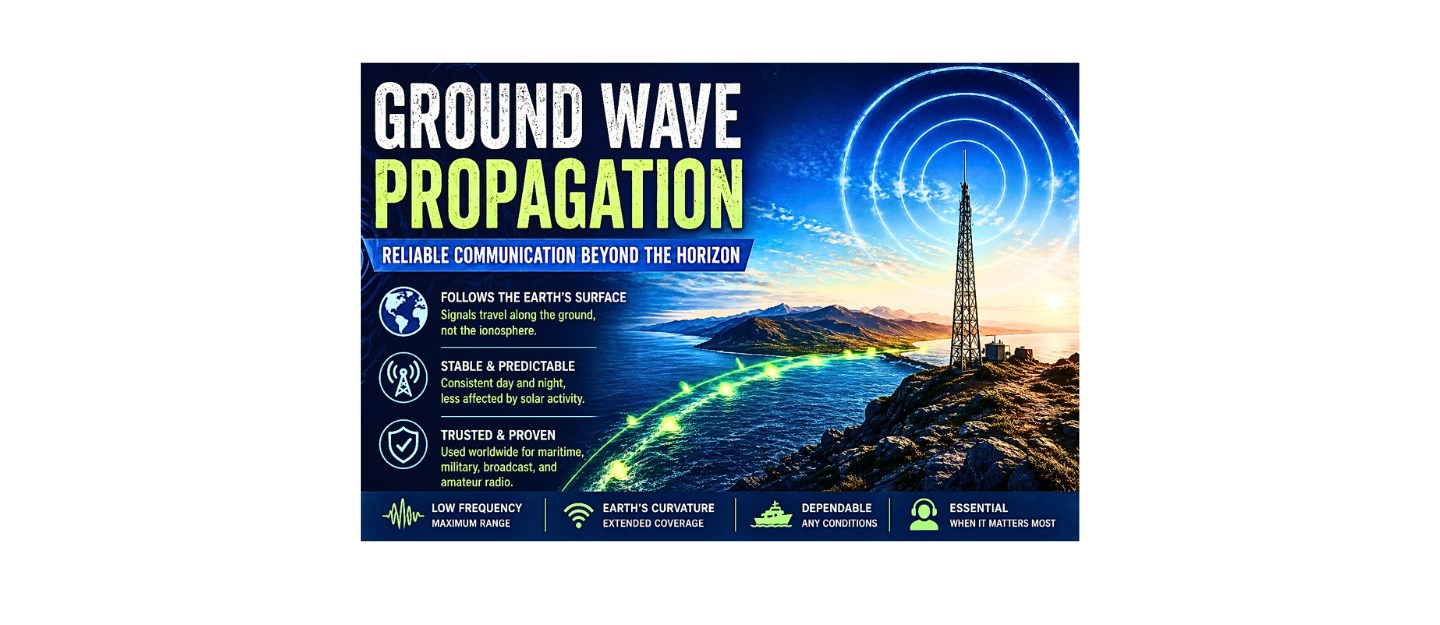
Ground wave propagation is one of the most reliable radio propagation modes for dependable communication below the horizon. Unlike skywave propagation, which depends on ionospheric reflection, ground waves travel along the Earth’s surface, providing stable regional and long-distance coverage with predictable performance. This makes ground wave propagation especially important for AM broadcast, maritime communication, emergency systems, and low-frequency amateur radio operation.
These waves follow the curvature of the planet, allowing reliable communication beyond the visible horizon. Because of this ability, ground wave propagation is commonly used in maritime, military, and AM broadcasting applications.
Moreover, it provides consistent coverage during both day and night, making it dependable for certain communication needs.
Want to learn more about propagation? Try Complete Guide to Ham Radio Propagation
What Is Ground Wave Propagation
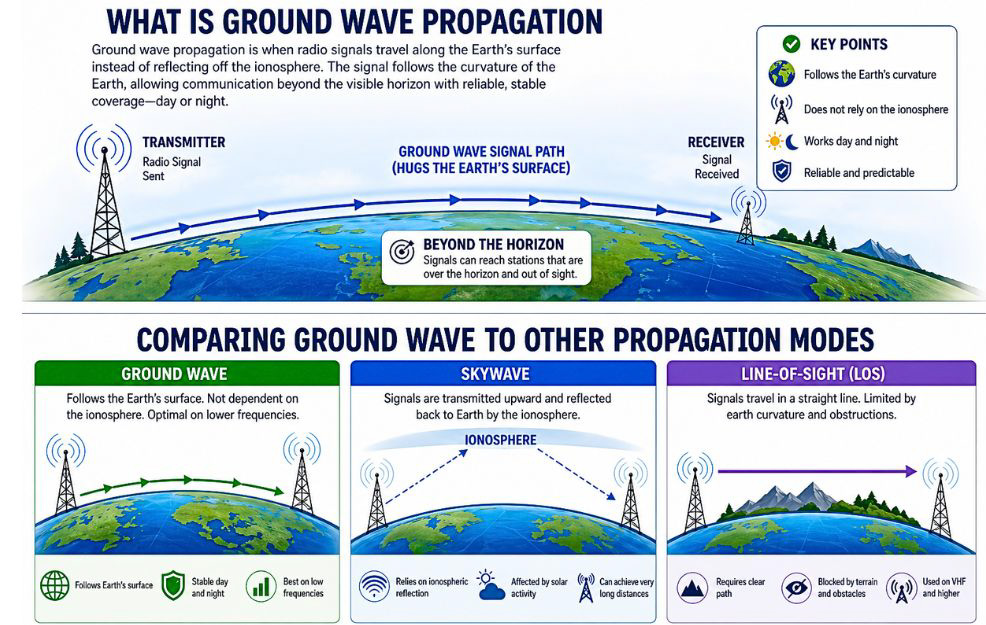
Ground wave propagation is a radio propagation mode where signals travel along the surface of the Earth instead of reflecting from the ionosphere. Because the signal follows the curvature of the planet, it can reach beyond the visible horizon while maintaining stable coverage. This makes it one of the most dependable propagation methods for low-frequency communication where reliability matters more than maximum range.
Why Ground Wave Propagation Matters
Ground wave propagation remains important because it provides reliable communication without depending on solar conditions or ionospheric behavior. Unlike skip-dependent modes, it delivers consistent performance during both day and night, making it especially valuable for emergency communication, maritime operation, and regional coverage where stability is more important than peak distance.
How Ground Waves Travel
Ground waves move by hugging the Earth’s surface, interacting with terrain, vegetation, and bodies of water. As they travel, the ground absorbs part of the signal’s energy, which causes gradual weakening over distance.
However, lower frequencies experience less absorption, which allows them to travel farther. For example, signals in the VLF and LF ranges can reach hundreds or even thousands of miles. Consequently, these frequencies are ideal for long-distance communication where line-of-sight methods are not practical.
Because the Earth is not a perfect conductor, the wavefront tilts slightly forward as it moves, allowing the signal to follow the planet’s curvature. Therefore, even stations that are far apart can maintain contact without relying on skywave reflection. Terrain and environmental factors greatly affect performance, with flat, conductive surfaces such as seawater supporting the strongest propagation.
Key Factors Affecting Ground Wave Strength
Several factors influence how far and how clearly a ground wave signal travels. First, frequency plays the most significant role. Lower frequencies propagate more efficiently because they resist absorption and diffraction losses. As the frequency increases, the signal tends to fade more quickly over distance.
Additionally, ground conductivity determines how much energy the wave loses along its path. Wet, salty ground or open ocean water provides excellent conductivity, resulting in stronger signals. In contrast, dry, sandy, or rocky terrain absorbs more energy, reducing range. Weather conditions also matter, as heavy rain or snow can slightly weaken signals by increasing ground losses.
Finally, transmitter power and antenna design impact overall performance. High-power transmitters generate stronger ground waves, while antennas designed for low-frequency operation can maximize signal efficiency. By optimizing these variables, operators can significantly improve their coverage area.
Where Ground Wave Propagation Works Best
Ground wave propagation performs best over conductive surfaces where signal loss is minimized. Saltwater provides the strongest performance, followed by moist soil and flat terrain. In contrast, dry rocky ground absorbs more signal energy and reduces effective range. Because of this, operators often see dramatically better performance near coastlines or over open water than inland over poor ground conditions.
Practical Applications of Ground Wave Propagation
Ground wave propagation is essential for several types of communication. AM broadcast radio relies heavily on ground waves during the day, providing local and regional coverage. As night falls, skywave reflections take over, but daytime operation depends entirely on ground wave performance.
Maritime communication is another important application. Ships use low- and medium-frequency transmissions to maintain contact with coastal stations, even when far offshore. Because seawater provides excellent conductivity, these signals travel exceptionally well. This reliability makes ground wave communication vital for navigation and safety.
Military forces also use ground wave propagation for secure and dependable communication. Since these waves do not depend on ionospheric conditions, they remain stable during periods of solar activity or geomagnetic storms. This stability ensures uninterrupted coordination in critical situations.
Ground Wave vs Other Propagation Modes
Ground wave is best suited for stable regional communication where consistent signal coverage is more important than extreme distance. Unlike skywave, it is not dependent on ionospheric conditions, and unlike line-of-sight, it is not limited to the visible horizon. This makes it one of the most predictable propagation methods available when operators need dependable communication under changing conditions.
Comparing Ground Wave to Skywave and Line-of-Sight
Ground wave propagation differs significantly from other modes, such as skywave and line-of-sight. Unlike skywave signals, which bounce off the ionosphere, ground waves do not depend on atmospheric layers. This makes them more predictable and less affected by solar cycles. However, their range is generally shorter unless very low frequencies are used.
In contrast, line-of-sight communication requires a direct path between antennas. VHF and higher frequencies rely on this mode but are limited by terrain and the Earth’s curvature. Ground waves overcome these limitations by following the surface, making them ideal for areas with obstacles like hills or buildings. Therefore, operators often combine multiple propagation modes to achieve reliable coverage under various conditions.
Maximizing Ground Wave Performance
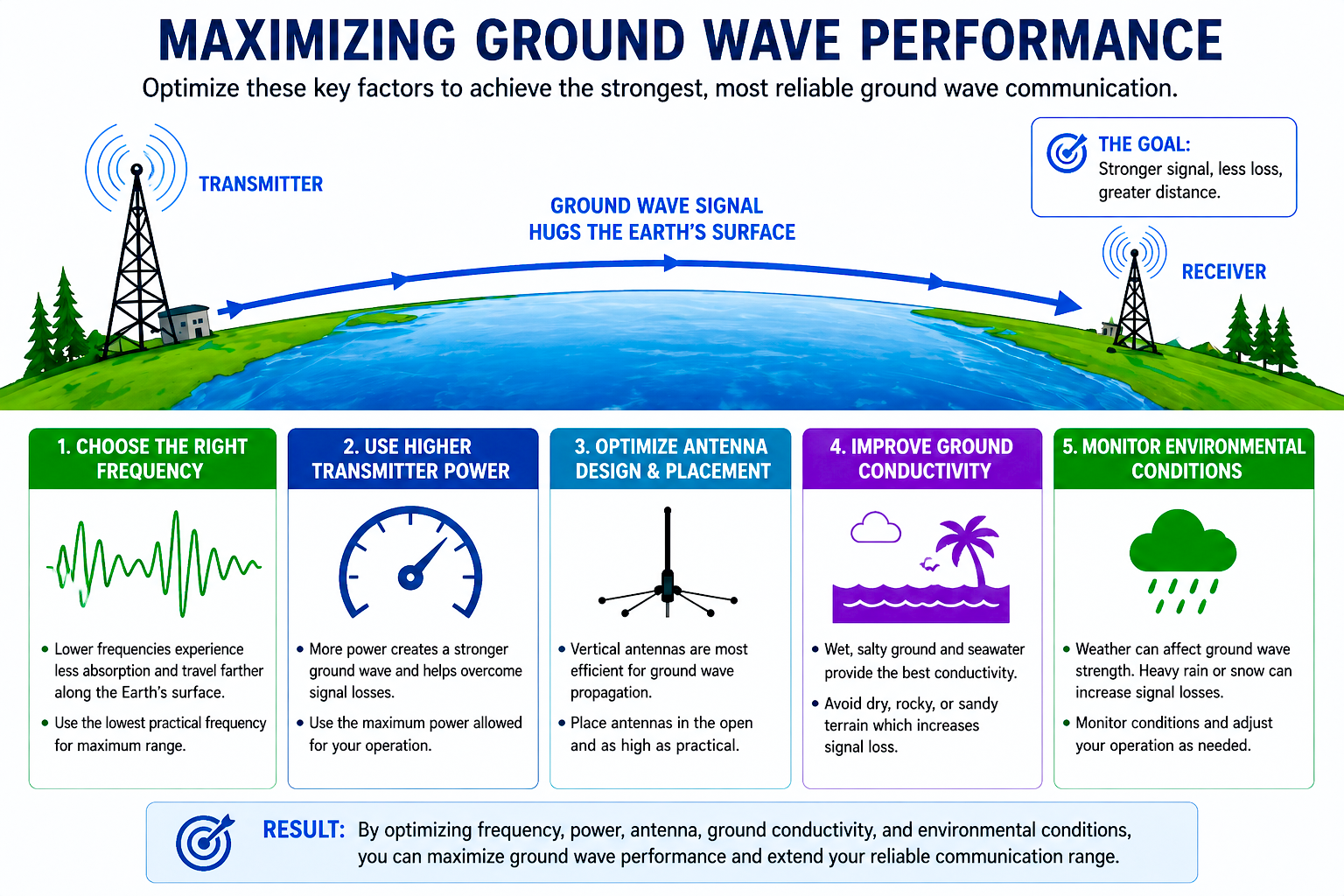
To improve ground wave communication, operators must focus on several key elements. Choosing the right frequency is critical, with lower frequencies providing the best results for long-distance operation. Additionally, increasing transmitter power boosts signal strength and helps overcome losses.
Antenna placement and design are equally important. Vertical antennas are commonly used because they radiate efficiently along the surface. Positioning antennas near conductive ground, such as moist soil or saltwater, further enhances performance. Moreover, operators should monitor environmental factors like weather and terrain to anticipate potential signal changes.
Ground Wave in Amateur Radio
Ground wave propagation remains especially useful in amateur radio for reliable local and regional communication on lower-frequency bands. Operators commonly use it for dependable daytime coverage on 160 meters and medium-wave experimentation where stable signal behavior is more important than skip distance. Because it offers predictable performance, it remains valuable for both practical communication and propagation study.
Importance in Modern Communication
Although technology continues to evolve, ground wave propagation remains vital in many fields. Emergency communication systems often rely on it when other methods fail, ensuring that vital information reaches affected areas. In remote locations where infrastructure is limited, ground waves provide a dependable way to connect communities.
Even as satellites and digital networks expand, the reliability and simplicity of ground wave communication keep it relevant. Amateur radio operators also use this propagation mode for experiments and regional communication, especially on bands like 160 meters. Because it offers stability and predictability, ground wave propagation serves as a foundation for many essential services.
Practical Operating Insight
Ground wave propagation is most effective when operators optimize for frequency, conductivity, and antenna efficiency together.
Lower frequencies, vertical antennas, and conductive terrain consistently produce the strongest results.
In practical operation, understanding these three variables matters more than raw transmitter power alone, making ground wave one of the most predictable and controllable propagation modes in radio.
Final Thoughts on Ground Wave Propagation
It continues to play an indispensable role in radio communication because it delivers stable, beyond-horizon coverage without depending on ionospheric conditions.
Its reliability makes it essential for maritime use, emergency systems, AM broadcasting, and lower-frequency amateur radio operation. By understanding how conductivity, frequency, and antenna design affect performance, operators can use ground wave propagation to build more dependable and resilient communication systems.
Frequently Asked Questions
How far can ground wave propagation travel
Ground wave propagation range depends on frequency, power, terrain, and conductivity. Lower frequencies over highly conductive surfaces such as seawater can travel hundreds of miles, while higher frequencies over poor ground conditions lose strength much faster.
Why does ground wave work better on lower frequencies
Lower frequencies experience less absorption and diffraction loss as they travel along the Earth’s surface. This allows them to maintain usable signal strength over much greater distances than higher frequencies.
Is ground wave propagation affected by weather
Ground wave propagation is generally stable, but heavy rain, snow, and poor ground conditions can slightly increase losses and reduce signal strength. Terrain and conductivity usually have a greater impact than weather alone.
Why does ground wave travel better over seawater
Seawater is highly conductive, which allows ground wave signals to lose less energy as they travel. This is why coastal and maritime communication often achieve much stronger ground wave performance than inland paths.
What bands are best for ground wave propagation
This propagation is strongest on VLF, LF, MF, and lower HF frequencies where signal absorption is lower and surface-following behavior is more efficient. This is why AM broadcast, maritime, and 160 meter operation benefit most from it.
Please consider Donating to help support this channel