
Complete Guide to HF Propagation
Complete Guide to HF Propagation, is the reason long-distance radio communication is possible without satellites or repeaters. Signals launched from an antenna can travel thousands of miles by interacting with layers of the upper atmosphere. Understanding how and why this happens gives operators the ability to predict band openings, improve signal strength, and make reliable long-distance contacts.
This guide explains the science behind HF propagation, what affects it, how to predict it, and how to use it to your advantage on the air.
What Is HF Propagation?
HF propagation describes how high frequency radio waves travel through the atmosphere and return to Earth after interacting with the ionosphere. Instead of moving only in straight lines like VHF or UHF signals, HF signals can bend, refract, and reflect due to charged particles high above the planet.
This process allows communication well beyond the visual horizon. A properly launched signal can travel across continents or even circle the globe.
Propagation is not constant. It changes continuously based on solar activity, time of day, atmospheric conditions, and frequency selection. Because of this, HF communication is dynamic and requires understanding environmental conditions.
(adsbygoogle = window.adsbygoogle || []).push({});Why HF Signals Can Travel So Far
HF signals travel long distances because of the ionosphere, a region of charged particles beginning roughly 30 miles above Earth and extending hundreds of miles into space.
When solar radiation strikes atmospheric gases, electrons are freed and form ionized layers. These layers can refract radio waves back toward Earth instead of allowing them to pass into space.
When a signal returns to Earth, it can bounce again, repeating the process. Each bounce extends communication range. This is often called skywave propagation.
Ground Wave Propagation
Ground wave propagation occurs when radio signals travel along the surface of the Earth. These signals follow the curvature of the ground and provide reliable coverage over short to medium distances.
This mode is commonly used on lower frequencies and is important for local communication, especially where consistent coverage is needed regardless of atmospheric conditions.
Skywave (Ionospheric) Propagation
Skywave propagation occurs when radio signals travel upward and are refracted back toward Earth by the ionosphere. This allows communication over very long distances, often thousands of miles beyond the horizon.
This is the primary propagation mode used for long-distance HF communication and is strongly influenced by solar activity, time of day, and seasonal changes.
• Greyline
• Sporadic E
• Tropospheric Ducting
Line-of-Sight Propagation
Line-of-sight propagation occurs when radio waves travel directly between antennas without significant reflection or bending. This mode is typical at higher frequencies such as VHF and UHF.
Communication range depends on antenna height, terrain, and obstacles between stations. Repeaters are often used to extend line-of-sight coverage.
The Ionosphere and Its Layers
The ionosphere is divided into several layers, each affecting radio signals differently.
D Layer
The lowest layer primarily absorbs radio energy, especially during daylight. It weakens lower HF frequencies and often limits daytime performance on bands like 160m and 80m.
At night, the D layer largely disappears. This is why lower bands improve dramatically after sunset.
E Layer
The E layer can refract some HF signals and occasionally supports medium-distance communication. It is also responsible for sporadic E events, which can produce unusually strong and unexpected propagation.
F Layer (F1 and F2)
The F layer is the most important for long-distance communication. During daylight it often separates into F1 and F2 regions. At night it usually merges into a single layer.
The F2 layer enables global communication because it remains ionized even after sunset and can refract higher frequencies than other layers.
Types of HF Propagation
Different propagation modes determine how signals travel and where they can be heard.
Ground Wave
Ground wave propagation occurs when radio waves travel along the surface of the Earth, following its curvature rather than reflecting off the atmosphere. This type of propagation is most effective at lower frequencies, particularly in the longwave and medium wave bands, where signals can remain in contact with the ground and extend well beyond the visual horizon.
As the signal moves outward, the Earth’s surface absorbs some energy, so signal strength gradually decreases with distance. However, conductivity of the terrain plays a major role, because signals travel farther over highly conductive surfaces like seawater than over dry soil or rocky ground. As a result, ground wave propagation provides reliable regional coverage and is commonly used for AM broadcasting, maritime communication, and other services that require stable signal paths without relying on atmospheric conditions.
Skywave
Skywave propagation occurs when radio signals travel upward from the transmitter and are refracted back toward Earth by ionized layers in the upper atmosphere known as the ionosphere. This bending effect allows signals to return to the surface far beyond the horizon, enabling long-distance communication over hundreds or even thousands of miles.
The effectiveness of skywave propagation depends on several factors, including frequency, time of day, season, and solar activity, because ionospheric density constantly changes. Lower HF frequencies often propagate better at night when ionospheric absorption decreases, while higher frequencies tend to perform better during daylight hours. As a result, skywave propagation makes worldwide communication possible on the HF bands and is fundamental to long-range amateur radio operation.
Multi-Hop Propagation
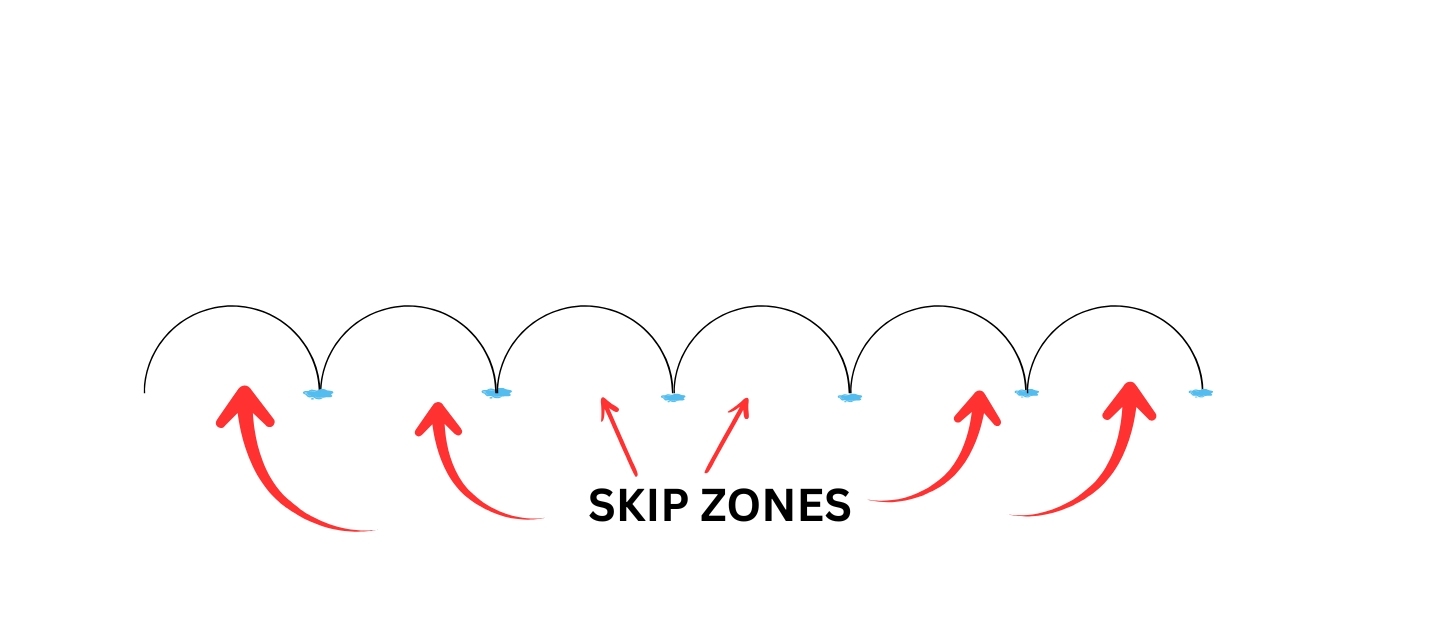
Signals bounce multiple times between Earth and the ionosphere, extending communication range across continents or oceans.
Gray Line Propagation
Gray Line Propagation occurs along the moving boundary between daylight and darkness. Signals can travel efficiently along this transition zone, often producing strong long-distance paths.
Sporadic E
Sporadic E is a form of unusual ionospheric propagation that occurs when dense patches of ionization suddenly form in the E layer of the ionosphere, typically between about 60 and 75 miles above Earth. These concentrated ionized clouds can reflect higher-frequency radio signals than normal E-layer conditions allow, often enabling strong, unexpected long-distance contacts on VHF and low UHF bands.
Although Sporadic E events are unpredictable, they most commonly occur in late spring and early summer, with a smaller peak in midwinter. Signals reflected by these ionized patches can travel hundreds to over a thousand miles in a single hop, producing rapid signal fading, sudden band openings, and strong but short-lived propagation paths. As a result, Sporadic E is especially exciting for amateur radio operators because it can turn normally local VHF bands into long-distance communication channels with little warning.
How Frequency Affects Propagation
Each frequency interacts differently with the ionosphere. Choosing the correct band is essential.
Lower HF bands:
- Travel farther at night
- Penetrate the ionosphere less easily
- Are more affected by absorption during daylight
Higher HF bands:
- Work best during daylight
- Require stronger ionization
- Support long-distance paths when solar activity is high
If frequency is too low, absorption increases. If too high, signals pass through the ionosphere into space.
Maximum Usable Frequency (MUF)
The Maximum Usable Frequency is the highest frequency that will refract back to Earth over a specific path.
Above the MUF, signals escape into space.
Below the MUF, communication is possible.
MUF varies constantly based on solar radiation and ionospheric density.
Lowest Usable Frequency (LUF)
The Lowest Usable Frequency is the lowest frequency that can be used for reliable communication.
Below the LUF, signal absorption becomes too strong for effective transmission.
The usable operating window exists between LUF and MUF.
Propagation Topics and Deep Dives
Understanding the fundamentals is only the beginning. HF propagation is influenced by many dynamic atmospheric and solar processes that affect signal behavior in different ways. The topics below explore specific propagation mechanisms and operating strategies in greater depth. Use these guides to expand your knowledge and improve real-world operating results.
Tropospheric Ducting
Learn how temperature inversions and atmospheric layering can trap radio waves and carry them far beyond normal line-of-sight range. This guide explains when ducting forms, how to recognize it, and how operators take advantage of enhanced VHF and UHF signal paths.
Seasonal Propagation Changes
Seasonal propagation shifts throughout the year as solar angle and atmospheric conditions change. This section explains how winter, summer, and transitional seasons affect band performance, absorption levels, and long-distance communication reliability.
Geomagnetic Storms
Solar disturbances like geomagnetic storms can dramatically alter ionospheric stability. Discover how geomagnetic storms disrupt propagation, cause sudden signal fading, or even create unexpected openings. Learn how to read geomagnetic indicators and protect operating plans during solar events.
Band Behavior by Time of Day
HF bands open and close in predictable daily cycles driven by solar radiation. This guide explains which bands perform best during daylight, nighttime, and transitional periods, helping you choose the most effective frequency for any time of operation.
DX Propagation Strategy
Successful long-distance communication requires more than luck. Learn how experienced operators analyze propagation forecasts, select frequencies, time transmissions, and optimize antenna performance to consistently work distant stations.
How Solar Activity Affects Propagation
The Sun drives ionospheric behavior. Increased solar radiation produces stronger ionization, which improves propagation at higher frequencies.
Solar influences include:
- Solar flux level
- Sunspot numbers
- Solar flares
- Coronal mass ejections
- Geomagnetic storms
High solar activity generally improves upper HF band performance but can also create instability.
Geomagnetic disturbances can disrupt the ionosphere and cause sudden signal loss or fading.
Time of Day Effects
Propagation changes dramatically between day and night.
Daytime:
- Higher bands perform better
- Lower bands experience absorption
- D layer present
Nighttime:
- Lower bands improve
- D layer weakens
- Long-distance paths increase
Band selection must follow the Sun’s position relative to the communication path.
Seasonal Propagation Changes
Propagation varies with seasons due to changes in solar angle and atmospheric composition.
Winter often favors lower frequencies with reduced absorption.
Summer can increase absorption but may enhance sporadic E activity.
Seasonal patterns influence band openings and signal strength.
Signal Takeoff Angle and Propagation
Takeoff angle describes the angle at which a radio signal leaves an antenna relative to the horizon, and it plays a major role in determining how far that signal will travel. A low takeoff angle sends energy closer to the horizon, which is ideal for long-distance communication because the signal can travel farther before interacting with the ionosphere or Earth’s surface.
In contrast, a high takeoff angle directs more energy upward, which favors shorter regional coverage as the signal returns to Earth more quickly. Antenna height above ground, surrounding terrain, and antenna design all influence the takeoff angle, so even small changes in installation can significantly affect communication range. As a result, operators aiming for DX contacts typically optimize their antennas for lower takeoff angles, while local or regional communication often benefits from higher angles.
Low angles produce long-distance paths.
High angles produce shorter regional coverage.
Propagation Prediction
Because propagation changes continuously, prediction tools and solar data help operators choose the best bands.
Key indicators include:
- Solar flux index
- Geomagnetic activity
- Ionospheric density
- Time of day
- Frequency selection
Experienced operators combine data with real-world listening to determine optimal operating conditions.
Common Propagation Effects
HF signals rarely remain constant. Typical behavior includes:
- Fading — signal strength varies over time
- Skip zones — areas where signals are not heard between hops
- Multipath distortion — signals arriving by multiple paths
- Signal enhancement — sudden strength increases
Understanding these effects improves operating success.
How Operators Use Propagation Knowledge
Successful operators use propagation understanding to:
Select the correct band
Time transmissions for best conditions
Aim signals at target regions
Adjust antenna performance
Predict long-distance openings
Propagation knowledge transforms random operation into strategic communication.
Improving Your HF Propagation Results
Improving your HF propagation results requires understanding how band conditions, antenna performance, and operating technique work together. First, choose the right band for the time of day and solar conditions, because ionospheric behavior changes constantly and different frequencies perform better under different conditions. In addition, optimizing your antenna system can make a major difference, since proper height, orientation, and low SWR help ensure more of your transmitted power is radiated effectively.
Monitoring propagation forecasts and listening for band activity also helps you identify openings as they develop. Furthermore, using appropriate power levels, clear audio, and efficient operating practices improves signal readability at long distances. By combining awareness of propagation conditions with a well-tuned station and good operating habits, you can significantly increase your chances of making reliable HF contacts.
Use antennas with appropriate height and pattern
Monitor solar and ionospheric conditions
Operate at times favorable for your target region
Experiment with frequency selection
Observe band behavior daily
Experience combined with knowledge produces the best results.
The Role of Propagation in Long-Distance Communication
HF propagation makes global communication possible without infrastructure. By using natural atmospheric behavior, radio signals travel enormous distances using modest power levels.
Every successful long-distance contact depends on understanding how the atmosphere behaves at that moment.
Propagation is not just a theory , it is the operating environment of HF radio.
Complete Guide to HF Propagation
Complete Guide to HF Propagation, this guide explains the fundamentals of how propagation works. The best way to master it is to observe real band conditions and experiment with different frequencies, antennas, and operating times.
Explore the articles below to deepen your understanding and see how propagation behaves in real operating situations.
Please consider Donating to help support this channel