
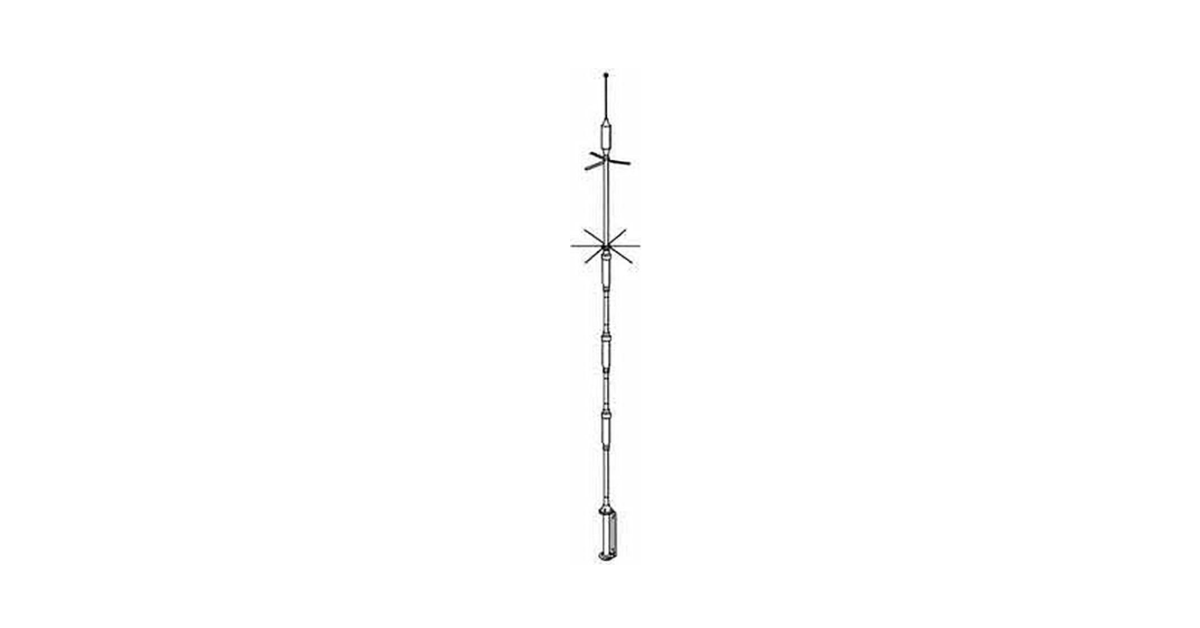
The hustler trap verticals antenna series includes the 4BTV, 5BTV, and 6BTV models. All three antennas share the same proven mechanical design, but each additional model adds more traps to support additional frequency bands. This modular approach allows operators to choose the exact band coverage they need while maintaining the same rugged construction and tuning simplicity.
A trap is a parallel resonant circuit that isolates sections of the antenna at specific frequencies. Each trap allows the vertical to operate efficiently on multiple bands without requiring separate radiating elements. This design makes trap verticals compact, practical, and highly effective for multi-band operation.
Hustler builds these antennas with solid fiberglass trap housings for mechanical strength and environmental durability. Heavy-wall 1.25-inch aluminum tubing forms the main structure, while stainless steel clamps allow precise adjustments without damaging the tubing. A heavy-duty base mounting bracket with high-strength insulators supports the entire structure and fits masts up to 1.75 inches in diameter.
These antennas can be ground mounted with or without radials, although radials significantly improve performance. They can also be mounted on rooftops or towers when used with an appropriate radial system. Installation is straightforward, tuning is simple, and the antennas can be fed with standard 50-ohm coax.
Author Experience and Real-World Validation
This review is based on hands-on installation, tuning, and on-air operation of Hustler trap vertical antennas in real station conditions. Performance observations include DX operation, radial system experimentation, and long-term stability across seasonal changes.
Unlike theoretical antenna discussions, this guide reflects practical results from actual use, including SWR behavior, tuning interaction between bands, and real-world signal reports
What Is a Hustler Trap Vertical Antenna?
A Hustler trap vertical antenna is a multiband HF vertical that uses resonant traps to isolate sections of the radiating element so one antenna can operate efficiently on several frequency bands. Each trap allows the antenna to function as a properly sized radiator on different bands, providing full quarter-wave performance in a compact vertical design.
What Is a Hustler Trap Vertical Antenna?
The hustler trap verticals are a multiband HF antenna that uses resonant traps to electrically isolate sections of the radiating element so one vertical can operate efficiently on multiple frequency bands. This allows full-size quarter-wave performance across several bands using a single compact antenna.
Hustler 4BTV Specifications and Coverage
The Hustler 4BTV is the most compact model in the series and covers four HF bands.
Band coverage includes:
10 meters
15 meters
20 meters
40 meters
Typical SWR remains near 1.6:1 at band edges when properly installed. The antenna stands approximately 21 feet 5 inches tall and weighs about 15 pounds. It handles up to 1500 watts SSB and 1000 watts continuous power. Wind survival rating is approximately 55 mph.
The 4BTV is ideal for operators who want strong multiband coverage in limited space while avoiding the added height of larger models.
Hustler 5BTV Specifications and Coverage
The Hustler 5BTV expands coverage by adding the 75 or 80 meter band. This makes it one of the most popular multiband vertical antennas for general HF operation.
Band coverage includes:
10 meters
15 meters
20 meters
40 meters
75 or 80 meters
The antenna provides approximately 100 kHz of coverage on 75/80 meters. It stands about 25 feet 1 inch tall and weighs roughly 17 pounds. Wind survival increases to about 70 mph, making it more robust in exposed installations.
Power handling reaches full legal limit levels for CW and SSB operation. For many operators, the 5BTV offers the best balance of band coverage, height, and performance.
Hustler 6BTV Specifications and Coverage
The Hustler 6BTV provides the widest band coverage in the series by adding 30 meters to the design.
Band coverage includes:
80 meters
40 meters
30 meters
20 meters
15 meters
10 meters
SWR at band edges typically approaches 2:1, and 75/80 meter coverage spans roughly 100 kHz. The antenna stands about 24 feet tall and weighs approximately 16.5 pounds. Power handling reaches 1500 watts SSB and 1000 watts CW.
For operators who want maximum band coverage in a single vertical antenna, the 6BTV provides the most flexibility.
Comparing the 4BTV, 5BTV, and 6BTV
All three antennas share identical construction quality and mounting hardware. The primary differences are band coverage and physical height.
The 4BTV is the simplest and shortest.
The 5BTV adds low-band capability.
The 6BTV adds both low-band and 30-meter coverage.
Choosing between them depends mainly on operating preferences and available space.
Hustler 4BTV vs 5BTV vs 6BTV Comparison
This comparison highlights the key differences in band coverage, height, and operating flexibility between the three Hustler BTV models.
| Model | Bands Covered | Height | Best Use |
|---|---|---|---|
| 4BTV | 10, 15, 20, 40m | Shortest | Compact multiband operation |
| 5BTV | 10–80m | Tallest | Best balance of coverage and size |
| 6BTV | 10–80m + 30m | Full coverage | Maximum band flexibility |
Although construction quality is the same across all three models, the number of supported bands and antenna height determine which version best fits a particular station installation.
Which Hustler BTV Performs Best for DX vs Local Contacts
Vertical antennas inherently favor low-angle radiation, which enhances long-distance DX performance. The Hustler BTV series excels in this role, particularly on 20 meters and above.
However, performance on 75/80 meters depends heavily on the radial system and ground conditions. While the 5BTV and 6BTV provide access to lower bands, they are not optimized for NVIS without significant radial investment.
Operators focused on DX will see strong results across all models, while those prioritizing regional communication should carefully consider ground system design.
Installation and Ground System Considerations
Vertical antennas rely heavily on the ground system for efficient radiation. Ground mounting with a large radial field produces the best overall performance. Even a modest radial system can significantly improve signal strength and reduce losses.
Elevated mounting requires radials tuned to operating frequencies. In many cases, improving the radial system produces greater performance gains than upgrading to a larger antenna model.
How Many Radials Do You Actually Need?
One of the most common misconceptions is that a vertical antenna requires exactly quarter-wave radials. In practice, performance improves primarily with quantity, not precision.
Typical real-world performance tiers:
- 4 radials → antenna works, but inefficient
- 8–16 radials → noticeable improvement
- 16–32 radials → strong performance
- 32+ radials → near optimal ground efficiency
Shorter radials still contribute to efficiency. A dense radial field outperforms a small number of perfectly cut radials in most installations.
Step-by-Step Tuning Procedure for Hustler Trap Verticals
Proper tuning ensures efficient operation across all supported bands. Adjustment should always be performed after the antenna is fully installed in its final location.
- Assemble the antenna completely according to specifications.
- Install the antenna at final height with the full radial system connected.
- Begin tuning with the lowest frequency band first.
- Measure SWR at the band center frequency.
- Adjust the appropriate section length in small increments.
- Recheck SWR after each adjustment.
- Repeat for each higher band moving upward in frequency.
- Perform final SWR checks across all bands.
Because trap interaction affects multiple bands, small adjustments produce noticeable changes. Always tune slowly and methodically.
Radial System Performance and Efficiency
Vertical antennas depend heavily on the ground system for efficient radiation. Although Hustler trap verticals will operate with minimal radials, performance improves dramatically as radial count increases.
Many installations begin with 8 to 16 radials, but additional radials continue to reduce ground loss and improve radiation efficiency. Radials do not need to be perfectly tuned to provide improvement, and longer radials generally increase performance on lower frequency bands.
In most installations, improving the radial system produces a greater performance increase than upgrading to a larger antenna model.
Typical Radial Length Guidelines by Band
Radials do not need to be exact quarter-wave lengths to improve performance, but approximate lengths help maximize efficiency.
Typical starting lengths:
- 80 meters → about 65 feet
- 40 meters → about 33 feet
- 30 meters → about 25 feet
- 20 meters → about 16 feet
- 15 meters → about 11 feet
- 10 meters → about 8 feet
Many installations use a mix of lengths or random lengths. Increasing the number of radials generally produces greater performance improvement than exact length precision.
Recommended Radial System for Best Performance
Although these antennas will function with minimal radials, performance improves dramatically as radial count increases. Many operators begin with 8 to 16 radials and expand over time. Radials do not need to be perfectly tuned to improve performance, but longer radials and greater quantity reduce ground loss and increase radiation efficiency.
Improving the radial system often produces greater performance gains than changing antenna models.
Real-World Operating Experience
Assembly and installation are straightforward when performed carefully. Taking time during initial setup helps ensure stable tuning across all bands. Replacing a single-band vertical with a trap vertical immediately expands operating flexibility. With an existing radial system in place, tuning becomes predictable and manageable.
In practical operation, the antenna tunes easily across supported bands and works well with both internal and external tuners. Amplifier use presents no difficulty when the antenna is properly adjusted.
DX performance is consistently strong. Contrary to common assumptions, noise levels are not excessive when the antenna is installed with a proper ground system. In many operating situations, performance approaches that of larger wire antennas. Additional radials further improve efficiency and help refine the SWR curve across the bands.
Common Installation Mistakes to Avoid
Improper installation can reduce performance significantly. The most common issues include insufficient radial systems, poor grounding, incorrect trap positioning, and tuning adjustments made before the antenna is fully assembled.
Making tuning adjustments only after complete installation and ensuring good electrical connections throughout the antenna structure greatly improves final performance.
Common Installation and Tuning Issues
Most performance problems are related to installation rather than antenna design. The most common issues include insufficient radials, poor grounding, or tuning adjustments made before the antenna is fully assembled and mounted.
High SWR is often caused by nearby conductive objects, incomplete radial systems, or incorrect trap positioning. Allowing the antenna to settle into its final mounting location before tuning helps ensure accurate adjustment.
Noise issues are usually related to local electrical interference rather than the antenna itself. Improving grounding and feedline routing often reduces received noise.
Installation Success Checklist
Completing these checks helps ensure stable performance and consistent tuning.
Before final operation, confirm the following:
- All tubing connections are tight and secure
- Traps are positioned correctly
- Radials are connected and spread evenly
- Feedline is properly routed and grounded
- SWR measured at operating height
- No nearby metal objects affecting tuning
Advantages of Hustler Trap Verticals
These antennas offer several practical benefits:
- Multiband coverage from one antenna
- Compact footprint
- Strong aluminum construction
- Predictable tuning
- Effective DX performance
- Flexible mounting options
Limitations to Consider
Like any vertical antenna, performance depends heavily on installation quality.
Operators should expect:
- Strong dependence on radial system design
- Narrower bandwidth on lower frequencies
- Need for careful initial adjustment
Who Should Consider a Hustler Trap Vertical
The hustler trap verticals are especially well suited for operators who have limited space but still want full HF capability. They are ideal where horizontal antennas cannot be installed at optimal height and for operators who want simple mechanical installation with broad band coverage.
Overall Performance Evaluation
Hustler trap verticals provide dependable multiband performance in a compact and durable package. Construction quality is excellent, tuning is predictable, and installation requirements are manageable.
When supported by an effective radial system, performance can rival much larger antenna installations. For many stations, they represent one of the most practical HF antenna solutions available.
Trap Vertical vs Dipole Performance
Trap vertical antennas and horizontal dipoles each offer distinct operating advantages.
Vertical antennas typically produce lower radiation angles, which improves long-distance communication and DX performance. They also require less horizontal space and can provide multiband coverage from a single structure.
Dipole antennas often produce stronger regional coverage and may receive less local noise in some environments. However, they require more physical space and usually operate efficiently on fewer bands without additional tuning.
Many stations use both antenna types because each excels under different propagation and operating conditions.
Integrating a Trap Vertical Into a Complete HF Station
Vertical antennas perform best when paired with efficient feedlines, proper grounding, and an effective antenna tuner when needed. Understanding how antenna systems interact with propagation and station design helps maximize performance across all supported bands.
Which Hustler BTV Should You Choose?
Choose the 4BTV if height or visual impact must be minimized.
Try the 5BTV if you want the best overall balance of performance and band coverage.
Choose the 6BTV if maximum band flexibility is the priority.
Most operators find the 5BTV offers the most practical combination of size and capability.
Overall Review Score
Based on installation, construction quality, tuning simplicity, and real-world performance, the Hustler BTV lineup leads the multiband verticals.
Final Verdict
The Hustler 4BTV, 5BTV, and 6BTV remain among the most proven multiband vertical antennas in amateur radio. They combine durable construction, efficient trap design, and reliable real-world performance.
With proper installation and a well-designed ground system, any model can provide years of dependable operation and excellent DX capability.
Realistic Performance Expectations
When installed with an effective radial system, Hustler trap vertical antennas can provide strong multiband performance and reliable DX capability. Signal strength often rivals larger wire antennas, especially on long-distance paths.
However, performance varies with ground conductivity, radial count, installation height, and surrounding environment. Like all vertical antennas, results improve significantly with careful installation and continued system optimization.
Operators who expand radial systems and refine tuning over time typically see measurable performance gains.
Which Hustler Trap Verticals Should You Choose?
The best model depends primarily on band coverage needs and available installation space.
Choose the 4BTV if height restrictions or visual impact are important and core HF bands are sufficient.
Choose the 5BTV if you want the best overall balance of size, low-band capability, and multiband performance. This is the most common choice for general HF operation.
Choose the 6BTV if maximum band flexibility is the priority and you regularly operate across many HF bands.
For most operators, the 5BTV provides the most practical combination of performance and coverage.
Performance vs Cost: Is It Worth It?
Hustler trap verticals consistently deliver performance that rivals much larger antenna systems when installed correctly. Compared to beam antennas or large wire arrays, they offer a significantly smaller footprint while maintaining strong DX capability.
The real cost factor is not the antenna itself, but the radial system. Operators who invest time in ground system optimization see the greatest return in signal strength and efficiency.
For most stations, the 5BTV provides the best value due to its balance of coverage, size, and performance.
Frequently Asked Questions
Do Hustler trap verticals require radials?
They will operate without radials, but performance improves significantly when radials are installed.
Are trap verticals good for DX?
Yes. Their low radiation angle makes them effective for long-distance communication.
Which model is most popular?
The 5BTV is often chosen because it balances size, band coverage, and performance.
Can they handle amplifiers?
Yes. All models support high power when properly installed and tuned.
Transparency and Testing Approach
This review is based on real-world installation and operation. No manufacturer influence or sponsorship affects the evaluation. Performance observations reflect practical use in typical amateur radio environments.
About the Author
Vince, W2KU, is a licensed Extra class amateur radio operator and the founder of Ham Shack Reviews. The committee named him Amateur of the Year in 2026 for his contributions to amateur radio education and equipment evaluation.
He runs Ham Shack Reviews across both his website and YouTube channel, where he shares in-depth guides, real-world operating techniques, and equipment insights for amateur radio operators.
He primarily operates HF, knows propagation very well, operates mobile and handhelds daily. Vince exchanges QSL cards for DXCC, contest confirmation, and award tracking and is the club QSL manager. His guidance focuses on practical operating procedures, accurate logging, and real-world amateur radio practices.
Please consider Donating to help support this channel