
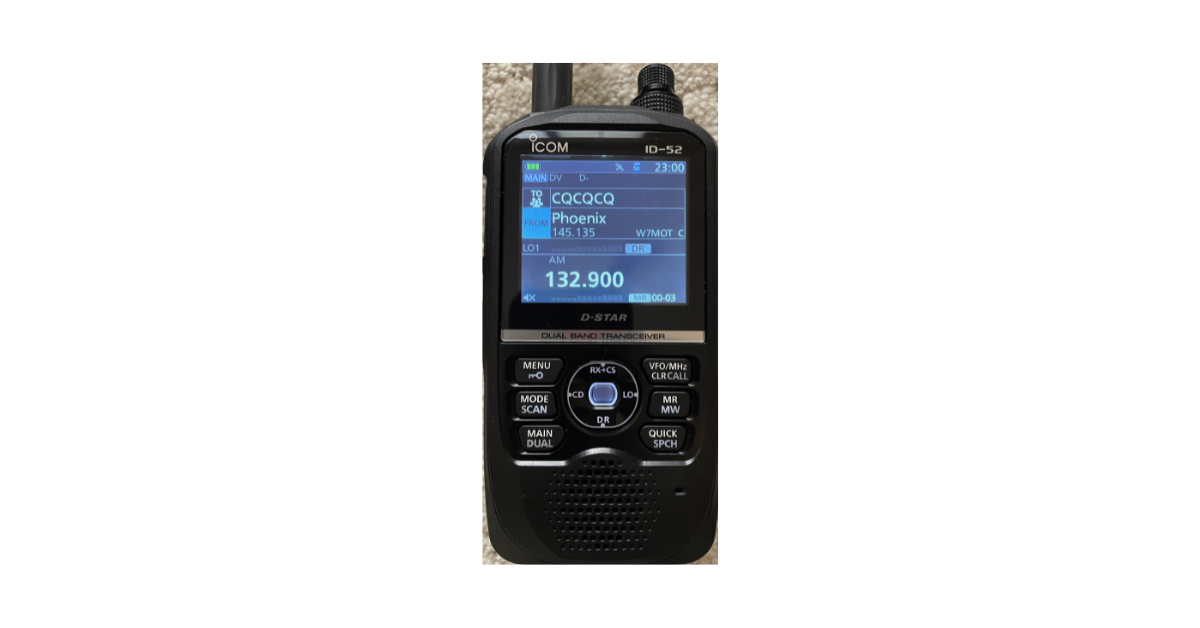
The ICOM ID-52 is a premium dual-band handheld transceiver designed for operators who want advanced digital communication, strong audio performance, and modern connectivity in a rugged portable radio. It replaces the long-running ID-51 series while expanding functionality, improving usability, and modernizing the user interface.
Two regional versions are available. The ID-52A is configured for North America, while the ID-52E supports European band standards. Both share the same hardware platform, larger display, and expanded digital capabilities.
The radio combines D-STAR digital voice, GPS positioning, Bluetooth connectivity, and simultaneous dual-band reception into a single handheld platform. As a result, it functions not only as a communication device, but also as a navigation and information tool for mobile, field, and emergency operation.
If you would like to see more radios including other models and brands, check out the Complete Guide to Ham Radio Transceivers.
Large Color Display and Outdoor Visibility
One of the most noticeable upgrades is the large 2.3-inch color display. The screen uses transflective technology, which reflects ambient light rather than fighting against it. This allows excellent readability in bright outdoor conditions where traditional displays often wash out.
The larger display also improves menu navigation, station information visibility, and GPS mapping features. Operators can monitor dual signals, location data, and system status without navigating through multiple screens.
Interface Navigation and Menu Control
The larger display also improves operational speed because menu navigation becomes more intuitive and easier to read at a glance. Dual-watch monitoring, signal information, and GPS data remain visible without constant screen changes. This reduces operator workload during mobile or field operation and allows faster adjustments while actively monitoring multiple signals.
D-STAR Digital Communication and Data Functions
The ID-52 continues Icom’s strong integration of D-STAR digital communication. Digital voice operation supports clear audio transmission along with simultaneous data exchange. Users can send location data, share images, and access networked repeaters through terminal or access point modes.
The D-PRS function displays received station locations, direction, and distance. Combined with the internal GPS receiver, the radio supports position reporting, repeater search functions, and automatic location updates.
These capabilities make the ID-52 especially useful for mobile operators, public service communication, and coordinated field activity.
Simultaneous Dual-Band and Dual-Mode Reception
The radio supports simultaneous reception in multiple configurations, including VHF-to-VHF, UHF-to-UHF, cross-band monitoring, or digital-to-digital reception. This flexibility allows operators to monitor repeaters, simplex channels, or digital networks at the same time.
Dual reception improves situational awareness and allows efficient monitoring of local and distant activity without switching frequencies manually.
Monitoring Efficiency in Real Operation
Dual receive capability is especially useful during events, emergency communication, or travel where monitoring multiple repeaters or calling frequencies is necessary. Operators can track local traffic while maintaining awareness of wider network activity without interrupting communication flow. This greatly improves situational awareness compared to single-receiver handheld radios.
Wideband Monitoring and Airband Capability
The enhanced UHF coverage includes military airband reception from 225 to 374.995 MHz. This extended monitoring capability allows listening to aviation activity beyond standard civilian ranges.
The wideband receiver also supports monitoring broadcast FM radio and other nearby signals. This makes the radio useful as a general-purpose monitoring receiver in addition to amateur communication.
Audio Performance and Field Usability
The ID-52 delivers a powerful 750 milliwatt audio output. This provides strong, clear sound even in noisy environments such as public events, vehicles, or outdoor field operation.
The larger frame improves grip and handling, while the rugged construction supports regular portable use. Controls are spaced for easy operation, and the improved display reduces strain during extended monitoring.
Real-World Range and Signal Performance
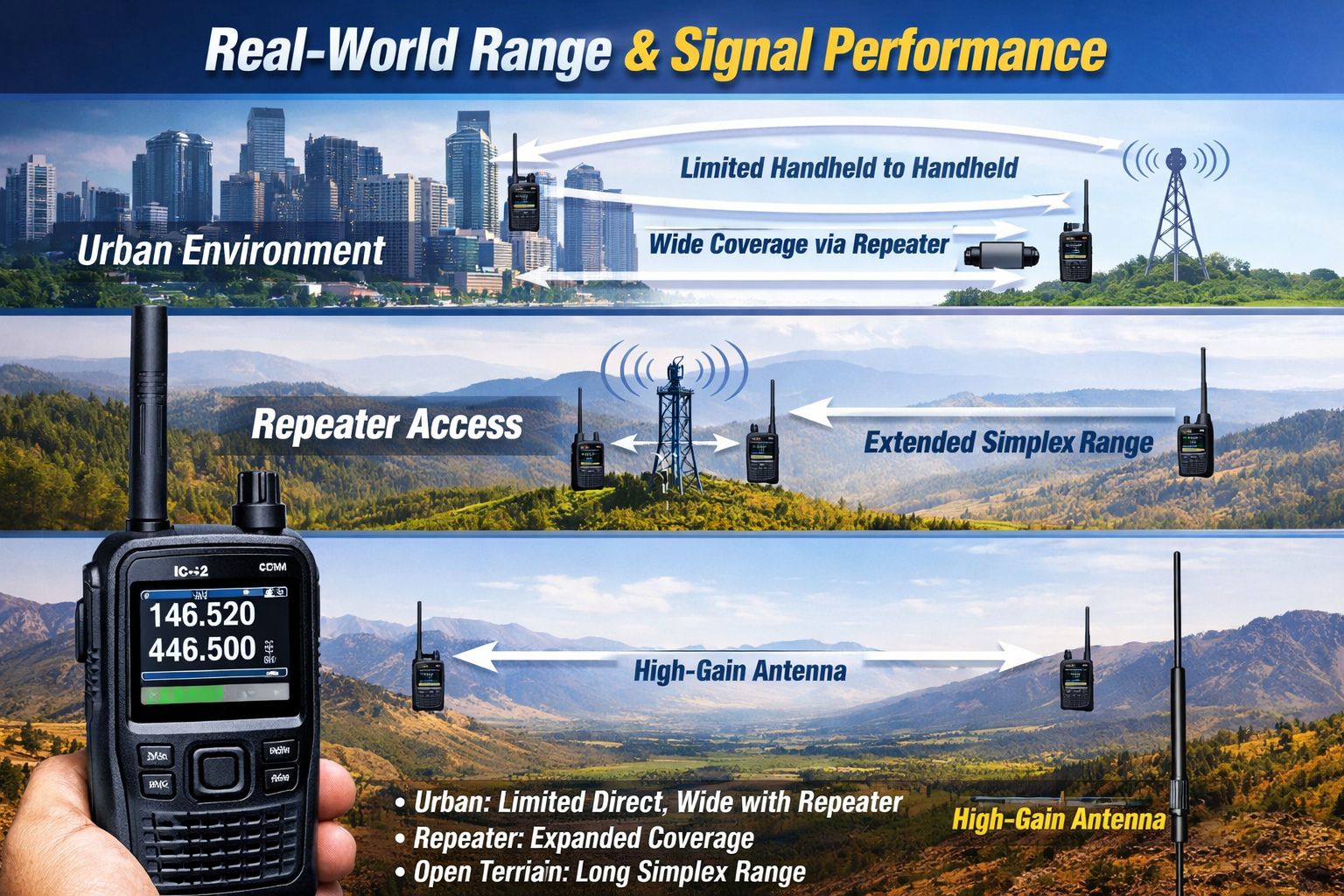
Actual communication range depends on terrain, antenna selection, and repeater access. In urban environments with building density, handheld-to-handheld range is naturally limited, while repeater operation provides significantly wider coverage. In open terrain, direct simplex communication extends much farther, especially when using higher elevation or improved antennas.
Signal clarity remains consistent across varying conditions, and receiver sensitivity supports reliable monitoring of weak signals. Dual monitoring allows simultaneous awareness of local and extended communication activity, improving operational effectiveness during mobile or field use.
Speaker Clarity and Signal Intelligibility
Strong audio output is only effective when clarity remains consistent across different signal strengths. The ID-52 maintains clean voice reproduction even with weak or noisy signals, which improves communication reliability in crowded or high-interference environments. Clear audio reduces listening fatigue during long monitoring periods and improves message accuracy.
Bluetooth and Wireless Integration
Built-in Bluetooth allows wireless audio connection to headsets, vehicle systems, and remote control devices. Operators can manage communication hands-free or integrate the radio into mobile environments without additional adapters.
Wireless connectivity also supports image transfer and system control functions, expanding how the radio interacts with other equipment.
Storage, Data, and Expandability
A microSD card slot provides storage for programming data, images, and system information. Operators can update firmware, manage repeater lists, and store communication data directly on removable media.
Accessory compatibility with the earlier ID-51 series makes upgrading simple. Existing batteries, chargers, and other accessories continue to work with the newer platform.
Power and Charging Convenience
The ID-52 supports modern charging through a micro USB connection. This allows charging from portable power banks, vehicle adapters, or standard USB sources, improving flexibility in field environments.
Portable charging options make extended operation more practical without requiring specialized power equipment.
Real-World Battery Performance
Battery runtime varies depending on transmit duty cycle, display brightness, and whether GPS or Bluetooth is active. Light monitoring with occasional transmission typically allows several hours of operation on a single charge. Continuous dual-receive monitoring and frequent transmission reduce operating time more noticeably.
Using GPS continuously increases power consumption, while moderate display brightness helps extend battery life. External USB power or spare batteries significantly extend field operation and are recommended for long events or emergency deployment.
Actual performance depends heavily on operating style, but typical mixed use supports reliable portable communication throughout normal field activity.
Real-World Battery Operating Time
Actual operating time depends heavily on transmit duty cycle, GPS usage, and display brightness. Typical mixed operation with periodic transmission and dual monitoring allows several hours of field use on a single charge. Carrying spare batteries or using external USB power extends operating duration significantly for portable or emergency deployment.
Real-World Operating Experience
In practical use, the radio feels solid and well built. The larger frame and display improve readability and control, especially in outdoor conditions. The strong audio output stands out immediately and remains clear in high-noise environments.
The integration of GPS with repeater information simplifies system selection and navigation. Programming becomes more intuitive, and finding nearby repeaters requires less manual setup.
Transmit performance is consistent, and accessory compatibility with earlier models reduces upgrade cost. Many operators appreciate the improved sound quality compared to other handheld radios in the same class.
Initial Setup and Programming Guide
Initial setup is straightforward once basic configuration steps are followed. After powering on, operators typically set language, time, and GPS preferences before configuring memory channels or repeater access. Using the internal GPS with repeater search greatly simplifies programming because nearby repeaters can be loaded automatically.
Memory management is handled efficiently through microSD storage. Channel data, configuration settings, and system backups can be stored or transferred easily. Bluetooth pairing and audio setup require only simple menu navigation, allowing wireless accessories to connect quickly.
Once configured, daily operation becomes very efficient because commonly used functions remain easily accessible through the main interface.
Programming and Setup Experience
Initial configuration is straightforward, especially when using stored repeater data and GPS-based repeater search functions. Memory management through microSD storage simplifies backup and system updates. Once programmed, daily operation becomes highly efficient because most commonly used functions remain quickly accessible.
Key Advantages
• Large high-visibility color display
• Strong and clear 750 mW audio output
• Integrated D-STAR digital voice and data
• Built-in GPS positioning and navigation
• Bluetooth wireless connectivity
• Simultaneous dual-band reception
• Extended airband monitoring capability
• Accessory compatibility with earlier models
Recommended Accessories for Expanded Capability
A few key accessories significantly improve overall operating flexibility. Spare batteries extend portable runtime and support long-duration field activity. High-gain antennas improve signal reach and reception clarity, especially during simplex operation.
A remote speaker microphone improves usability in mobile or public environments, while protective carrying cases help prevent physical damage during transport. External power options and USB charging accessories support extended deployment and emergency readiness.
These additions allow the handheld platform to adapt to a wide range of operating conditions.
Performance Advantages Over Earlier Models
Compared to previous handheld designs, the ID-52 improves readability, audio output, and wireless integration while maintaining familiar operating structure. The combination of digital communication, location awareness, and modern connectivity creates a more complete portable communication platform than earlier models focused primarily on voice operation.
Operational Considerations
• Larger frame than some compact handheld radios
• Digital features require familiarization for new users
• Advanced functionality may exceed basic communication needs
When the ID-52 May Not Be the Best Choice
Operators who use only analog communication and have no interest in digital voice systems may not benefit from the advanced D-STAR functionality. Users who prefer extremely compact handheld radios may find the larger frame less convenient for minimal carry setups.
Those who do not require GPS tracking, wireless connectivity, or dual monitoring may prefer simpler models focused strictly on basic communication. The radio is designed for advanced capability, which may exceed the needs of operators seeking minimal features.
Which Handheld Should You Choose
Choosing between these radios depends primarily on digital system preference, operating style, and desired feature depth.
Choose the ID-52 if you want the loudest audio output, excellent outdoor display visibility, strong wideband monitoring capability, and advanced D-STAR integration. It is particularly well suited for field operation, monitoring multiple signals, and GPS-based communication.
Choose the FT5DR if your operating environment centers on C4FM digital networks or Yaesu System Fusion repeaters. It integrates smoothly into that ecosystem and provides compact modern handheld performance.
Choose the ID-51 only if you already own one and do not require upgraded display visibility, stronger audio, or expanded wireless capability. Most operators upgrading from earlier D-STAR handhelds will find the ID-52 a significant improvement.
For most operators seeking maximum capability, monitoring flexibility, and long-term usability, the ID-52 provides the most complete feature set.
Ideal Applications
The ID-52 works exceptionally well for mobile operators, digital communication users, public service events, and field deployment. Its integrated GPS and data functions support coordinated activity, while strong audio and dual reception improve monitoring capability.
Operators who prefer D-STAR digital communication and wide monitoring coverage benefit most from its feature set.
Emergency Communication Capability
Integrated GPS, dual monitoring, and strong audio output make the radio well suited for coordinated communication during public service events or emergency response. Operators can track position data, monitor multiple channels, and maintain reliable communication across changing conditions.
Wireless connectivity and data functions further support organized communication and situational awareness in structured operating environments.
ICOM ID-52 vs Yaesu FT5DR
Both radios are premium dual-band handheld transceivers designed for advanced amateur radio operation, but they focus on different digital ecosystems and operating priorities.
The ICOM ID-52 centers on D-STAR digital communication, strong audio output, and wideband monitoring capability including military airband reception. It emphasizes signal clarity, dual monitoring flexibility, and integrated GPS navigation features.
The Yaesu FT5DR focuses on C4FM digital voice operation and system fusion network integration. It offers a slightly more compact form factor and strong digital network connectivity for operators heavily invested in Yaesu’s digital infrastructure.
Audio performance is a major difference. The ID-52 produces louder and fuller receive audio, which improves usability in noisy environments. The FT5DR provides excellent digital voice quality but typically delivers less overall speaker volume.
Operators who primarily use D-STAR networks, want strong monitoring capability, or prefer louder audio often choose the ID-52. Operators deeply involved in C4FM digital systems may prefer the FT5DR.
ICOM ID-52 vs ICOM ID-51
The ID-52 is the direct successor to the ICOM ID-51 and expands nearly every major operating area while maintaining accessory compatibility.
The most visible upgrade is the larger color display with improved outdoor readability. Navigation and information visibility are significantly enhanced compared to the smaller screen of the ID-51.
Audio output is stronger, providing clearer reception in noisy environments. Bluetooth connectivity adds wireless audio and control capability that was not standard on earlier models.
Processing performance, GPS integration, and D-STAR functionality are also more advanced. Dual monitoring operation remains familiar but is easier to manage through the updated interface.
For operators upgrading from the ID-51, the ID-52 feels like a refinement of the same operating concept with improved usability, visibility, and connectivity.
Handheld Feature Comparison Chart
| Feature | ICOM ID-52 | Yaesu FT5DR | ICOM ID-51 |
|---|---|---|---|
| Digital voice system | D-STAR | C4FM | D-STAR |
| Display | Large 2.3″ color transflective | Color touch display | Smaller color display |
| Audio output | Very loud 750 mW | Moderate | Lower output |
| Bluetooth | Yes | Yes | Limited / external |
| GPS | Built in | Built in | Built in |
| Dual receive | Full simultaneous | Yes | Yes |
| Airband monitoring | Extended including military UHF | Standard airband | Standard airband |
| MicroSD storage | Yes | Yes | Yes |
| USB charging | Yes | Yes | No |
| Accessory compatibility | ID-51 compatible | Unique accessories | Original platform |
| Overall usability | Most advanced | Compact digital focused | Earlier generation |
Emergency and Public Service Communication
Integrated GPS, strong audio output, and dual monitoring capability make the radio well suited for coordinated communication during events or emergency response. Operators can track location data, monitor multiple channels, and maintain reliable voice communication in rapidly changing environments.
ICOM ID-52 Frequently Asked Questions
Is the ID-52 suitable for outdoor use?
Yes. The transflective display improves visibility in bright sunlight, making it well suited for field operation.
Can the radio monitor aviation frequencies?
Yes. It supports wideband monitoring including extended airband reception.
Does it require programming software?
Basic setup can be done directly from the radio, although memory management and data transfer are easier using microSD storage.
Is the audio loud enough for noisy environments?
Yes. The high-power speaker output provides strong audio clarity even in busy surroundings.
Does it support simultaneous monitoring?
Yes. The radio can monitor multiple signals at the same time using dual receive capability.
Performance Summary
The ICOM ID-52 represents a significant evolution in handheld amateur radio design. It combines digital communication, location awareness, wireless connectivity, and strong audio performance into a single portable platform.
By expanding functionality while maintaining rugged field usability, it delivers a versatile communication tool suited for both everyday operation and advanced digital networking.
For operators who want a modern handheld radio with powerful digital capability and strong real-world performance, the ID-52 stands among the most capable VHF/UHF handheld transceivers available.
Final Buyer Decision Summary
The ID-52 delivers a highly capable handheld platform combining digital communication, GPS integration, strong audio performance, and flexible monitoring capability. Its feature set supports both everyday communication and advanced field operation.
Operators who want maximum functionality, clear audio, and modern wireless integration will find it a highly capable long-term handheld solution. Those seeking simpler operation or minimal features may prefer more basic radios, but for advanced portable communication capability, it stands among the most complete handheld platforms available.
ICOM ID-52 vs Previous Generation Handhelds
The ID-52 expands on earlier handheld designs by combining improved display visibility, stronger audio output, wireless connectivity, and expanded digital functionality. These enhancements improve usability in real operating conditions while maintaining compatibility with established accessories and operating methods. The result is a more capable and versatile portable radio platform.
Long-Term Reliability and Upgrade Value
Durable construction, accessory compatibility, and firmware update capability support long-term usability. Because the radio integrates multiple communication and monitoring functions into a single handheld platform, it reduces the need for additional equipment while maintaining flexibility as operating needs change.