
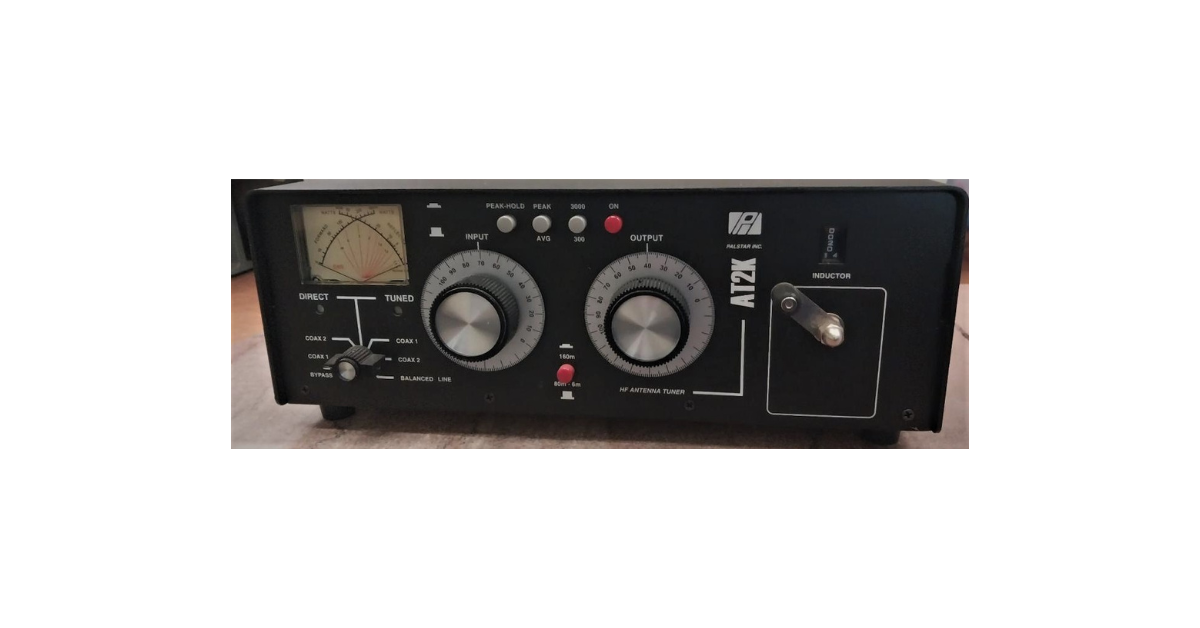
Palstar AT2K Antenna Tuner Review and Performance Overview
Palstar AT2K Review (Quick Verdict)
The Palstar AT2K is a high-power manual antenna tuner designed for serious HF operators who need precise impedance matching and long-term reliability.
- Best for high-power stations and amplifiers
- Extremely wide matching range with precise control
- Not ideal for beginners or operators wanting automatic tuning
Is the Palstar AT2K Worth It?
The AT2K is worth it if you operate high power, use non-resonant antennas, or want precise manual control over impedance matching.
It may not be the best choice if:
- You want automatic tuning
- You frequently change bands quickly
- You prefer plug-and-play operation
👉 This tuner is built for performance, not convenience.
For a complete breakdown of tuner types, setup methods, and real-world operation, see our
Antenna Tuner Guide, which explains how to match antennas effectively across different bands and conditions.
The Palstar AT2K is a high-power manual antenna tuner designed for serious amateur radio operators who require precise impedance matching and long-term reliability. This review explains how it performs in real-world operation, what makes it different from typical tuners, and whether it is the right choice for your station.
The Palstar AT2K antenna tuner is built for serious high-power amateur radio operation. While many tuners focus on convenience, this unit focuses on precision, durability, and wide impedance matching capability. Because modern stations often operate across multiple bands and antenna systems, a high-performance manual tuner can dramatically improve transmission efficiency and equipment protection.
This tuner is designed to match complex antenna loads while handling significant RF power levels. As a result, it is commonly used in high-power HF stations, contest environments, and installations where accurate impedance matching is critical. Although manual tuners require operator involvement, they provide control and tuning accuracy that automated systems often cannot achieve.
Who This Antenna Tuner Is Best For
The Palstar AT2K is best suited for operators running high-power HF stations, linear amplifiers, or multi-band antenna systems that require precise manual tuning.
It is particularly useful for:
- Contest operators
- DX stations
- Non-resonant antenna setups
- Multi-antenna stations
- Operators who prefer manual control over automatic tuning
Key Specifications (Quick Reference)
- Frequency Coverage: 160m – 6m
- Power Handling: High-power (amplifier capable)
- Tuning Type: Manual T-network
- Components: Roller inductor + variable capacitors
- Metering: Cross-needle (SWR, forward, reflected power)
What the Palstar AT2K Antenna Tuner Is Designed to Do
An antenna tuner does not make an antenna resonate, but it allows the transmitter to operate efficiently by transforming impedance. Therefore, the Palstar AT2K works as an impedance matching network that minimizes reflected power and protects sensitive transmitter components.
Because mismatched impedance causes high standing wave ratios, transmitters can lose power or shut down entirely. However, precise manual tuning allows the operator to achieve extremely low reflected power levels. Consequently, signal transfer improves while equipment stress decreases.
This tuner supports high-power transmission across a wide frequency range. Additionally, it accommodates multiple antenna types, which makes it suitable for complex station configurations.
What an Antenna Tuner Actually Does (Important Clarification)
Many operators assume an antenna tuner improves antenna performance directly. In reality, it allows the transmitter to see a proper impedance match, which improves power transfer and protects equipment.
The antenna itself does not become resonant. Instead, the tuner transforms impedance so the transmitter can operate efficiently under non-ideal conditions.

Frequency Coverage and Power Handling Capability
The Palstar AT2K operates across a wide HF and low VHF range. Therefore, it supports operation from 160 meters through 6 meters, allowing multi-band coverage without requiring additional matching devices.
Power handling is one of its defining characteristics. The tuner supports high peak envelope power levels, which makes it suitable for amplifier-driven stations. Because many operators run high duty-cycle digital modes or contest transmissions, reliable power handling becomes essential for long-term equipment stability.
The wide impedance matching range allows the tuner to accommodate antennas that are significantly off resonance. As a result, operators can use wire antennas, verticals, beams, or multi-band systems without requiring perfect antenna tuning at each frequency.
Why the T-Network Design Matters
The T-network design used in the AT2K provides one of the widest impedance matching ranges available in manual tuners.
This allows the tuner to match antennas that are far from resonance, including long-wire antennas, off-center-fed dipoles, and multi-band systems.
Because of this flexibility, the AT2K can solve matching problems that smaller tuners cannot handle.
Real-World Power Handling Considerations
While the AT2K is rated for high power, real-world performance depends on duty cycle, mode, and antenna conditions.
Digital modes such as FT8 or RTTY create continuous carrier conditions that stress components more than SSB. Therefore, operators should operate within safe limits based on mode and transmission duration.
Proper tuning and gradual power increase are essential to avoid component stress or arcing.
Tuning Performance and Matching Range
The Palstar AT2K provides extremely wide matching capability across a broad range of antenna impedances. Because the large roller inductor allows fine incremental adjustment, the tuner can achieve precise matches even on difficult loads. This makes it especially effective for multiband wire antennas, non-resonant antennas, and amplifier-driven systems.
In practical operation, matching occurs quickly once the operator becomes familiar with control interaction. The wide capacitor range and smooth inductance adjustment allow accurate SWR reduction with minimal overshoot. As a result, the tuner maintains stable matches across the HF spectrum and into 6 meters when used within appropriate power limits.
Internal Design and Tuning System
The tuner uses a traditional T-network matching circuit. This design allows precise adjustment of capacitance and inductance to transform impedance across a wide range. Because the system uses large high-voltage components, it maintains stability under high RF stress.
A roller inductor provides continuously adjustable inductance. Meanwhile, precision variable capacitors allow fine tuning of the matching network. Together, these components provide smooth control across the entire operating range.
Vernier dial mechanisms allow accurate repeatable settings. Therefore, once an operator records tuning positions for each band, retuning becomes extremely fast. This repeatability is one of the major advantages of high-quality manual tuners.
Control Precision and Adjustment Behavior
One of the defining characteristics of the AT2K is the mechanical precision of its tuning controls. The roller inductor moves smoothly and predictably, allowing extremely fine inductance changes without sudden jumps. Because of this control resolution, operators can approach a perfect match gradually rather than hunting for it.
The capacitors respond with similar precision. Small adjustments produce measurable SWR changes, which makes fine tuning both accurate and repeatable. This level of mechanical control is especially valuable when working high-power systems where precise matching improves efficiency and reduces stress on equipment.
Metering and Measurement Capabilities
Accurate measurement is essential for proper tuning. For this reason, the Palstar AT2K includes an illuminated cross-needle meter that displays forward power, reflected power, and standing wave ratio simultaneously.
Because the meter displays both forward and reverse power in real time, operators can immediately see the effect of adjustments. Consequently, tuning becomes more efficient and precise.
Peak power measurement functions also help operators monitor amplifier output during transmission. Therefore, the tuner acts not only as a matching device but also as a monitoring instrument.
Understanding SWR and Reflected Power
Standing wave ratio indicates how efficiently power transfers from the transmitter to the antenna.
High SWR means more power reflects back toward the transmitter, reducing efficiency and potentially causing damage. By adjusting the tuner to reduce reflected power, operators improve signal output and protect equipment.
Accurate metering allows operators to see these changes in real time and make precise adjustments.
Antenna Switching and Station Integration
Modern stations often connect multiple antennas. Therefore, the tuner includes a multi-position antenna selector that allows operators to switch between feedlines without rewiring connections.
This feature simplifies station management because antennas can be selected directly from the front panel. Additionally, a bypass position allows direct feedline connection when matching is not required.
Balanced line operation is supported through an external balun. As a result, the tuner works with coaxial feedlines, wire antennas, and balanced transmission systems.
Integrating the AT2K Into a Station
The AT2K typically sits between the transmitter or amplifier and the antenna system.
In high-power setups, it is often placed after the amplifier to handle full output power. Proper grounding and short feedline runs improve performance and reduce RF issues.
Careful station layout ensures safe operation and optimal efficiency.
Precision Tuning and Operator Control
Manual tuning provides complete control over impedance matching. Although automatic tuners prioritize speed, manual tuners prioritize accuracy. Because the operator adjusts inductance and capacitance directly, extremely low SWR values can be achieved.
This level of control is especially valuable when operating high-power amplifiers. Even small impedance mismatches can stress modern solid-state equipment. However, careful manual tuning allows precise matching that protects amplifier output stages.
Additionally, manual tuning encourages operators to understand antenna behavior across frequencies. Therefore, the tuning process becomes part of station optimization rather than an automated background function.
Manual vs Automatic Tuners
Manual tuners like the AT2K prioritize control and precision, while automatic tuners prioritize speed and convenience.
Automatic tuners work well for quick band changes, but they often have limited matching range and reduced accuracy under difficult conditions.
Manual tuners allow exact adjustment, which is critical for high-power and non-resonant antenna systems.
High-Power Operation Stability
The AT2K is designed for sustained high-power operation, which makes it well suited for stations using linear amplifiers. The heavy internal components, large spacing, and robust construction help maintain electrical stability under load. As power levels increase, the tuner continues to respond predictably without sudden drift or instability.
Because manual tuning allows precise control over matching conditions, operators can optimize efficiency at high output levels. This stability helps protect both transmitter and amplifier while maintaining consistent on-air performance.
Real-World Operating Performance
In practical operation, the Palstar AT2K handles a wide variety of antenna systems. Because of its wide impedance range, it can match antennas that are not perfectly resonant on a given band.
Multi-band wire antennas, verticals, and directional arrays can all be matched effectively. As a result, operators gain flexibility when changing bands or experimenting with antenna configurations.
The mechanical construction supports long-term reliability. Large capacitors, heavy inductors, and robust switching components are designed to withstand high RF voltages. Therefore, the tuner performs consistently even during extended high-power transmission.
Real-World Use Case Examples
In contest environments, the AT2K allows rapid retuning between bands once settings are known.
For multi-band wire antennas, it enables operation across several bands without physically changing the antenna.
In high-power amplifier stations, it provides stable matching that protects expensive equipment.
Advantages and Limitations
The AT2K offers extremely wide matching capability, very precise tuning control, and stable high-power performance. Its mechanical design provides smooth adjustment and long-term durability.
However, manual tuning requires operator involvement, and the unit is larger than compact tuners. It also does not provide automatic memory or preset recall.
Pros and Cons Summary
Pros:
- Extremely wide matching range
- Precise manual control with roller inductor
- Excellent for high-power operation
- Durable, heavy-duty construction
Cons:
- Requires manual tuning skill
- Larger and heavier than compact tuners
- No automatic memory or presets
Why High-Power Operators Prefer Manual Tuners
Manual tuners provide maximum tuning range and precise control. While automatic tuners prioritize convenience, they often have limited matching capability at high power levels.
Because high-power stations require stable impedance transformation, manual tuners remain popular among experienced operators. Additionally, manual systems allow exact repeatable settings, which reduces tuning time after initial calibration.
Operators who run amplifiers, contest stations, or wide-band antennas often prefer manual tuning for reliability and precision.
Comparison to Typical Manual Antenna Tuners
Compared to standard manual antenna tuners, the AT2K offers significantly greater control resolution and power handling capability. Many smaller tuners provide adequate matching but lack the mechanical precision needed for fine adjustment at high power.
The large roller inductor and wide capacitor range give the AT2K a broader tuning envelope than most compact designs. As a result, it performs more consistently across difficult impedance conditions while maintaining stable operation under heavy load.
Palstar AT2K vs MFJ High-Power Manual Tuners
Both Palstar and MFJ produce high-power manual antenna tuners, but their design priorities differ. MFJ high-power tuners often emphasize versatility and affordability, while the AT2K focuses heavily on mechanical precision and long-term stability.
The AT2K’s roller inductor provides smoother and more controlled adjustment than many tapped-inductor designs. Because of this, fine matching tends to be easier and more repeatable. Operators who value precise manual control and heavy-duty construction often prefer the AT2K, while those seeking lower cost or simpler adjustment may choose alternative designs.
What to Consider Before Buying
Before choosing the AT2K, consider your station power level, antenna types, and operating style.
If you frequently change bands and prefer convenience, an automatic tuner may be more suitable. However, if you operate high power, use non-resonant antennas, or want maximum control, a manual tuner provides significant advantages.
Understanding your station requirements ensures you select the right tuning solution.
Check Current Price and Availability
If you’re considering the Palstar AT2K for your station, check current pricing and availability below:
Station Optimization Benefits
Proper impedance matching improves overall station efficiency. When reflected power decreases, more transmitter energy reaches the antenna. Therefore, signal strength increases without increasing transmitter output.
Additionally, reduced SWR protects feedlines, connectors, and amplifier components. Because high reflected power can generate excessive heat and voltage stress, proper matching extends equipment life.
The Palstar AT2K supports these improvements by providing stable, precise impedance transformation across multiple bands.
Improve Your Antenna System
To get the most out of a tuner like the AT2K, these guides will help:
- 👉 Antenna Tuning Guide
- 👉 SWR Explained
- 👉 Coax Cable Loss Guide
- 👉 Best HF Antennas
Who Should Choose the Palstar AT2K
The AT2K is ideal for operators running high-power transmitters, linear amplifiers, or multiple antenna systems that require precise manual tuning. It is especially well suited for experienced operators who prefer direct control over matching conditions.
Stations using non-resonant antennas, multiband wire systems, or frequently changing operating bands benefit most from its wide tuning range and mechanical precision. Operators seeking maximum control and long-term durability will find the AT2K particularly well matched to their needs.
Build Quality and Mechanical Design
Mechanical durability is essential in high-power RF environments. The Palstar AT2K uses high-voltage rated components and precision mechanical assemblies.
Large variable capacitors handle significant RF voltage without arcing. Meanwhile, the roller inductor uses durable materials designed for continuous adjustment under load conditions.
The enclosure is built to support heavy components while maintaining stable alignment. Therefore, tuning accuracy remains consistent over time.
Final Verdict: Is the Palstar AT2K Worth Buying?
The Palstar AT2K is one of the best manual antenna tuners available for high-power amateur radio operation.
It excels in precision, durability, and wide impedance matching capability. Operators running amplifiers or complex antenna systems will benefit most from its performance.
However, it is not designed for convenience. Beginners or operators who prefer automatic tuning may find it less practical.
👉 For experienced operators who want full control and long-term reliability, the AT2K is an outstanding choice.
Frequently Asked Questions
Does the Palstar AT2K improve antenna performance?
No, it does not make the antenna more efficient. It allows the transmitter to operate properly by matching impedance.
Can the AT2K handle full amplifier power?
Yes, but actual limits depend on mode, duty cycle, and tuning conditions.
Is a manual tuner better than an automatic tuner?
Manual tuners provide more precise control and wider matching range, while automatic tuners offer convenience.
Do I need a tuner if my antenna is resonant?
Not always, but a tuner can still help optimize matching and reduce reflected power.
About the Author
Vince, W2KU, is a licensed Extra class amateur radio operator and the founder of Ham Shack Reviews. The committee named him Amateur of the Year in 2026 for his contributions to amateur radio education and equipment evaluation.
He primarily operates HF, knows propagation very well, operates mobile and handhelds daily. Vince exchanges QSL cards for DXCC, contest confirmation, and award tracking and is the club QSL manager. His guidance focuses on practical operating procedures, accurate logging, and real-world amateur radio practices.
Please consider Donating to help support this channel