
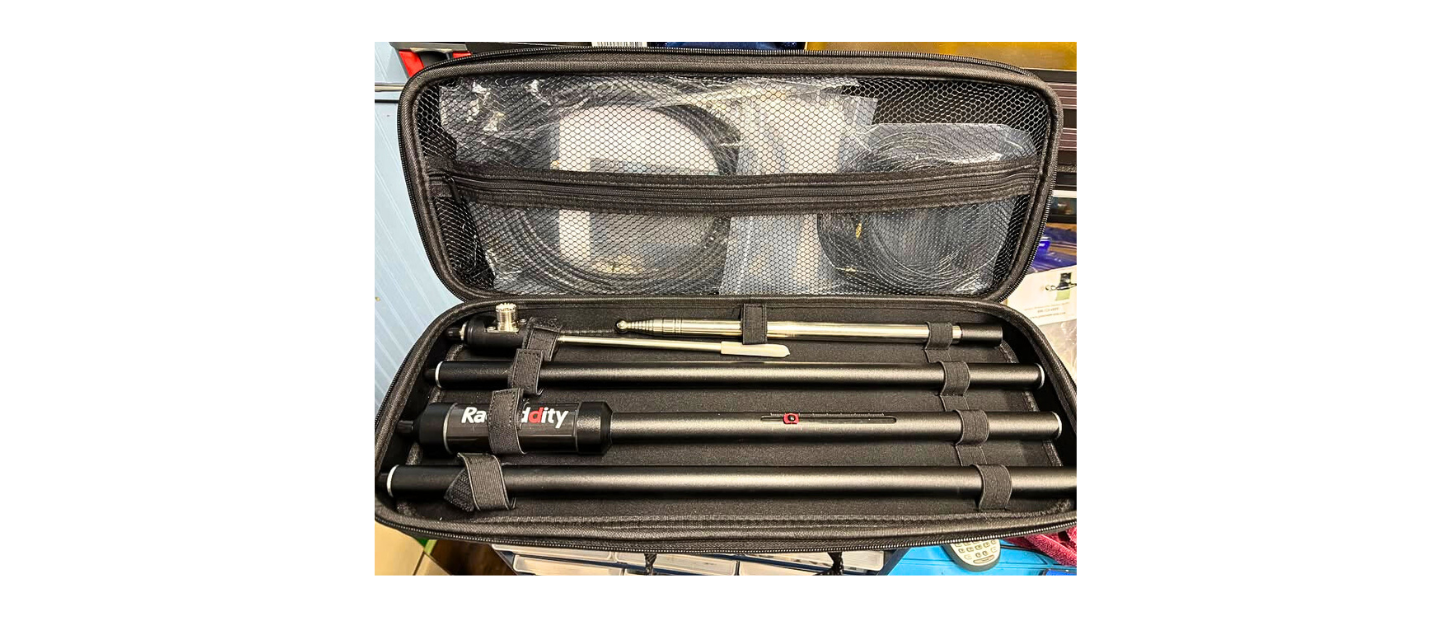
Radioddity HF-009 Antenna Review: Full Performance Testing, Installation, Tuning, Grounding, and Real-World Field Operation Guide
Radioddity HF-009 Portable HF Antenna Quick Answer
The Radioddity HF-009 Antenna is a manually tunable portable HF vertical antenna that uses a telescopic whip and adjustable loading coil to achieve resonance across multiple HF bands from roughly 7 MHz through 30 MHz. Because it compensates for shortened physical length using inductive loading, it delivers practical multi-band performance for portable, mobile, QRP, and emergency communication when installed with an effective counterpoise and tuned carefully.
Introduction to the Radioddity HF-009 Portable HF Antenna
Portable HF operation requires equipment that balances electrical performance with mechanical portability. Operators must deploy quickly, tune precisely, and maintain reliable radiation efficiency in unpredictable environments. Therefore, a portable antenna must function as a complete field communication solution rather than just a compact radiator.
The Radioddity HF-009 was designed specifically to address these field operating realities. Because full-size HF antennas demand physical space that portable operators rarely have, engineers use electrical techniques to simulate required antenna length. The HF-009 accomplishes this through a telescopic whip combined with a manually adjustable loading coil. This configuration allows electrical resonance across multiple HF bands without requiring physically long elements.
Additionally, portable operators frequently run low transmitter power. Therefore, antenna efficiency determines communication success far more than transmitter output. When tuned correctly and paired with a proper counterpoise, the HF-009 converts a significant portion of transmitter energy into radiated signal. Consequently, operators achieve meaningful communication range even with QRP power levels.
Moreover, the antenna collapses into a compact transport length. Because portability directly influences deployment speed, operators can carry and deploy the HF-009 in field packs, emergency kits, vehicle installations, and temporary stations without logistical difficulty.
Fundamental Electrical Design and Operating Theory
Every shortened HF antenna must compensate for insufficient physical conductor length. Normally, a resonant quarter-wave radiator at lower HF frequencies requires significant height. However, portable operation rarely allows structures of that scale. Therefore, designers introduce inductive loading to simulate the missing electrical length.
The HF-009 uses a loading coil to provide inductive reactance. Because inductive reactance offsets capacitive reactance caused by shortened conductor length, the antenna reaches electrical resonance at the desired operating frequency. Consequently, the antenna behaves electrically like a longer radiator while remaining physically compact.
Meanwhile, the telescopic whip provides adjustable physical length. Operators extend or retract the whip to fine tune resonant frequency after selecting the correct coil tap. Because whip length changes the effective electrical length of the radiating element, small mechanical adjustments produce measurable impedance changes.
Additionally, the antenna operates with vertical polarization. Vertical polarization produces low-angle radiation patterns. Because low-angle radiation propagates efficiently through ionospheric reflection, it supports long-distance communication. Therefore, portable operators gain practical DX capability even from temporary field locations.
Radiation Efficiency and System Loss Mechanisms
Radiation efficiency determines how much transmitter power becomes useful radiated energy. Shortened antennas inherently exhibit reduced radiation resistance and increased loss resistance. Therefore, minimizing loss becomes critical.
Ground loss represents the largest efficiency factor. Because RF return current must flow through a counterpoise or ground system, poor grounding converts energy into heat rather than radiation. Consequently, a properly designed counterpoise dramatically improves signal strength.
Loading coil resistance introduces unavoidable loss as well. However, efficient coil design reduces resistive heating and preserves usable power.
Feedline loss and connection resistance also influence system efficiency. Therefore, proper mechanical assembly and secure electrical connections are essential for optimal performance.
When operators minimize these loss mechanisms, the HF-009 delivers efficient radiation despite its compact physical dimensions.
Mechanical Construction and Structural Reliability
Portable antennas experience frequent assembly, transport, vibration, and weather exposure. Therefore, mechanical durability directly affects long-term reliability.
The HF-009 uses a stainless steel telescopic whip. Because stainless steel resists corrosion and mechanical fatigue, it maintains structural integrity through repeated extension cycles. Additionally, the loading coil housing protects internal windings from environmental exposure and mechanical stress.
The antenna mounts using a standard threaded interface. Consequently, operators can attach it securely to tripods, magnetic mounts, or vehicle mounting hardware. Mechanical stability prevents movement that could detune the antenna during operation.
Frequency Coverage and Multi-Band Operation
The HF-009 operates across approximately 7 MHz through 30 MHz. Because this range includes multiple amateur HF bands, operators can adjust frequency coverage based on propagation conditions.
Lower frequencies require greater inductive loading and more careful grounding. However, higher frequencies require less electrical compensation and often tune more easily. Consequently, operators can retune rapidly as propagation changes throughout the day.
This multi-band flexibility allows a single antenna to support continuous operation across varying propagation windows.
Real-World Portable Performance Characteristics
Field operation introduces environmental variables that strongly influence antenna performance. Soil conductivity, mounting height, terrain, and surrounding objects all affect radiation efficiency and pattern shape.
However, when operators provide an effective counterpoise and proper tuning, the HF-009 produces consistent signal reports across multiple HF bands. Elevated installation frequently improves radiation efficiency because it reduces ground absorption.
Once tuned and mechanically secured, the antenna maintains stable electrical characteristics. Therefore, operators can rely on consistent performance during extended operating sessions.
QRP Efficiency and Low-Power Performance
Portable HF stations frequently operate with low transmitter power. Therefore, efficient energy transfer becomes essential.
Because the HF-009 allows precise manual tuning, operators achieve low SWR across multiple bands. Reduced reflected power increases effective radiated energy. Consequently, even modest transmitter power produces useful communication range.
Additionally, vertical polarization supports low-angle radiation, which enhances long-distance propagation. Therefore, QRP operators can achieve reliable regional and DX contacts when propagation conditions support communication.
Step-by-Step Installation and Deployment Procedure
Proper installation determines overall antenna performance. Therefore, follow a structured setup sequence.
1 Mount the antenna securely on a stable support structure.
2 Install a counterpoise or radial system.
3 Extend the telescopic whip to starting length.
4 Connect the feedline securely.
5 Select the operating band.
6 Adjust the loading coil tap gradually.
7 Monitor SWR while tuning.
8 Fine tune whip length for minimum SWR.
8 Secure all mechanical adjustments.
Because precise tuning maximizes radiated energy, careful installation directly improves communication effectiveness.
Grounding and Counterpoise Optimization
Vertical antennas depend heavily on return current paths. Therefore, grounding quality strongly influences radiation efficiency.
A properly sized counterpoise reduces ground loss and stabilizes impedance. Elevated radial wires often outperform direct ground contact because they reduce resistive loss.
Because soil conductivity varies by location, operators should experiment with radial length and configuration to optimize performance on specific bands.
Field Deployment Environments and Operating Scenarios
Operators deploy the HF-009 in diverse environments. Summit activations, remote field sites, emergency communication staging areas, and mobile installations all benefit from rapid deployment capability.
Because the antenna assembles quickly, operators establish communication with minimal preparation time. Additionally, compact size allows transport with limited equipment capacity.
Vehicle mounting provides another effective deployment method. Because vehicle bodies provide conductive mass, they frequently function as efficient counterpoise systems.
Controlled Testing Methodology and Performance Evaluation
Accurate evaluation requires consistent testing conditions. Therefore, performance measurements included SWR stability, signal reports from distant receiving stations, and tuning repeatability after multiple deployments.
Testing used consistent transmitter power levels and identical feedline lengths. Additionally, evaluation compared different counterpoise configurations and mounting heights.
Because controlled testing isolates performance variables, results represent true antenna behavior rather than environmental randomness.
Environmental Effects on Performance
Weather conditions, terrain, and nearby conductive objects influence antenna performance. Moist soil improves ground conductivity and can increase radiation efficiency. Nearby structures can distort radiation patterns.
Because environmental factors vary widely, site evaluation improves communication results.
Comparison With Other Portable HF Antenna Designs
Portable HF antennas follow multiple design approaches. Long wire antennas provide high efficiency but require support structures. Magnetic loop antennas offer compact size but narrow bandwidth. Multi-section vertical antennas provide strong performance but increase transport complexity.
The HF-009 prioritizes compact size and manual tuning flexibility. Therefore, it offers rapid deployment with moderate efficiency. While full-length antennas outperform it when space allows, portable operators often prioritize mobility.
Quick Comparison Insight
HF-009 excels in portability and rapid deployment, while wire and full-size vertical antennas provide higher peak efficiency when space permits.
Field Performance Comparison
| Field Test Category | Radioddity HF-009 Vertical | Portable Wire Antenna (EFHW / Dipole) | Magnetic Loop Antenna | Full-Size Portable Vertical |
|---|---|---|---|---|
| Deployment Time | Very fast (2–5 minutes) | Moderate (10–20 minutes with supports) | Fast (5–10 minutes) | Slow (15–30 minutes with radials) |
| Required Setup Space | Very small footprint | Requires horizontal span or trees | Very compact | Moderate ground area required |
| Multi-Band Operation | Manual tuning via coil and whip | Band specific unless tuner used | Continuous tuning required | Band dependent, often multi-band with radials |
| Tuning Difficulty | Moderate manual tuning | Usually minimal if resonant | Very precise tuning required | Moderate depending on design |
| SWR Stability After Setup | Stable once secured | Very stable | Sensitive to nearby objects | Stable if radial field consistent |
| Grounding Requirement | Critical for best performance | Minimal or none | Minimal | Essential for efficiency |
| Radiation Efficiency | Moderate for size | High when properly installed | Moderate but narrow bandwidth | High when fully deployed |
| DX Performance | Good low-angle radiation | Excellent when elevated | Good but power limited | Excellent with proper ground system |
| Noise Pickup | Moderate vertical noise | Generally lower noise floor | Often low noise | Moderate |
| QRP Performance | Very good when tuned properly | Excellent | Good but tuning sensitive | Excellent |
| Power Handling | Moderate (portable limits) | High depending on wire and balun | Limited by loop design | High |
| Portability | Excellent | Good but bulkier | Excellent | Moderate |
| Wind / Weather Resistance | Good if secured | Depends on supports | Sensitive to movement | Good when anchored |
| Mechanical Complexity | Low | Moderate | High precision components | Moderate |
| Field Repair Simplicity | Very easy | Easy | Difficult | Moderate |
| Ideal Use Scenario | Rapid deployment portable HF | Long operating sessions with space | Restricted space or stealth | Semi-permanent field station |
Common Setup Errors and Troubleshooting
Inadequate grounding remains the most common performance limitation. Without sufficient counterpoise, radiation efficiency drops significantly.
Incorrect coil adjustment produces high SWR and reduced signal output. Therefore, operators must tune gradually and monitor SWR carefully.
Mechanical instability can shift resonance. Secure mounting prevents detuning.
Maintenance and Long-Term Reliability
Routine inspection preserves performance. Operators should check whip sections for wear and ensure coil connections remain secure. Cleaning contact surfaces prevents resistive loss.
Buyer Decision Framework
Choose the HF-009 if portability, rapid deployment, and multi-band flexibility are primary priorities. It suits operators who deploy frequently and adapt to changing environments.
Operators with permanent installations may prefer full-size resonant antennas for maximum efficiency.
Advantages and Limitations
Advantages include compact size, adjustable resonance, and multi-band capability. Limitations include reduced efficiency compared to full-length verticals and dependence on proper grounding.
Technical Specifications
Frequency range approximately 7 to 30 MHz
Telescopic stainless steel whip
Adjustable loading coil
Standard threaded mount
Power handling up to 100 watts SSB
Collapsed length approximately 2.5 feet
Extended length approximately 8.5 feet
Lightweight portable construction
Professional Operating Perspective
Experienced portable operators understand that antenna performance depends more on installation quality than equipment complexity. Because the HF-009 allows precise manual tuning, skilled operators can optimize performance rapidly.
Expanded Frequently Asked Questions
Does the antenna require an external tuner?
Often no when tuned correctly
Can it operate effectively on 40 meters?
Yes with proper counterpoise
Is it suitable for emergency deployment?
Yes due to rapid setup
Does mounting height affect performance?
Yes elevation improves radiation efficiency
About the Author
Vince, W2KU, is a licensed Extra class amateur radio operator and the founder of Ham Shack Reviews. He was named Amateur of the Year in 2026 for contributions to practical amateur radio education and equipment evaluation.
He primarily operates HF, knows propagation very well, operates mobile and handhelds daily. Vince exchanges QSL cards for DXCC, contest confirmation, and award tracking and is the club QSL manager. His guidance focuses on practical operating procedures, accurate logging, and real-world amateur radio practices.
Final Evaluation of the Radioddity HF-009 Antenna
The Radioddity HF-009 Antenna provides practical multi-band HF capability in a compact portable structure. Because it combines adjustable electrical length with portable mechanical design, it supports reliable communication from temporary operating locations. When installed properly and tuned carefully, it delivers consistent performance across multiple HF bands.
Please consider Donating to help support this channel