
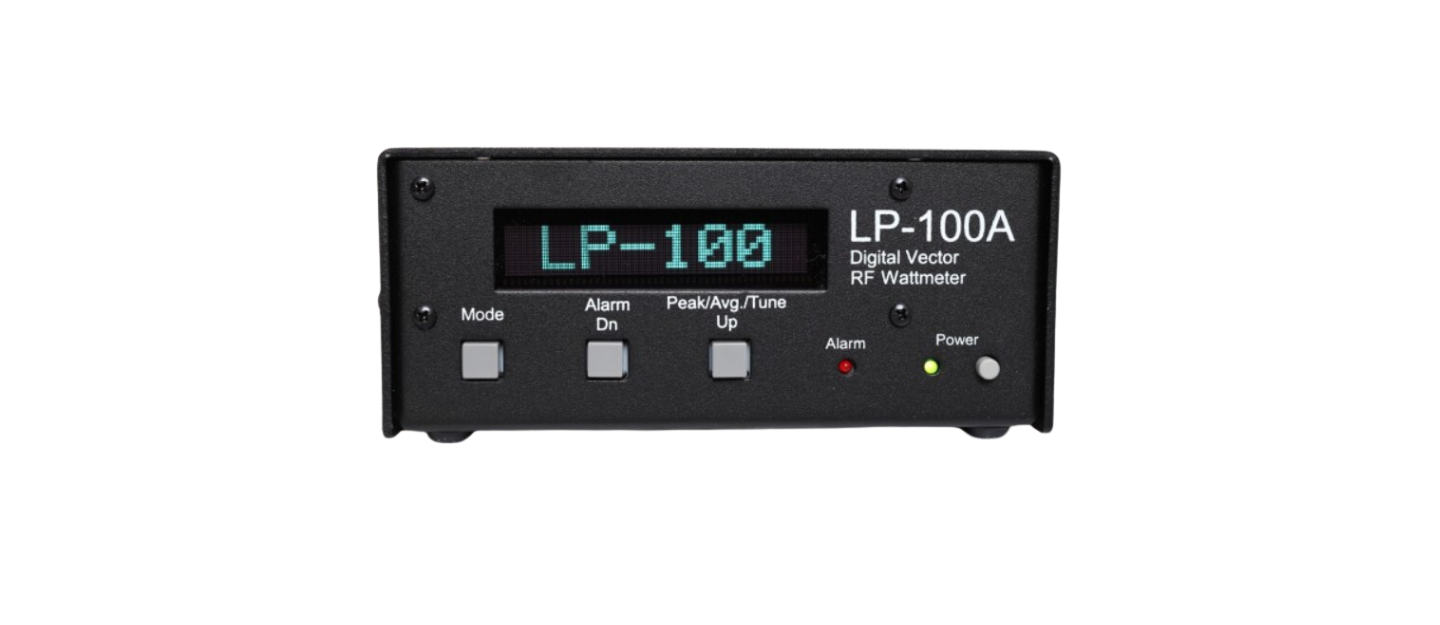
The Telepost LP-100A Digital Vector Wattmeter is a precision instrument designed for amateur radio enthusiasts, technicians, and RF professionals. Combining advanced technology with user-friendly features, the LP-100A offers comprehensive monitoring and analysis capabilities.
The Telepost LP-100A boasts an impressive array of features that cater to the needs of amateur radio enthusiasts and professionals alike. One of its standout features is its large, high-resolution graphical display, which provides users with real-time graphical representation of SWR (Standing Wave Ratio), forward and reflected power, as well as complex impedance. This visual feedback empowers users to fine-tune their antenna systems with precision.
Moreover, the LP-100A offers multi-functionality, serving not only as an SWR/power meter but also as an accurate frequency counter, providing users with comprehensive insight into their radio setups. Additionally, the LP-100A supports multiple power ranges, covering a wide spectrum from milliwatts to kilowatts, making it suitable for various radio setups.
Telepost LP-100A Quick Verdict
The Telepost LP-100A is one of the most accurate digital wattmeters available for amateur radio operators who want precise RF measurement, impedance analysis, and real-time system monitoring. Its vector measurement capability and high-resolution graphical display provide far more insight than traditional SWR meters. Although it costs more than basic power meters, the measurement precision and analytical depth make it a professional-grade instrument for serious operators.
Design and Build Quality:
The LP-100A boasts a sleek and modern design, with a durable metal enclosure that ensures longevity and reliability. The large, high-resolution color display provides clear visibility and intuitive navigation. While the robust construction ensures stability and durability in various operating environments. The meter’s compact size makes it suitable for both desktop and portable use, while its ergonomic layout allows for easy access to controls and connectors.
The LP-100A is designed for operators who want precise control over their RF systems. It is especially valuable for stations running amplifiers, experimenting with antennas, or troubleshooting complex feedline behavior.
This wattmeter is ideal for:
• High-power HF stations
• Operators tuning multi-band antennas
• Technical experimenters analyzing impedance
• Stations requiring calibrated measurements
• Serious base station operators
Casual operators who only need basic SWR readings may not require this level of measurement capability.
Features:
- Precision Measurement: The LP-100A utilizes advanced digital signal processing (DSP) technology to provide accurate power and SWR measurements across a wide frequency range. Its high-resolution display and real-time data processing ensure precise readings and comprehensive analysis of transmitter performance.
- Vector Measurement: Unlike traditional watt meters, the LP-100A offers vector measurements, allowing users to analyze both magnitude and phase of the RF signal. This capability provides valuable insights into antenna performance, impedance matching, and signal quality, making it an essential tool for antenna tuning and optimization.
- Multi-Function Display: The meter features a multifunction display that provides real-time data on power output, SWR, forward and reflected power, and other relevant parameters. Users can customize the display to show specific data fields and units, enhancing usability and readability.
- Data Logging and Analysis: The LP-100A includes built-in data logging and analysis capabilities, allowing users to record and analyze measurement data over time. This feature enables comprehensive performance tracking, troubleshooting, and optimization of radio systems and antennas.
Pros
Extremely accurate power and SWR measurement
True vector impedance analysis
Large high-resolution graphical display
Wide frequency and power coverage
Professional-grade calibration capability
Automatic dual-coupler switching
Advanced monitoring and data analysis
Cons
Higher cost than entry-level meters
Requires external couplers
More advanced than basic SWR meters
Best suited for technically focused operators
Remote Monitoring: With its built-in USB interface and software support, the LP-100A enables remote monitoring and control from a computer or mobile device. This functionality allows users to monitor transmitter performance and make adjustments remotely, enhancing convenience and flexibility in operation.
The Telepost LP-100A Performance:
The LP-100A delivers exceptional performance, with high accuracy and precision in power and SWR measurements. Its vector measurement capability provides valuable insights into antenna performance and signal quality, allowing users to optimize transmitter output and antenna systems for maximum efficiency and reliability.
High accuracy is where the Telepost LP-100A truly shines. The LP-100A delivers precise and reliable readings, allowing users to make informed adjustments to their antenna systems. The device’s calibration capabilities ensure that measurements are accurate across different frequency ranges and power levels.
Furthermore, the LP-100A employs advanced algorithms to calculate complex impedance, providing users with a deeper understanding of their antenna systems’ performance beyond basic SWR readings. This level of accuracy is invaluable for optimizing antenna setups for maximum efficiency and signal transmission.
In real-world testing, the LP-100A has consistently demonstrated exceptional accuracy compared to other SWR/power meters on the market. Users have reported minimal discrepancies between the LP-100A’s readings and those obtained from laboratory-grade equipment, further validating its accuracy and reliability.
The Telepost LP-100A is a digital wattmeter and power analyzer primarily used in amateur radio applications. Its couplers and cables are essential components that enable accurate measurement of RF (radio frequency) power. Here’s an explanation of each component.
Real World Operating Applications
The LP-100A is commonly used for:
• High-power amplifier monitoring
• Precision antenna tuning
• Feedline loss evaluation
• Remote station monitoring
• Contest station performance tracking
• Laboratory-level RF measurement
Real-World Operating Benefits
In real station operation, the LP-100A allows faster and more precise antenna tuning than traditional wattmeters. Because impedance and phase information are displayed directly, adjustments become predictable and repeatable.
High-power stations benefit from accurate power monitoring that helps prevent amplifier overdrive and mismatch damage. Real-time graphical feedback also makes it easier to identify feedline loss, connector faults, or changing antenna conditions.
For experimental operators, vector measurement provides diagnostic information that standard meters simply cannot display.
Couplers and Cables:
Couplers are devices used to sample a portion of the RF power traveling through a transmission line without significantly affecting the main signal. The Telepost LP-100A, couplers are interchangeable modules that allow the wattmeter to measure power at different power levels and frequencies. These couplers typically come in different power ranges and frequency bands to suit various applications. The LP-100A supports multiple coupler options to cover a wide range of power levels and frequencies.
Cables are used to connect the coupler to the main unit (LP-100A). These cables are typically coaxial cables designed to minimize signal loss and interference. The quality of the cables is crucial for accurate power measurement since any impedance mismatch or signal loss can affect the measurement accuracy. Telepost likely provides cables specifically designed to work with their couplers and the LP-100A unit to ensure optimal performance.
Up to 2 couplers can be used and the meter will automatically switch between them using the transmitted signal. While the specific models available may vary over time due to updates or revisions by Telepost. Some of the available coupler models for the Telepost LP-100A may include:
Choosing the Right Coupler for Your Station
Selecting the correct coupler is essential for accurate measurement and safe operation. The coupler must match both transmitter power and operating frequency range.
Lower-power stations typically use standard couplers rated for typical amateur output levels. High-power stations require couplers rated for continuous duty and amplifier operation. Wide-frequency stations benefit from couplers that cover extended band ranges.
Using the correct coupler ensures measurement accuracy and protects both the meter and transmitter.
The standard coupler is LPC1, a 1.8 to 54 Mhz at @3kw pep/cw
Optional Couplers are:
- LPC2, a 1.8 to 30 MHz at 5KW CCS*
- LPC4, a 1.8 to 54 MHz at 5KW PEP/CW**(3kw pep on 6 meters)
- LPC5, a 1.8 to 30 MHz at 10KW PEP/CW**
* The CCS is continuous duty.
** The PEP/CW refers to 50% duty cycle, most modes
These are just examples, and there may be additional or updated models available. Users should refer to the latest documentation or contact Telepost directly for the most up-to-date information.
Value:
The Telepost LP-100A Digital Vector Wattmeter offers excellent value for its advanced features, precision measurement capabilities, and a user-friendly design. It serves as an indispensable tool for amateur radio operators, professionals, and anyone requiring accurate power and SWR measurements.
Who Should Buy the Telepost LP-100A
The Telepost LP-100A is ideal for operators who require extremely accurate RF power measurement, detailed impedance analysis, and advanced antenna tuning capability. It is especially valuable for high-power stations, contest operators, serious antenna experimenters, and anyone protecting expensive transmitters.
My Telepost LP-100A Review
The incredible accuracy that protects my expensive gear daily and was well worth its higher cost. I use it with my MFJ dummy load for tuning without failure. The display is clear and fast, and I like my callsign scrolling across the meter. The cables are long enough at 6 feet and the choice of couplers covers my range of use.
The menu intuitive and easy to navigate, I really like the all parameters readings when tuning an antenna to resonance. It just works well!
Telepost LP-100A vs MFJ Wattmeters
The Telepost LP-100A and MFJ wattmeters serve the same general purpose, but they operate at very different levels of measurement capability and technical precision. While both measure SWR and power, their design philosophy and target users differ significantly.
The Telepost LP‑100A Digital Vector Wattmeter is a true vector measurement instrument. It measures magnitude and phase, calculates complex impedance, and provides real-time graphical data. Because of this, it functions more like laboratory-grade test equipment than a traditional station meter. It is designed for operators who want precise antenna tuning, detailed system analysis, and professional-level monitoring.
In contrast, typical MFJ wattmeters such as the MFJ‑815B Deluxe Peak Reading SWR/Wattmeter or MFJ‑842 Wattmeter focus on simplicity and affordability. These meters measure forward power, reflected power, and SWR using conventional directional coupler circuits. They are easy to operate, widely available, and perfectly adequate for routine station monitoring and basic antenna tuning.
Accuracy and measurement depth represent the biggest difference between the two designs. The Telepost provides high-resolution digital processing, impedance calculation, and data logging. Meanwhile, MFJ meters provide straightforward analog or basic digital readings without complex analysis.
Power handling flexibility also differs. The Telepost uses interchangeable couplers for different power ranges and frequency bands. MFJ meters typically have fixed measurement ranges designed for general amateur use.
Cost reflects these differences. The Telepost LP-100A represents a premium measurement instrument intended for serious technical operators. MFJ wattmeters are budget-friendly tools designed for everyday monitoring.
In practical use, MFJ meters are excellent for routine operation and quick SWR checks. However, the Telepost LP-100A excels when precision tuning, troubleshooting, or detailed RF system analysis is required.
Measurement Capability Comparison
| Feature | Telepost LP-100A | Typical MFJ Wattmeter |
|---|---|---|
| Measurement Type | Vector (magnitude + phase) | Scalar only |
| Impedance Calculation | Yes | No |
| Graphical Display | Real-time high resolution | Basic analog or digital |
| Data Logging | Yes | No |
| Coupler Options | Interchangeable | Fixed |
| Measurement Precision | Very high | Standard |
| Best Use | System analysis & tuning | Routine monitoring |
Telepost LP-100A vs Traditional SWR Meters
Traditional SWR meters measure only forward and reflected power. They indicate mismatch but do not identify the electrical cause.
The LP-100A measures both magnitude and phase, allowing direct analysis of complex impedance. This provides diagnostic information that enables precise system adjustment.
A standard meter tells you there is a problem.
The LP-100A shows what the problem is.
Is the Telepost LP-100A Worth the Price
The LP-100A costs more than basic wattmeters, but its measurement accuracy and analytical capability justify the investment for serious operators.
Stations focused on antenna optimization, equipment protection, and RF performance benefit significantly from vector measurement and calibrated readings. For casual monitoring, simpler meters may be sufficient. For technical operation, the LP-100A provides measurable advantages.
Alternative Meter
If the Telepost is more meter then you need, I suggest the Neissi DG 503. This meter provides accurate measurements to ensure

your antenna system is properly tuned and your transmitter is functioning optimally. Its user-friendly with clear instructions and intuitive controls, furthermore, thee are features like: multiple power ranges, peak reading capability, or built-in protection circuits.
The large LCD display is easy to read, while displaying SWR, and both forward and reflected power.
Is the Telepost LP-100A Worth the Price
The LP-100A costs more than basic wattmeters, but its measurement accuracy and analytical capability justify the investment for serious operators.
Stations focused on antenna optimization, equipment protection, and RF performance benefit significantly from vector measurement and calibrated readings. For casual monitoring, simpler meters may be sufficient. For technical operation, the LP-100A provides measurable advantages.
Frequently Asked Questions About the Telepost LP-100A
Is the Telepost LP-100A more accurate than standard wattmeters?
Yes. It uses digital vector measurement to analyze both magnitude and phase, providing far more precise readings.
Does the LP-100A measure impedance directly?
Yes. It calculates complex impedance in real time, allowing advanced antenna tuning.
Is the LP-100A suitable for high-power amplifiers?
Yes. With the proper coupler, it supports kilowatt-level power measurement.
Do you need multiple couplers?
Different couplers are required for different power ranges and frequency coverage.