
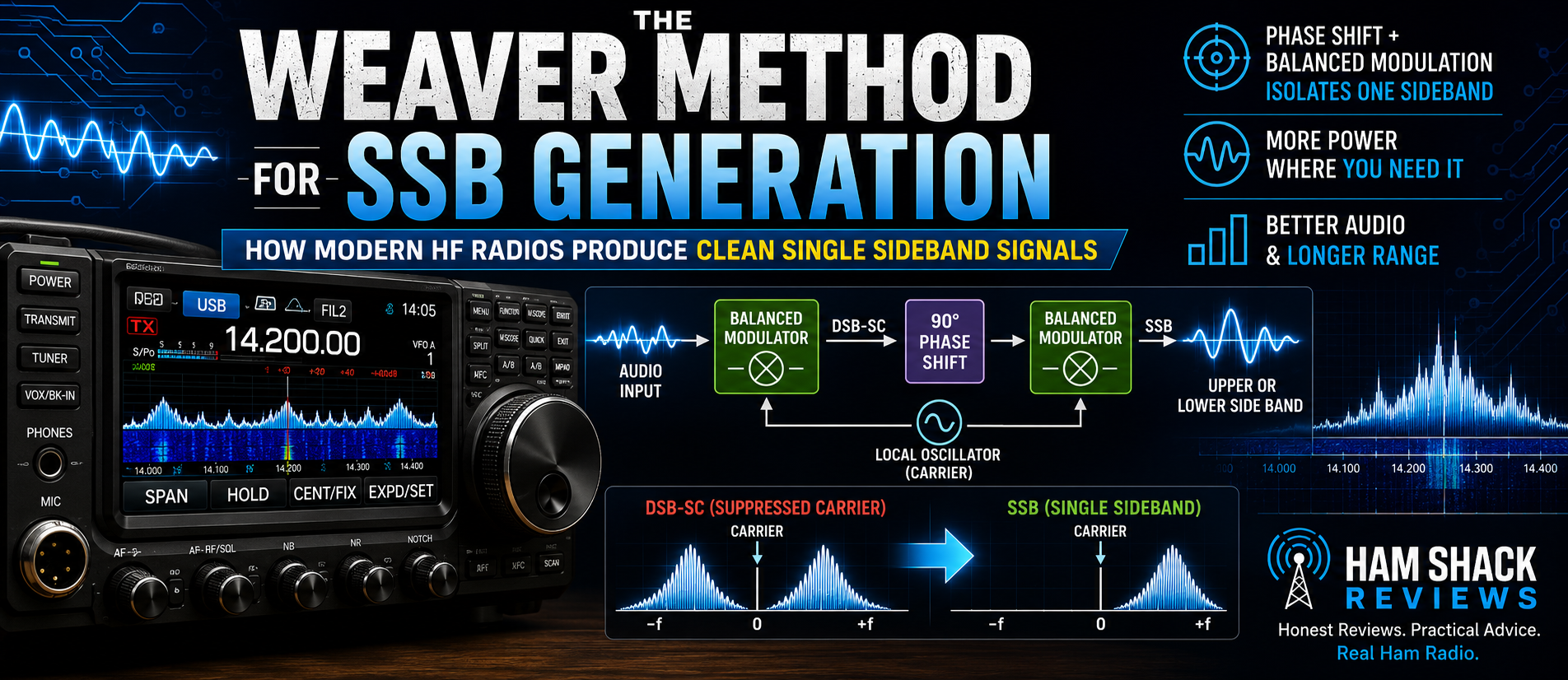
Weaver Method for Single Sideband (SSB) has remained the primary voice mode for HF amateur radio operators for decades because it provides excellent spectrum efficiency and allows long-distance communication using relatively low transmitter power. While most operators understand how to tune and operate SSB, far fewer know how modern transceivers actually generate a clean single sideband signal.
One of the most important advances in SSB technology is the Weaver method, a technique developed to generate single sideband signals without relying entirely on traditional crystal or mechanical filters. Instead of removing the unwanted sideband after it is created, the uses carefully controlled phase relationships and mathematical cancellation to produce only the desired sideband.
Although relatively few amateur radio manufacturers identify the Weaver method by name, its principles continue to influence modern digital signal processing (DSP) and software-defined radio (SDR) technology.
Today’s high-performance transceivers often generate exceptionally clean SSB signals using digital quadrature processing based on the same mathematical concepts introduced by Donald K. Weaver.
Understanding this method provides valuable insight into the evolution of amateur radio technology. If you enjoy operating vintage equipment, modern HF transceivers, or software-defined radios, learning how the Weaver method works helps explain why today’s radios produce cleaner signals with greater flexibility than many earlier designs.
Quick Answer About Weaver Method
The single sideband (SSB) signals are generated by using quadrature audio processing, balanced mixers, and mathematical sideband cancellation instead of depending solely on crystal or mechanical filters. Many modern DSP and SDR transceivers use digital I/Q processing based on the same fundamental principles.
At a Glance
| Feature | Description |
|---|---|
| Inventor | Donald K. Weaver |
| Purpose | Generate single sideband signals |
| Primary Technique | Quadrature processing |
| Uses Crystal Filter | Not required for sideband generation |
| Uses Phase Shifting | Yes |
| Common Today | DSP and SDR architectures |
| Primary Benefit | Excellent sideband suppression |
What Is the Weaver Method?
The Weaver method is a technique for generating single sideband signals using quadrature signal processing rather than relying entirely on narrow crystal or mechanical filters. Instead of producing both sidebands and filtering one away, the Weaver method mathematically cancels the unwanted sideband before transmission.
The process begins by dividing the audio into two signal paths. One path receives a precise 90-degree phase shift while the other remains unchanged. Each signal then mixes with separate local oscillator signals that also maintain a 90-degree phase relationship. When the mixer outputs combine correctly, one sideband reinforces itself while the unwanted sideband cancels almost completely.
This mathematical approach produces a clean SSB signal without requiring highly selective analog filters for sideband removal.
Why Was the Weaver Method Developed?
Early single sideband transmitters primarily relied on two methods for generating SSB signals.
The first used crystal or mechanical filters to remove one sideband after generating a double-sideband signal. While this approach produced excellent results, high-quality filters were expensive and often limited flexibility.
The second relied on analog phase-shift networks. Although the phasing method eliminated the need for crystal filters, maintaining an accurate 90-degree phase shift across the entire audio spectrum proved difficult with analog components.
Donald Weaver introduced a different solution. By moving much of the phase processing to a lower intermediate frequency, the Weaver method simplified sideband generation while reducing many of the phase accuracy problems found in earlier phasing systems.
How the Weaver Method Works
The Weaver method follows a logical sequence that produces only the desired sideband.
- The transmitter divides the incoming audio into two identical paths.
- One audio signal receives a precise 90-degree phase shift.
- Balanced mixers combine each audio path with separate local oscillator signals that also differ by 90 degrees.
- The resulting signals combine mathematically.
- The desired sideband adds together while the unwanted sideband cancels.
- The transmitter converts the resulting SSB signal to its final operating frequency for transmission.
Instead of depending on steep crystal filter characteristics, the Weaver method relies on accurate phase relationships and signal addition to achieve excellent unwanted sideband suppression.
Advantages of the Weaver Method
The Weaver method introduced several important improvements that influenced later radio designs.
One major advantage is the reduced dependence on crystal or mechanical filters. Eliminating these components can simplify transmitter design while providing greater operating flexibility.
The Weaver method also produces excellent sideband suppression because mathematical cancellation removes the unwanted signal before transmission.
Another advantage is improved compatibility with digital signal processing. Modern DSP systems naturally perform mathematical operations with extremely high precision, making quadrature signal processing well suited for today’s transceiver architectures.
The technique also allows designers to implement highly accurate signal generation entirely in software, reducing the number of precision analog components required inside the radio.
Limitations of the Weaver Method
Although this method offers significant advantages, it also introduces several design challenges.
Accurate quadrature signals remain essential. Any phase or amplitude imbalance reduces unwanted sideband suppression and can increase unwanted emissions.
The method also requires multiple mixers, oscillators, and carefully controlled signal paths. While modern digital processors perform these functions efficiently, early analog implementations required greater circuit complexity than conventional filter-based transmitters.
Finally, designers must maintain excellent frequency stability throughout the signal generation process to achieve the highest possible SSB performance.
Weaver Method vs. Filter Method
For many years, crystal filter transmitters dominated amateur radio because they produced reliable and consistent performance. Rather than mathematically canceling one sideband, these transmitters generated both sidebands and physically removed the unwanted signal with precision filters.
The Weaver method approaches the problem differently. Instead of filtering after signal generation, it creates conditions that prevent the unwanted sideband from appearing in the final transmitted signal. This difference represents one of the most important advances in SSB technology and laid the foundation for many modern digital transmitter designs.
Weaver Method vs. Phasing Method
The Weaver method and the traditional phasing method both use quadrature signal processing to generate single sideband signals, but they achieve that goal differently.
The classic phasing method requires highly accurate 90-degree phase shifts across the entire audio frequency range. Maintaining that level of precision with analog components proved difficult because even small phase errors reduced unwanted sideband suppression.
The Weaver method solves much of this problem by performing quadrature processing at a lower intermediate frequency. This approach simplifies circuit design while maintaining excellent sideband rejection. As a result, designers can achieve cleaner SSB generation without depending entirely on precision analog phase-shift networks.
The Weaver Method and Modern DSP Radios
Although relatively few manufacturers identify the this method by name, its concepts remain highly relevant in today’s amateur radio equipment. Modern DSP-based transceivers and software-defined radios generate SSB signals digitally using in-phase (I) and quadrature (Q) processing based on the same mathematical principles.
Instead of relying on analog circuitry to create and cancel sidebands, digital signal processors perform these calculations with exceptional precision. This digital approach improves signal purity, reduces unwanted emissions, and provides greater flexibility for software-controlled radios.
Modern direct-sampling SDRs extend these concepts even further by processing received and transmitted signals almost entirely in software. Rather than depending on multiple analog stages, these radios use high-speed analog-to-digital and digital-to-analog converters combined with powerful digital signal processors.
Amateur Radios That Use Related DSP and I/Q Techniques
While manufacturers rarely state that a transceiver uses Donald Weaver’s original analog circuit, many modern radios generate SSB using digital I/Q processing that evolved from the same mathematical concepts.
Examples include:
| Radio | Architecture |
|---|---|
| FlexRadio FLEX-5000 | Software-defined radio with digital I/Q processing |
| FlexRadio FLEX-6000 Series | Direct-sampling SDR |
| Apache Labs ANAN Series | OpenHPSDR architecture |
| Expert Electronics SunSDR Series | SDR with quadrature DSP |
| Elecraft K4 | DSP-based I/Q architecture |
| Icom IC-7300 | Direct-sampling SDR |
| Icom IC-7610 | Dual direct-sampling SDR |
| Yaesu FTDX101D | Hybrid SDR architecture |
| Yaesu FTDX101MP | Hybrid SDR architecture |
Although these radios do not necessarily implement the original Weaver circuit exactly, they use digital quadrature processing and mathematical sideband cancellation derived from the same fundamental principles. The Weaver method remains an important milestone in the evolution of modern DSP and SDR technology.
Why the Weaver Method Matters Today
This method helped transform how engineers think about SSB generation. Instead of relying solely on analog filters, it demonstrated that mathematical signal processing could create exceptionally clean sideband signals while improving flexibility and reducing dependence on specialized hardware.
Modern software-defined radios continue to build on these ideas. Powerful processors now perform operations that once required complex analog circuits, allowing manufacturers to add new features and improve performance through firmware updates rather than hardware changes.
Understanding the Weaver method also provides a deeper appreciation for how modern transceivers generate clean transmit signals. Whether a radio uses DSP, SDR, or hybrid digital architectures, many of the underlying concepts trace their origins to quadrature processing techniques pioneered decades ago.
Practical Benefits for Amateur Radio Operators
Most amateur radio operators never need to design an SSB exciter, but understanding this method offers several practical advantages.
It helps explain why modern transceivers produce exceptionally clean transmitted signals with excellent unwanted sideband suppression.
It also makes many DSP features easier to understand because digital filtering, quadrature processing, and I/Q signal generation all rely on closely related mathematical concepts.
For operators interested in software-defined radios, learning the Weaver method provides a foundation for understanding digital modulation, digital demodulation, and modern transmitter design.
Frequently Asked Questions
Who invented the Weaver method?
Donald K. Weaver developed the Weaver method as an alternative approach for generating single sideband signals using quadrature signal processing.
Does the Weaver method require crystal filters?
No. The Weaver method generates SSB through mathematical sideband cancellation rather than depending solely on crystal or mechanical filters.
Is the Weaver method still used today?
The original analog implementation is uncommon, but its principles continue to influence modern DSP and SDR transceivers that generate SSB using digital I/Q processing.
How does the Weaver method differ from the filter method?
The filter method removes an unwanted sideband after generating a double-sideband signal. The Weaver method mathematically cancels the unwanted sideband during signal generation.
How does the Weaver method differ from the phasing method?
Both methods use quadrature processing, but the Weaver method performs much of the phase processing at a lower intermediate frequency, reducing the sensitivity to analog phase-shift errors.
Do modern SDR radios use the Weaver method?
Modern SDR radios generally use digital I/Q processing based on the same mathematical principles, although they do not necessarily implement Donald Weaver’s original analog circuit.
Final Thoughts
The Weaver method represents one of the most influential developments in the history of single sideband generation. By replacing much of the complexity of analog filtering with mathematical signal processing, it demonstrated a new way to create clean, efficient SSB signals.
Although today’s amateur radio operators often associate DSP and SDR technology with modern digital electronics, many of the underlying concepts trace back to the Weaver method. Its use of quadrature processing, balanced mixing, and mathematical sideband cancellation helped shape the design philosophy behind many of today’s most advanced transceivers.
Whether you operate a traditional HF transceiver or a state-of-the-art software-defined radio, understanding the Weaver method provides valuable insight into the engineering that makes reliable single sideband communication possible. It remains an important chapter in amateur radio history and a key stepping stone in the evolution of modern digital signal processing.
Please consider Donating to help support this channel