
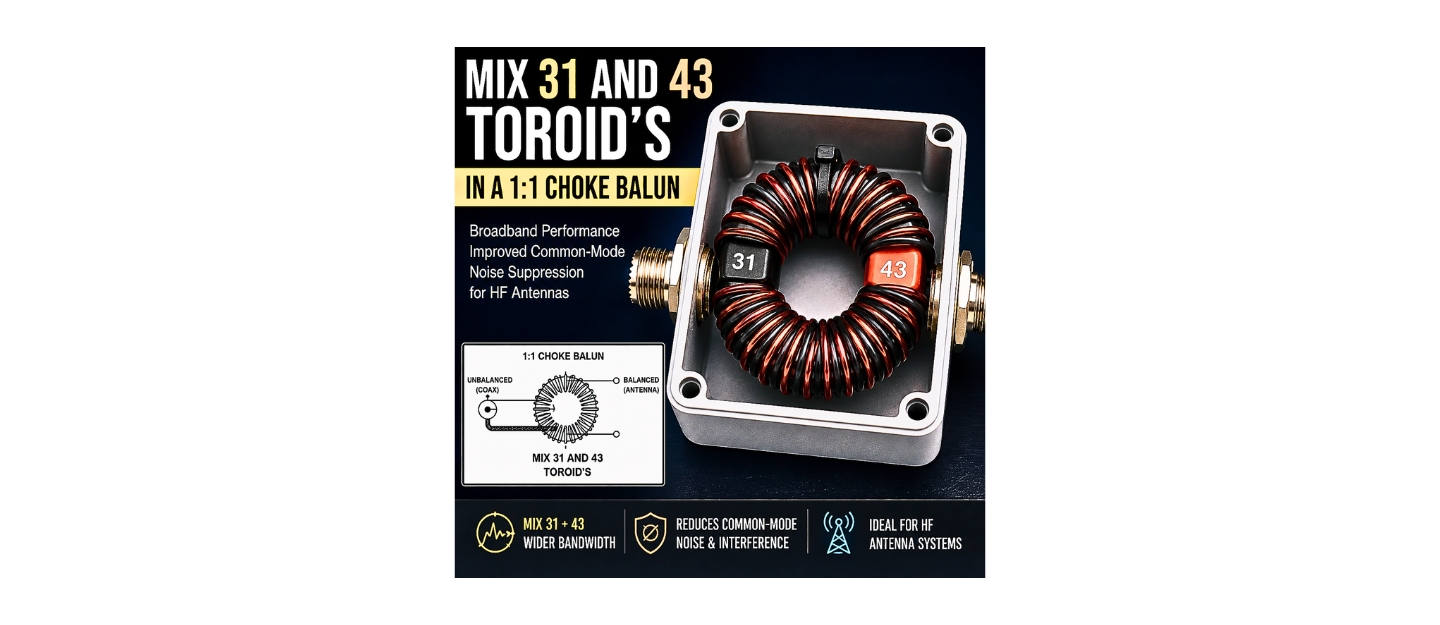
Mixing Mix 31 and 43 Toroid’s
Can You Mix Mix 31 and 43 Toroid’s in a choke? One of the most common questions amateur radio operators ask when building a 1:1 choke balun is whether it is acceptable to stack one Mix 31 ferrite toroid with one Mix 43 ferrite toroid. Since each ferrite material performs differently across the HF spectrum, it is natural to wonder if combining them produces better performance or simply creates an expensive compromise.
The short answer is yes. Mixing one Mix 31 core with one Mix 43 core works very well in many HF choke balun applications. The two ferrite materials do not cancel each other, fight each other, or reduce the effectiveness of the choke. Instead, each material contributes its own frequency characteristics, producing a broader choking impedance curve than either material can provide alone.
That does not automatically make a mixed-core choke the best solution for every antenna. Like every engineering decision, there are advantages and disadvantages. Understanding why the two materials behave differently allows you to choose the best ferrite combination for your operating goals instead of relying on internet myths or outdated advice.
New to the hobby? Start with our Complete Guide to Ham Radio Fundamentals.
Understanding What a 1:1 Choke Balun Actually Does
Before discussing ferrite materials, it helps to understand the purpose of a 1:1 choke balun. Unlike a voltage balun, a current choke balun does not transform impedance. A properly designed 1:1 choke simply presents a very high impedance to common-mode current flowing on the outside of the coax shield while allowing the desired differential RF currents inside the coax to pass with very little loss.
When common-mode current is reduced, several benefits occur:
- Feedline radiation decreases.
- RF in the shack is reduced.
- Antenna patterns become more predictable.
- Noise picked up on the outside of the feedline is minimized.
- Transmitter performance often improves.
The effectiveness of a choke balun is determined primarily by its common-mode impedance, not its SWR.
This is one of the biggest misconceptions found on internet forums. A choke can show an excellent 1.0:1 SWR while providing very little common-mode suppression. Conversely, a properly designed choke may exhibit extremely high choking impedance while having almost no measurable effect on differential-mode SWR.
Why Ferrite Material Matters
Ferrite is far more than a simple magnetic ring. Every ferrite formulation is engineered with specific magnetic characteristics that determine how efficiently it suppresses RF energy over a particular frequency range. These characteristics include permeability, magnetic losses, resistive impedance, and reactive impedance.
Because each ferrite mix behaves differently as frequency changes, selecting the proper material is one of the most important decisions when designing a choke balun. Using the wrong ferrite material may still produce a functioning choke, but its common-mode impedance may be significantly lower where you need it most.
Conversely, choosing the proper material can increase choking impedance by several thousand ohms without changing the physical size of the balun.
What Is Mix 31?
Mix 31 is one of the most popular ferrite materials for HF common-mode chokes because it performs exceptionally well at the lower amateur HF bands.
Its magnetic properties produce strong resistive impedance over much of the lower HF spectrum, making it especially useful for antennas used on 160, 80, 60, and 40 meters.
Many commercial choke manufacturers select Mix 31 when designing wideband HF choke baluns because of its excellent low-frequency performance.
Some characteristics include:
- Excellent performance below approximately 10 MHz.
- High resistive losses where common-mode suppression is needed.
- Broad HF coverage.
- Excellent choice for all-band HF antennas.
Because common-mode suppression depends heavily on resistive impedance rather than purely reactive impedance, Mix 31 has earned an outstanding reputation among serious HF operators.
What Is Mix 43?
Mix 43 has probably been the most widely used ferrite material in amateur radio for decades. It became popular because it provides excellent choking performance throughout much of the HF spectrum while remaining relatively inexpensive and readily available.
Its strongest performance generally occurs higher in the HF range than Mix 31, making it an outstanding choice for operators spending most of their time on 20 through 10 meters.
Although Mix 43 still performs well on lower frequencies, it typically does not provide the same low-frequency choking impedance as Mix 31.
Its strengths include:
- Excellent HF performance.
- Strong suppression from approximately 10 to 30 MHz.
- Widely available.
- Proven reliability.
- Used in countless commercial RF products.
Many amateur radio choke baluns built during the past twenty years have used Mix 43 because it provides an excellent balance of performance, cost, and availability.
Why Do Mix 31 and 43 Toroid’s Behave Differently
At first glance, both toroid’s appear nearly identical. They have similar dimensions, similar mechanical strength, and can often be wound using identical techniques.
The difference lies entirely inside the ferrite material itself. Each mix has a different complex permeability curve. As frequency increases, the balance between inductive reactance and resistive losses changes.
Since common-mode chokes rely heavily on resistive impedance to dissipate unwanted RF energy, these changing characteristics determine how effectively each ferrite material suppresses common-mode currents across the amateur HF spectrum.
This explains why one material may outperform another on 80 meters while the opposite becomes true on 10 meters. The ferrite itself has not changed. The operating frequency has.
What Happens When You Stack One Mix 31 and One Mix 43 Core?
When one FT240-31 and one FT240-43 ferrite toroid are stacked together, both cores experience the same magnetic field produced by the coax winding. Contrary to what is sometimes claimed online, one ferrite mix does not overpower or cancel the other. Instead, each core contributes its own frequency-dependent impedance.
You can think of the two cores as working together. At lower HF frequencies, the Mix 31 core contributes most of the choking impedance. As the frequency increases, the Mix 43 core becomes increasingly effective. The result is a choke that often provides useful common-mode suppression across a wider portion of the HF spectrum than either core alone.
This is one reason experienced balun builders occasionally mix ferrite materials for broadband applications. Rather than optimizing for a single amateur band, the goal is to achieve consistently high choking impedance across multiple bands.
Does One Core Cancel the Other?
No. This is probably the most persistent myth surrounding mixed ferrite chokes. Ferrite materials are passive magnetic materials. They do not generate RF energy or oppose each other simply because they are different mixes.
Since both cores are threaded by the same coax winding, they each respond according to their own magnetic characteristics. The total choking impedance becomes the combined contribution of both materials.
In practice:
- Mix 31 dominates the lower HF frequencies.
- Mix 43 contributes more at higher HF frequencies.
- The resulting impedance curve becomes broader.
- Common-mode suppression remains effective over a wider frequency range.
Instead of reducing performance, properly selected ferrite combinations often improve overall broadband performance.
Expected Performance Across the HF Bands
Although every choke design is different, the general behavior is fairly predictable.
| Amateur Band | Two Mix 31 Cores | Mix 31 + Mix 43 | Two Mix 43 Cores |
|---|---|---|---|
| 160 meters | Excellent | Very Good | Fair |
| 80 meters | Excellent | Excellent | Good |
| 40 meters | Excellent | Excellent | Very Good |
| 30 meters | Very Good | Excellent | Excellent |
| 20 meters | Very Good | Excellent | Excellent |
| 17 meters | Good | Excellent | Excellent |
| 15 meters | Good | Very Good | Excellent |
| 12 meters | Good | Very Good | Excellent |
| 10 meters | Fair to Good | Excellent | Excellent |
This comparison illustrates why many builders like the mixed-core approach. It produces fewer “weak spots” across the HF spectrum.
Why Broadband HF Operators Like Mixed Ferrite Cores
Most amateur stations today operate on several HF bands rather than a single frequency. A station might use:
- 80 meters after sunset.
- 40 meters during evening nets.
- 20 meters throughout the day.
- 17 and 15 meters during DX openings.
- 10 meters when solar conditions improve.
A choke optimized for only one portion of the spectrum may perform exceptionally well there but less effectively elsewhere.
By combining Mix 31 and 43 Toroid’s, the choke’s impedance curve spreads across a larger frequency range. The peak impedance may not always be as high as a choke optimized for one specific band, but overall performance becomes more consistent from 160 through 10 meters.
For many operators, that consistency is more valuable than chasing the highest possible impedance at one frequency.
Are There Any Disadvantages?
Like every engineering solution, mixing ferrite materials involves compromise. The primary disadvantage is that the choke is no longer optimized for one specific frequency range.
For example, if your station operates almost exclusively on 80 meters, two Mix 31 cores will generally outperform a mixed stack. Likewise, if you operate primarily on the upper HF bands, two Mix 43 cores may provide slightly higher choking impedance where you spend most of your time.
Other considerations include:
- Mixed cores are more difficult to model accurately.
- Published performance data is limited.
- Commercial manufacturers generally publish specifications for identical core materials.
- Repeatability becomes slightly more complex in production environments.
For the average amateur operator, however, these disadvantages are relatively minor compared to the benefit of broader HF coverage.
Why Commercial Manufacturers Usually Don’t Mix Ferrite Materials
Some builders assume that because commercial manufacturers rarely advertise mixed ferrite chokes, combining materials must be a bad idea.
That conclusion is incorrect. Manufacturers often avoid mixed materials for practical reasons rather than technical ones.
Using identical cores simplifies:
- Inventory management.
- Automated production.
- Quality control.
- Performance testing.
- Published specifications.
- Manufacturing costs.
Commercial products must also be repeatable. If thousands of baluns are produced each year, using one ferrite mix throughout the production run makes quality assurance much easier.
Individual amateur radio operators are not constrained by those manufacturing requirements. A home builder can optimize performance for a particular operating style without worrying about production efficiency.
How Many Turns Should You Use?
The number of turns has a major influence on common-mode impedance. Too few turns may provide insufficient choking impedance on the lower HF bands.
Too many turns can increase stray capacitance and reduce performance at higher frequencies. For stacked FT240 cores, the following are reasonable starting points:
| Core Configuration | Typical Turns with RG-400 |
|---|---|
| Two FT240-31 | 11–13 turns |
| Two FT240-43 | 10–12 turns |
| One FT240-31 + One FT240-43 | 11–12 turns |
These values are intended as starting points. The optimum number of turns depends on coax diameter, winding style, spacing, operating frequency, and the desired impedance curve.
Whenever possible, measure the finished choke with a NanoVNA or laboratory-grade vector network analyzer rather than assuming a published design will perfectly match your application.
Does Mixing Ferrite Materials Increase Power Handling?
One of the most common misconceptions is that combining a Mix 31 and 43 Toroid’s core somehow doubles the power handling of a choke balun. While stacking two ferrite toroids generally improves heat dissipation and distributes the magnetic flux over a larger volume, the increase in power handling comes primarily from using two cores, not from using two different ferrite mixes.
Power handling depends on several factors working together, including:
- Total ferrite volume
- Operating frequency
- Common-mode current
- Duty cycle
- Mode of operation
- Ambient temperature
- Coax type
- Winding technique
A choke carrying 1,500 watts on CW with a well-balanced antenna may run surprisingly cool, while the same choke can become much hotter at only a few hundred watts during high-duty-cycle digital modes if excessive common-mode current is present.
The most important point is that a choke balun should never be judged solely by transmitter power. The amount of common-mode current flowing through the choke has a much greater influence on heating than the transmitter’s output rating.
Does a Mixed-Core Choke Have More Loss?
Some operators worry that adding two different ferrite materials increases RF loss.
For the desired differential RF signal traveling inside the coax, the answer is essentially no. A properly designed current choke introduces very little insertion loss because the wanted RF currents cancel their magnetic fields inside the transmission line.
The ferrite is primarily acting on the undesired common-mode current flowing on the outside of the shield.
This is exactly what you want.
A good choke converts unwanted common-mode energy into a small amount of heat while allowing the desired RF signal to pass with minimal attenuation.
Measuring a Mix 31 and 43 Toroid’s Choke
The only reliable way to evaluate a choke balun is by measuring its common-mode impedance.
Many builders mistakenly connect a dummy load, measure SWR, and conclude the choke is working well. Unfortunately, SWR tells you almost nothing about common-mode suppression.
A proper measurement uses a fixture that forces common-mode current through the choke while measuring the resulting impedance or attenuation.
Popular test equipment includes:
- NanoVNA
- SV4401A
- Professional vector network analyzers
When using S-parameter measurements, most builders use:
- S21 LogMag for attenuation measurements.
- Common-mode fixtures designed specifically for choke testing.
- Calibration before every measurement session.
The resulting graph provides a much clearer picture of how effectively the choke suppresses unwanted current across the amateur HF bands.
Why SWR Is Not a Good Indicator
This point deserves emphasis because it causes endless confusion.
A choke balun can show:
- 1.00:1 SWR
- 1.02:1 SWR
- 1.05:1 SWR
…and still provide almost no common-mode suppression.
Likewise, an excellent choke may have essentially the same SWR reading because SWR measures impedance matching between the transmitter and load, not the amount of current flowing on the outside of the coax shield.
If your goal is reducing feedline radiation, RF in the shack, or pattern distortion, common-mode impedance is the specification that matters.
Choosing the Right Coax
The coax used to wind the choke influences both performance and power handling.
Many builders successfully use:
| Coax | Typical Use |
|---|---|
| RG-316 | Portable and QRP choke baluns |
| RG-303 | Medium-power applications |
| RG-400 | High-power HF choke baluns |
| RG-142B/U | High-power, low-loss installations |
For legal-limit stations, RG-400 and RG-142B/U remain two of the most popular choices because of their silver-plated conductors, PTFE insulation, and excellent high-temperature characteristics.
Best Applications for a Mixed-Core Choke
A Mix 31 and Mix 43 combination is particularly well suited for broadband HF antennas that operate across multiple amateur bands.
Examples include:
- Center-fed dipoles
- Off-center-fed dipoles
- Doublets
- Ladder-line-fed antennas
- Horizontal loops
- End-fed random-wire antennas
- Vertical antennas requiring feedline isolation
- Portable HF antennas
- Multi-band field operation
These antenna systems benefit from a choke that provides useful suppression over a broad frequency range rather than being optimized for only one band.
When Two Mix 31 Cores Are the Better Choice
Although a mixed-core choke is versatile, there are situations where two Mix 31 cores are the better engineering decision.
If you spend most of your operating time on:
- 160 meters
- 80 meters
- 60 meters
- Lower 40 meters
A dual Mix 31 choke will usually provide higher common-mode impedance where you operate most often.
This is especially true for low-band DX stations, AM operators, and regional net participants.
When Two Mix 43 Cores Make More Sense
Operators concentrating on the upper HF bands may prefer two Mix 43 cores.
This includes stations that spend most of their operating time on:
- 20 meters
- 17 meters
- 15 meters
- 12 meters
- 10 meters
In these situations, two identical Mix 43 cores often provide slightly better performance than a mixed stack.
Common Myths About Mixing Ferrite Materials
Several myths continue circulating among amateur radio operators despite having little engineering basis.
Myth: Mix 31 and Mix 43 cancel each other.
Reality: They do not. Their impedances add together over different portions of the frequency spectrum.
Myth: Mixed ferrite chokes cannot handle high power.
Reality: Power handling depends on ferrite volume, winding technique, duty cycle, and common-mode current—not whether the ferrite mixes match.
Myth: SWR proves a choke is working.
Reality: SWR indicates impedance matching, not common-mode suppression.
Myth: One ferrite mix is always superior.
Reality: Every ferrite material has an operating range where it performs best. Choosing the right mix depends on the intended application.
Frequently Asked Questions
Can I stack one FT240-31 and one FT240-43 together?
Yes. This is a practical approach for creating a broadband HF choke balun.
Will the ferrite materials interfere with each other?
No. Each core contributes its own impedance characteristics without canceling the other.
Is a mixed-core choke better than two identical cores?
Not always. It depends on whether you want maximum performance on one band or broader performance across multiple bands.
Is Mix 31 better than Mix 43?
Neither is universally better. Mix 31 generally excels at lower HF frequencies, while Mix 43 performs very well across much of the upper HF spectrum.
Can I use RG-400 with mixed ferrite cores?
Yes. RG-400 is an excellent choice for high-power choke baluns because of its PTFE dielectric and silver-plated conductors.
Does a mixed-core choke work on 160 through 10 meters?
Yes. One of its primary advantages is broad HF coverage.
Final Thoughts
Using Mix 31 and 43 Toroid’s in a 1:1 choke balun is a sound engineering practice when your goal is broad HF performance rather than peak performance on a single amateur band. Each ferrite material contributes its strengths over different portions of the spectrum, producing a choke with a wider and more balanced common-mode impedance curve.
For operators using multiband antennas such as dipoles, off-center-fed dipoles, loops, verticals, and end-fed antennas, a mixed-core choke can provide excellent all-around performance from 160 through 10 meters. While it may not always equal the peak impedance of a choke optimized with two identical cores for one specific frequency range, it offers a practical compromise that performs consistently across the HF amateur bands.
The best choke balun is not determined by internet opinions or marketing claims. It is determined by sound engineering, careful construction, and verified measurements. By understanding how Mix 31 and 43 Toroid’s work with certain ferrite materials behave individually, and together, you can build a choke balun that is matched to your operating style, antenna system, and station requirements rather than relying on trial and error.
Please consider Donating to help support this channel