
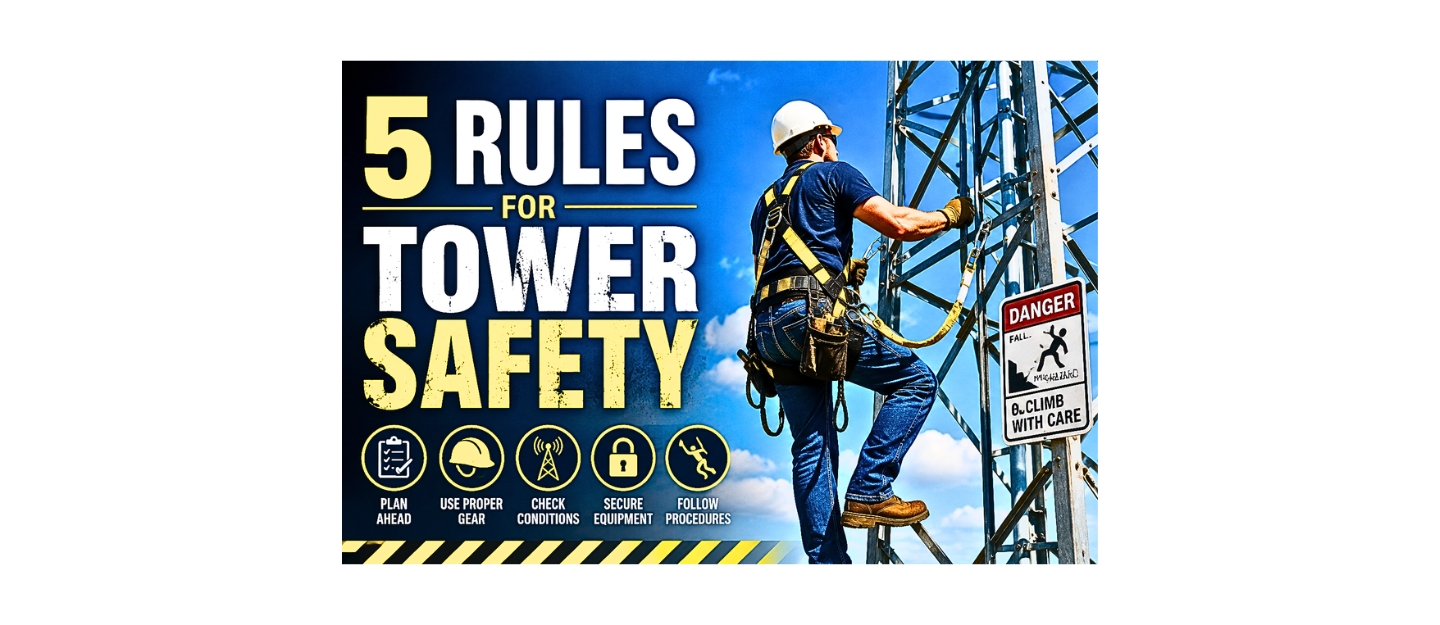
5 Rules for Tower Safety
5 Rules for Tower Safety rules can help operators recognize the hazards that exist before, during, and after a climb. Height, structural condition, weather, electrical hazards, falling objects, equipment failure, and human fatigue can turn a routine antenna job into a life-threatening situation within seconds. Gravity never negotiates, which means every climb must begin with preparation, not confidence or routine.
Amateur radio operators often build, maintain, and modify their own antenna systems. That hands-on approach is one of the great advantages of the hobby, but tower work requires a level of discipline that goes beyond ordinary antenna installation. A tower is a structural system, not simply a support for an antenna, and mistakes involving the tower, guy system, fall protection, electrical clearance, or weather can have catastrophic consequences.
Experience does not eliminate these hazards. In some situations, experience can actually encourage complacency because a familiar tower may begin to feel routine. A climber who has safely climbed the same structure many times can become tempted to skip an inspection, overlook changing weather, or take a shortcut during a transition.
5 Rules for Tower Safety requires the opposite approach. Every climb should receive the same deliberate attention regardless of how many successful climbs came before it. This guide presents 5 Rules for Tower Safety rules for amateur radio operators, along with practical considerations involving inspections, fall protection, weather, electrical hazards, tools, fatigue, communication, rescue planning, and human factors.
This information does not replace professional tower-climbing training, applicable safety regulations, equipment instructions, engineering evaluation, or qualified professional advice. Anyone who lacks appropriate training and equipment should not climb a tower.
Rule One: Inspect the Tower and Site Every Time
Never assume that a tower remains safe simply because it supported an antenna system during the previous climb. Before anyone leaves the ground, inspect the tower, foundation, guy system, anchors, hardware, surrounding ground, and equipment attached to the structure. Look for corrosion, bent members, loose or missing hardware, cracked components, damaged connections, deteriorated fittings, and any other condition that could affect the tower’s structural integrity.
Guyed towers require particular attention because the tower depends on the guy system for stability. Inspect guy wires for corrosion, broken strands, damaged fittings, unusual slack, damaged insulators where applicable, and other signs of deterioration.
Examine the guy anchors and the surrounding soil as well. Erosion, ground movement, frost damage, flooding, construction activity, or other changes can affect an anchor even when the tower itself looks normal.
Pay attention to changes that occurred since the previous inspection. Severe weather can damage tower components without making the problem obvious from a distance. High winds can affect guy tension, falling branches can strike tower members, lightning can damage components, and ice accumulation can place substantial additional loads on the structure.
The antenna system itself also deserves inspection. Examine masts, booms, brackets, rotators, feed lines, connectors, clamps, mounting hardware, and other components before climbing. A loose antenna component can become a falling-object hazard or create an unexpected load on the tower.
Inspection
Inspect the area around the tower as carefully as the tower itself. Identify overhead electrical conductors, trees, buildings, vehicles, unstable ground, construction equipment, fences, guy wires, guy anchors, and other obstacles. Make sure the area provides sufficient room for safe access and for establishing a controlled work zone.
If you discover a suspected structural defect, do not climb the tower to investigate it more closely. A damaged tower can fail when subjected to additional loads from a climber, tools, antennas, wind, or movement. Structural concerns should receive an appropriate evaluation from someone qualified to assess the structure.
A tower inspection should become a standard part of every climb, not something you perform only after a storm or when something looks wrong. The fact that the tower was safe last week does not prove that it remains safe today.
Rule Two: Use the Right Safety Gear and Verify It Before Climbing
Proper fall-protection equipment provides one of the most important layers of protection during tower work. A climber should use equipment specifically designed and rated for the intended application rather than attempting to improvise a climbing system.
Before every climb, inspect the full-body harness, lanyards, connectors, energy absorbers, lifelines, climbing devices, and other components used in the fall-protection system. Follow the inspection requirements established by the equipment manufacturer and remove damaged or questionable equipment from service.
Look carefully at webbing, stitching, buckles, connectors, hooks, gates, energy absorbers, and other components. Cuts, burns, excessive wear, chemical contamination, deformation, corrosion, missing components, or other damage can compromise equipment performance.
Do not assume that a piece of equipment remains safe because it looks acceptable at first glance. Follow the manufacturer’s inspection criteria and service-life requirements. If the manufacturer requires a component to be removed from service after a fall or under specific damage conditions, follow those requirements.
A proper harness must also fit the user correctly. The operator should adjust it according to the manufacturer’s instructions before climbing. Loose or incorrectly configured equipment can interfere with movement and may not perform as intended during a fall.
Never substitute an ordinary belt, rope, hardware-store carabiner, improvised strap, or other non-rated component for equipment designed for fall protection. Tower climbing places unusual forces on equipment, particularly during a fall. Every component must be appropriate for the system and compatible with the other components being used.
Training matters just as much as equipment. A climber needs to understand how to inspect, wear, connect, transfer, and use the equipment before attempting a tower climb. Learning how a fall-protection system works after reaching the top of a tower is far too late.
Rule Three: Maintain Continuous Fall Protection
Never intentionally climb unprotected, even for a short distance. A few feet of exposure can produce the same catastrophic consequences as a much longer fall. The objective of a properly designed climbing system is to maintain appropriate fall protection throughout ascent, work positioning, transitions, and descent.
When transferring between attachment points, follow the procedures taught during appropriate tower-climbing training and the instructions provided by the equipment manufacturer. The climber should understand exactly how to move from one connection point to another without creating unnecessary exposure.
Transitions require particular attention because the climber may need to manipulate hardware while moving around tower members. Never rush a transition simply because the next attachment point appears close.
A common misunderstanding involves the phrase “three points of contact.” Maintaining two hands and one foot, or two feet and one hand, can improve climbing stability, but three points of contact do not constitute fall protection. A climber can lose a handhold or foothold unexpectedly. Proper fall protection remains necessary.
The attachment point also matters. Never assume that every piece of tower steel provides an appropriate attachment location for fall protection. Use attachment points and structural members that are suitable for the specific fall-protection system and follow the applicable equipment and tower requirements.
Climbing technique should remain controlled from the first step to the last. Avoid unnecessary stretching, swinging around members, reaching beyond a comfortable working position, or attempting to perform a task while poorly positioned.
If the work requires a position that cannot be reached safely using the existing system, stop and reassess the climbing arrangement rather than improvising.
Rule Four: Control Tools, Weather, Electrical Hazards, and Fatigue
Tools become dangerous objects when someone drops them from a tower. A screwdriver, wrench, drill, connector, bolt, antenna component, or other object can gain substantial speed while falling and can seriously injure anyone below.
Secure tools and equipment using methods designed for elevated work. Keep loose hardware contained and prevent objects from resting where they can easily fall through the tower structure.
Never throw tools or materials from a tower. Use an appropriate hoisting method when equipment needs to move between the ground and an elevated work position. Make sure the lifting equipment is suitable for the load and that the ground area remains controlled while equipment moves overhead.
Establish a drop zone before work begins. Keep people who are not directly involved with the operation away from the area below and around the tower. Vehicles, pets, family members, visitors, and other people should not be allowed to wander into the work area.
Bad Weather
Build a constant discipline for equipment inspection including bad weather climbing. Wind, rain, ice, snow, lightning, and rapidly changing conditions can dramatically increase tower hazards.
Wind presents a particular problem because the force on a tower and antenna system increases as wind speed increases. Large antennas, beams, dishes, and other structures can act as substantial wind loads. Wind can also make climbing physically difficult and reduce the climber’s ability to maintain stable control.
Rain can make tower members slippery and can reduce grip. Ice creates an additional hazard because it can increase structural loading while making climbing surfaces extremely difficult to use. Lightning creates an obvious and potentially fatal electrical hazard and should result in the work being stopped and the tower being evacuated.
Do not let a schedule dictate a climb. If weather conditions become unsafe, descend using the established safe procedure and postpone the work.
Electrical hazards deserve special attention because amateur radio towers can exist near utility lines, service drops, generators, electrical equipment, and other sources of electrical energy. A tower or antenna does not have to touch a power line for electrical contact to become possible.
Before beginning work, identify nearby electrical conductors and maintain the required clearance. If the location presents an electrical hazard that cannot be adequately controlled, do not climb.
Fatigue creates another significant hazard. Tower climbing requires concentration, coordination, physical strength, balance, and good judgment. As fatigue increases, reaction time and decision-making can deteriorate.
Take appropriate breaks and remain properly hydrated. If you notice declining concentration, shaking, poor coordination, excessive fatigue, or difficulty handling equipment, descend safely and stop the work.
No antenna repair is important enough to justify continuing when your physical or mental condition is deteriorating.
Rule Five: Never Climb Alone and Always Have a Communication and Rescue Plan
A tower climb should never depend on the assumption that nothing will go wrong. Always establish a communication plan and a rescue plan before climbing.
A capable person on the ground provides an important additional layer of protection. The ground person can monitor the work area, watch weather conditions, maintain the exclusion zone, communicate with the climber, call emergency services when necessary, and recognize problems that the climber may not see.
However, simply having someone standing near the tower does not constitute a rescue plan. A serious fall can leave a climber suspended in a harness or otherwise unable to descend without assistance. The people involved in the operation should understand what happens if the climber becomes injured, unconscious, trapped, or unable to move normally.
Know how emergency responders will reach the property. Make sure someone knows the exact location of the tower and the best access route. Keep the necessary emergency information readily available rather than attempting to remember it during an emergency.
Communication equipment should also be tested before climbing. A handheld radio can provide a convenient way for the climber and ground person to communicate, but the radio should never become a substitute for an actual rescue plan.
Establish communication procedures before leaving the ground. The climber and ground person should know how to communicate normal status, request assistance, report changing conditions, and initiate an emergency response.
The rescue plan must account for the actual tower, climbing system, access conditions, available personnel, and equipment. A generic statement such as “call 911” does not solve every tower-rescue problem.
Understanding Human Factors in Tower Accidents
Equipment failure receives considerable attention when people discuss tower accidents, but human decisions also influence the outcome of many dangerous situations. Rushing, complacency, distraction, inadequate preparation, poor weather decisions, and overconfidence can all increase exposure to hazards.
Experience should make a climber more disciplined rather than more casual.
A person who has climbed the same tower many times may begin to think of the ascent as routine. That mindset can encourage shortcuts such as skipping an inspection, climbing without a ground partner, failing to check the weather, or using equipment that should have been removed from service.
Every climb should receive a fresh assessment.
The tower may have changed. The antenna configuration may have changed. The guy system may have changed. The weather may have changed. The ground conditions may have changed. The climber’s physical condition may have changed.
Those changes make yesterday’s successful climb irrelevant to today’s safety decision.
Creating a Personal Pre-Climb Checklist
A written pre-climb checklist turns safety from a memory exercise into a repeatable process. Before climbing, review the tower structure, guy system, anchors, hardware, antenna system, weather, electrical hazards, fall-protection equipment, tools, communications, work plan, rescue plan, and ground area.
The checklist should also identify exactly what work you intend to perform. Know whether you are inspecting an antenna, replacing a feed line, repairing a connector, adjusting a rotator, installing hardware, replacing an antenna, or performing another task. A clear work objective helps prevent unnecessary improvisation once you are elevated.
Review the checklist with the ground person before climbing. Two people reviewing the same plan can identify hazards that one person may overlook.
A checklist should not become meaningless because the operator has used it hundreds of times. Its value comes from completing it consistently.
Inspect Your Fall-Protection Equipment Before Every Use
Fall-protection equipment deserves its own inspection because its condition can determine whether a fall results in a survivable event or a catastrophic injury.
Inspect webbing for cuts, tears, burns, abrasion, chemical damage, excessive wear, and other deterioration. Inspect stitching for damage and examine buckles, connectors, hooks, gates, and other hardware for deformation, corrosion, cracks, or improper operation.
Pay particular attention to equipment that has previously arrested a fall. Follow the manufacturer’s instructions regarding inspection and removal from service after a fall. Do not assume that equipment remains safe simply because it does not show obvious damage.
Keep equipment clean and store it according to the manufacturer’s instructions. Avoid exposing fall-protection equipment to chemicals, excessive heat, sharp edges, or other conditions that can degrade materials.
Do not modify safety equipment. Adding knots, drilling holes, altering connectors, replacing components with non-approved hardware, or making other modifications can compromise the system.
Respect Tower Structural Loading
Amateur radio operators frequently add antennas to an existing tower over time. A tower may begin with one antenna and later support a beam, vertical, VHF antenna, UHF antenna, satellite antenna, rotator, mast, feed lines, brackets, and other equipment.
Every additional component can affect the structure. Wind loading is particularly important. An antenna does not need to be extremely heavy to impose substantial forces on a tower during high winds. Large surface-area antennas can produce significant wind loads even when their physical weight appears modest.
The tower foundation, guy system, tower sections, mounting hardware, and associated structures all need to support the intended configuration. Never assume that an existing tower can safely support an additional antenna simply because the tower looks strong.
When structural capacity is uncertain, obtain an appropriate engineering evaluation rather than relying on visual judgment.
Guyed Towers Require Special Attention
Guyed towers depend on their guy system for stability, which means the entire system must remain in good condition.
Inspect guy wires, guy anchors, fittings, turnbuckles, attachment points, and surrounding soil. Look for corrosion, broken strands, unusual movement, loose fittings, damaged hardware, and evidence of anchor movement.
Never adjust guy tension casually.
Changing guy tension can alter the loading throughout the structure and can create dangerous conditions if performed incorrectly. If the guy system requires adjustment or repair, follow the tower manufacturer’s procedures and obtain appropriate professional assistance when necessary.
Guy wires also create hazards for people and vehicles at ground level. Mark or otherwise identify guy locations appropriately and prevent vehicles from striking anchors or wires.
Protect People on the Ground
A tower project can injure someone who never climbs the tower.
Establish an appropriate controlled area around the structure before work begins. Keep unnecessary personnel outside the drop zone and make sure everyone involved understands the hazards.
Falling objects can travel beyond the exact footprint of the tower, especially when wind affects the trajectory. The size of the controlled area should therefore reflect the work being performed, the height of the structure, the equipment being handled, and the surrounding conditions.
Do not allow children, pets, visitors, or uninvolved workers into the work area. If you are performing tower work at a residence, tell everyone on the property what is happening and establish clear boundaries before beginning.
Electrical Safety Must Come Before RF Performance
Amateur radio operators naturally think about RF exposure, SWR, antenna efficiency, feed-line loss, grounding, and transmitter power. Those subjects matter, but electrical safety takes priority over antenna performance.
Before climbing, identify all nearby power lines and electrical equipment. Consider the complete path of the tower, antennas, masts, tools, feed lines, and any equipment that could be moved during the work.
Never rely on the assumption that you will simply “be careful” around a power line. A sudden movement, dropped tool, shifting antenna, gust of wind, or loss of balance can place equipment closer to an electrical conductor than intended.
If electrical clearance cannot be maintained safely, stop the project and obtain appropriate professional assistance.
Weather Can Change the Entire Risk Assessment
A tower that is perfectly manageable in calm conditions can become dangerous in strong wind. Rain can reduce traction. Ice can increase structural loading and make tower members extremely slippery. Lightning can create a fatal hazard.
Do not interpret a short period of calm weather as proof that conditions will remain safe. Monitor weather before and during tower work, and establish clear conditions under which the climb will stop.
Experienced operators should never feel embarrassed about postponing an antenna project because of weather. Choosing not to climb under unsafe conditions demonstrates good judgment.
Do Not Let an Antenna Problem Force You Into a Dangerous Climb
Antenna problems can create unnecessary pressure. A transmitter suddenly develops a high SWR. A beam stops rotating. A feed line develops an intermittent connection. A digital mode stops producing contacts. The natural reaction may be to climb immediately and find the problem.
That reaction can lead to poor decisions. Troubleshoot everything that can safely be checked from the ground first. Use an antenna analyzer, SWR meter, VNA, receiver, visual inspection, continuity measurements, or other appropriate methods to determine whether the problem actually requires a climb.
Sometimes a problem that appears to be an antenna failure originates in the shack, feed line, connector, relay, switch, or control cable. If the problem does require tower access, schedule the climb properly rather than treating it as an emergency simply because the radio is currently off the air.
Never Challenge a Tower
Tower climbing is not a test of courage.
There is no prize for climbing in higher winds, continuing when you are tired, reaching farther than your equipment allows, or completing a repair after recognizing that something is wrong.
A professional attitude means recognizing the limits of the equipment, the structure, the weather, and yourself.
The safest climber is not the person who takes the greatest risks. The safest climber is the person who recognizes risks early and refuses to turn manageable hazards into emergencies.
Respect Your Physical Condition
Tower climbing places physical demands on the entire body. Grip strength, balance, leg strength, endurance, concentration, and coordination all matter. The physical demands become more significant as the climb becomes longer or the operator spends extended periods working at height.
Do not assume that because you could comfortably climb the tower several years ago you can automatically do the same today.
Age, illness, medication effects, fatigue, dehydration, injury, and changes in physical fitness can all affect climbing ability. Honest self-assessment should occur before every climb.
If you are not physically capable of performing the work safely, use another method or obtain qualified assistance.
Eliminate Distractions
Tower work requires concentration.
Avoid unnecessary phone calls, conversations, entertainment, or other distractions while climbing. If you need to communicate about something unrelated to the work, complete the communication before climbing or after returning safely to the ground.
The same principle applies to the ground person.
The ground person should remain attentive to the climber, weather, tools, equipment, and surrounding area rather than becoming distracted by unrelated activities.
A momentary distraction can have serious consequences when someone is working at height.
Plan the Work Before You Leave the Ground
One of the easiest ways to reduce tower exposure is to plan the job carefully before climbing.
Determine which tools you need, what parts you need, how the equipment will reach the work position, where the work will occur, how the climber will maintain fall protection, and how the job will end.
If you discover that you forgot a tool after reaching the tower, do not improvise a dangerous solution. Descend safely and obtain the correct equipment.The few extra minutes required to plan the job on the ground can save considerable time and reduce unnecessary exposure at height.
Tower Safety Includes the Descent
Many operators focus on reaching the work position and completing the repair but pay less attention to the descent.
That is a mistake.
Fatigue often increases toward the end of a climb. The operator may be carrying equipment, thinking about the completed job, or eager to return to the ground. Those factors can lead to rushed movements.
Maintain the same level of concentration during descent that you used during ascent. Continue using the established fall-protection system, maintain controlled movements, and avoid rushing simply because the ground is getting closer. The job is not complete until the climber is safely back on the ground.
Choosing to Walk Away Is a Safety Skill
Sometimes the safest decision occurs before anyone climbs.
If the tower inspection raises questions, the weather becomes questionable, fall-protection equipment is damaged, the ground person is unavailable, electrical clearance is inadequate, or the climber does not feel physically capable of completing the work safely, postpone the climb.
- A tower repair can wait.
- An antenna installation can wait.
- A contest can wait.
- A rare DX opportunity can wait.
Equipment can be replaced. Antennas can be repaired. A tower can be climbed another day. A serious injury can permanently change a person’s life. Walking away from an unsafe situation is not a failure of experience. It is evidence of good judgment.
Building a Safety Culture in Amateur Radio
Tower safety becomes much more effective when operators treat it as part of their normal operating culture.
Experienced operators should demonstrate safe practices to newer amateurs. If someone sees another operator preparing to climb without appropriate protection, ignoring weather, or working around electrical hazards, speaking up may prevent an accident.
Safety should not become a competition between operators.
The goal is not to demonstrate who can climb the highest, work the fastest, or take the greatest risks. The goal is to complete antenna work safely and return to normal amateur radio operations.
A strong amateur radio community encourages operators to ask questions, seek training, use appropriate equipment, and obtain professional assistance when a project exceeds their experience.
Making Tower Safety Part of Your Antenna Planning
Tower safety should begin before the tower is installed. When planning an amateur radio antenna system, consider how the tower will be inspected, how antennas will be maintained, how feed lines will be replaced, how rotators will be serviced, and how future modifications will be performed.
Plan for future access while designing the system. Place components where they can be serviced appropriately, route cables carefully, protect connectors, and avoid unnecessary complexity that could increase future climbing requirements. Good antenna design considers both RF performance and maintainability.
An antenna system that performs exceptionally well but it requires regular maintenance, a successful and well planned installation to last for many years, It also improves conditions to follow the 5 Rules for Tower Safety, as well as other safety techniques.
Five Rules for Tower Safety
Tower climbing requires preparation, training, discipline, and respect for the hazards involved. The 5 Rules for Tower Safety rules provide a practical foundation for safer amateur radio tower work.
First, inspect the tower and site every time. Look for structural damage, corrosion, loose hardware, guy-system problems, anchor movement, electrical hazards, and changes in the surrounding environment.
Second, use the right safety gear and verify it before climbing. Use properly selected fall-protection equipment, inspect it before use, follow manufacturer requirements, and obtain appropriate training.
Third, maintain continuous fall protection. Do not intentionally climb unprotected, and never confuse three points of contact with an actual fall-protection system.
Fourth, control tools, weather, electrical hazards, and fatigue. Secure everything that goes aloft, establish a drop zone, monitor weather, maintain electrical clearance, and stop when fatigue affects judgment or physical ability.
Fifth, never climb alone and always have a communication and rescue plan. A ground partner provides valuable assistance, but a real rescue plan must account for the possibility that the climber becomes injured or unable to descend.
Final Thoughts on Tower Safety
Amateur radio operators spend considerable time thinking about antennas, towers, feed lines, SWR, baluns, grounding, propagation, transmit power, and station performance. Those technical subjects are important, but none of them matter if an antenna project results in a serious injury.
Tower work demands a different mindset. Approach every climb as a potentially hazardous operation. Inspect the structure before climbing. Use properly selected fall protection. Maintain protection throughout the climb. Control tools and equipment. Watch the weather. Identify electrical hazards.
Manage fatigue. Keep people out of the drop zone. Communicate with someone on the ground. Have a realistic rescue plan. Most importantly, know when to stop. Experience should make an operator more cautious, not more confident about taking unnecessary risks.
The best tower climber is not the person who ignores fear or believes an accident cannot happen. The best tower climber recognizes the hazards, prepares for them, uses appropriate equipment and procedures, and understands that the safest decision sometimes means staying on the ground.
Every antenna installation can wait for another day.
The objective of tower safety is simple: climb only when the work can be performed safely, protect yourself throughout the operation, and make sure everyone involved goes home when the job is finished.
Please consider Donating to help support this channel