
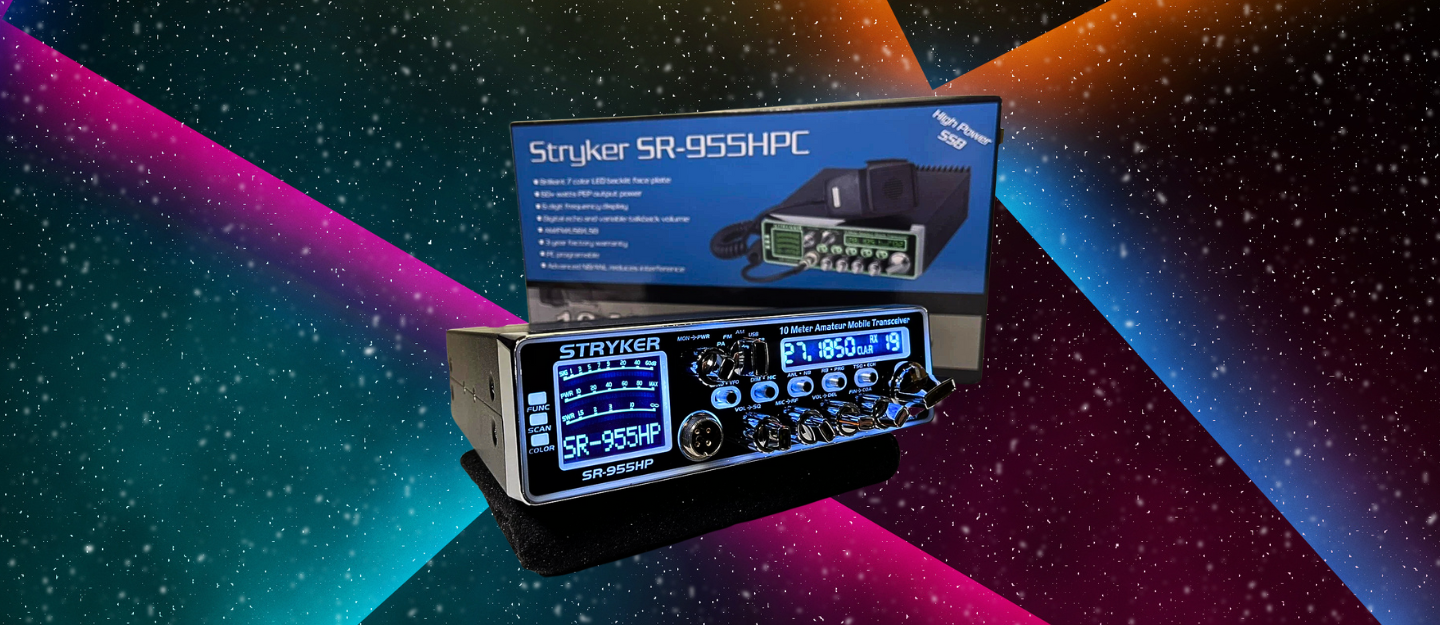
10 Meter Radio vs CB: What Is the Difference?
The difference between true 10 meter radios, a CB-based 10 meter export radio, and a standard CB radio goes far beyond the frequency range printed on the radio. The receiver architecture, filtering, dynamic range, transmitter design, spectral cleanliness, and intended operating purpose determine how these radios actually perform.
A radio marketed as a 10 meter radio may therefore fall into a very different equipment category from a purpose-built amateur HF transceiver. Understanding the differences makes it easier to determine whether a particular radio is designed as a true amateur transceiver or is fundamentally a CB-based platform with expanded frequency coverage and increased transmit power.
Quick Answer: Is a 10 Meter Radio a CB Radio?
Not every 10 meter radio is a CB radio. A true 10 meter amateur transceiver is engineered specifically for licensed amateur operation, while many export-style 10 meter radios originate from CB architectures and add expanded frequency coverage and higher transmit power.
The most important technical distinction is the receiver architecture. A purpose-built amateur transceiver generally emphasizes dynamic range, selectivity, filtering, spectral purity, and weak-signal performance, while a CB-derived export radio may retain much of its original CB-style receiver architecture.
Many radios sold as “10 meter radios” look like amateur transceivers, yet in real-world operation a large percentage behave more like modified CB radios with expanded frequency coverage and higher transmit power. Because of that, operators often debate whether these radios are legitimate amateur equipment or simply CB radios with 10 meters added to bypass power and channel limits.
This guide explains the technical reality in full detail. It distinguishes true amateur 10 meter transceivers from CB-based export radios, explains how each is engineered, and describes how they actually perform under real operating conditions. It also addresses the single most important technical question: when is a 10 meter radio a true amateur transceiver, and when is it simply a glorified CB radio?
This explanation is based on real operating experience, measured performance characteristics, and known RF design principles used across both amateur and CB equipment classes.
The three categories should not be treated as interchangeable simply because they may cover similar frequencies. Their internal design priorities can differ substantially, particularly in the receiver, filtering, dynamic range, transmitter circuitry, and intended operating environment.
The distinction becomes especially important when comparing radios in crowded RF environments, where strong nearby signals can expose limitations in receiver selectivity and dynamic range.
For a full overview of this technology and related systems, see our Complete Guide to Two-Way Radios
The Three Equipment Categories Most People Confuse
Many discussions fail because people compare only two radio types when there are actually three distinct equipment categories.
Technical Evaluation Approach
The comparison in this guide considers both measurable technical characteristics and practical operating behavior. Receiver architecture, dynamic range, third-order intercept, filtering, transmitter spectral behavior, and performance in crowded RF environments provide the technical basis for distinguishing the equipment categories.
The goal is not to judge a radio solely by its advertised transmit power or frequency coverage. Instead, the comparison considers the characteristics that determine how the equipment actually handles signals during operation.
True Amateur HF Transceivers
These radios are engineered specifically for licensed amateur service. Designers prioritize receiver performance, spectral purity, selectivity, and precision control. They are built to operate in dense RF environments and handle weak signals near strong ones.
10 Meter Amateur Transceiver vs Export Radio vs CB Radio
| Feature | True 10 Meter Amateur Transceiver | CB-Based 10 Meter Export Radio | Standard CB Radio |
|---|---|---|---|
| Primary Design Purpose | Licensed amateur communication & experimentation | High-power expanded CB-style communication | License-free short-range communication |
| Frequency Coverage | 28.000–29.700 MHz continuous tuning | Expanded CB platform covering 10m + often 11m | Fixed 40 CB channels |
| Receiver Architecture | Double/triple conversion or SDR with roofing filter | Usually CB-derived single/dual conversion | Basic single conversion consumer design |
| Typical First IF | Often high IF (45 MHz, 64 MHz, etc.) | Commonly ~10.695 MHz class architecture | ~10.695 MHz typical CB IF |
| Dynamic Range (Typical) | ~90–105 dB | ~65–80 dB | Lower consumer-grade levels |
| 3rd Order Intercept (Typical) | +10 to +20 dBm | Often 0 dBm or lower | Consumer-grade |
| SSB Filter Width | ~2.1–2.8 kHz selectable | Often fixed ~2.4–3 kHz | Limited or none |
| CW/Digital Narrow Filters | Often <500 Hz available | Rare | Not available |
| Roofing Filter | Yes (protects early stages) | Usually no | No |
| Spectral Purity Priority | High emphasis on clean IMD & low harmonics | Emphasis on power output | Meets basic certification standards |
| Transmit Power Focus | Balanced with signal cleanliness | Often marketed for high power | Strictly limited by regulation |
| Performance in Crowded Bands | Maintains selectivity & weak-signal clarity | Can overload in strong RF environments | Limited selectivity |
| License Required | Yes | Yes (for legal 10m use) | No |
| Typical User | Licensed amateur operator | Performance-focused CB operator | General public user |
| Best Use Case | Weak-signal work, DX, experimentation | Strong mobile signals & expanded flexibility | Local short-range communication |
What the Comparison Shows
The comparison demonstrates why frequency coverage alone does not determine whether a radio performs like a true amateur transceiver. Receiver architecture, filtering, dynamic range, third-order intercept, and spectral purity all influence how the equipment handles real RF conditions.
Transmit power is therefore only one part of the comparison. A radio can produce substantial output while still having a receiver architecture that differs significantly from that of a purpose-built amateur HF transceiver.
CB-Based 10 Meter Export Radios
These radios typically originate from CB radio architectures. Manufacturers extend frequency coverage upward and increase transmitter power capability. However, the receiver and signal processing sections often remain CB-derived.
Standard CB Radios
These are consumer radios designed for fixed channels, simplified operation, and strict regulatory limits. Performance priorities emphasize usability rather than signal discrimination.
Understanding this three-tier structure is essential because many radios marketed as “10 meter” equipment fall into the middle hybrid category.
What a True 10 Meter Amateur Transceiver Is Engineered to Do
A genuine amateur 10 meter transceiver is designed for precision communication across the 28.000 to 29.700 MHz band. Engineers build these radios to detect weak signals, reject interference, and maintain clean spectral output.
Design priorities include:
- High dynamic range front-end circuitry
- Low phase noise local oscillators
- Multiple IF stages with narrow filtering
- Selectable bandwidth control
- Clean intermodulation performance
- Stable frequency synthesis
- Multi-mode capability
In side-by-side testing of export radios and full HF transceivers, operators consistently observe that true amateur receivers maintain intelligibility even when strong nearby stations are present.
Measured lab results typically show dynamic range values in the 90 to 105 dB region for quality amateur HF transceivers, with third-order intercept points often around +10 dBm to +20 dBm depending on design. These values allow strong signal environments without overload.
This level of performance is not accidental. It results directly from receiver architecture.
Receiver Architecture: The Defining Technical Difference
Receiver design is the single most important factor separating true amateur radios from CB-based export radios.
Many CB and export-style radios use single or simplified dual conversion architectures. A common CB intermediate frequency is approximately 10.695 MHz. Because this IF is relatively low, image rejection is limited unless additional filtering stages are added.
In contrast, high-performance amateur receivers often use a high first IF, sometimes 45 MHz, 64 MHz, or higher. A higher first IF improves image rejection because unwanted signals appear farther away in frequency, making them easier to filter.
After the first conversion stage, a roofing filter is placed early in the signal path. This filter protects later amplifier and mixer stages from strong adjacent signals. By limiting signal energy before gain stages, the receiver maintains linearity and prevents overload.
Many CB-derived export radios do not include narrow roofing filters. Instead, they rely on broader filtering later in the chain. Consequently, strong nearby signals can pass through early stages and reduce dynamic range.
In high-RF-density environments such as urban mobile installations, this architectural difference becomes immediately noticeable. Operators report signal desensitization and audio distortion on CB-based receivers, while full amateur transceivers remain stable.
The practical importance of this architecture becomes apparent when multiple signals occupy nearby frequencies. A receiver with greater selectivity and dynamic range can better separate weaker signals from stronger nearby signals, while a receiver with broader or simpler filtering can become more susceptible to overload and signal masking.
For that reason, receiver architecture provides a more meaningful technical comparison than transmitter power alone when determining whether a 10 meter radio behaves like a purpose-built amateur transceiver or a CB-derived export platform.
Intermediate Frequency Bandwidth and Filter Performance
Typical CB-derived receiver bandwidths are relatively wide because they are designed for fixed channel spacing and simpler filtering. IF bandwidths often exceed 6 kHz in AM mode and remain broad even in SSB configurations.
True amateur transceivers provide selectable IF bandwidths. Common SSB filter widths range from approximately 2.1 to 2.8 kHz, while narrow filters for CW or digital modes may be under 500 Hz.
Narrower bandwidth improves signal-to-noise ratio and reduces adjacent channel interference. Measured lab comparisons consistently show improved weak-signal readability with narrower IF filtering.
This is one reason experienced operators immediately recognize the difference between CB-derived receivers and precision amateur designs.
Dynamic Range and Third-Order Intercept in Real Operation
Dynamic range describes how well a receiver handles weak signals in the presence of strong nearby signals. Third-order intercept indicates resistance to intermodulation distortion.
Measured lab results typically show:
Quality amateur HF transceiver dynamic range: about 90 to 105 dB
Typical export radio dynamic range: often 65 to 80 dB
Third-order intercept comparison:
Amateur HF transceivers: commonly +10 to +20 dBm
CB-derived export radios: frequently below 0 dBm
These differences directly affect performance in crowded band conditions. In practical operation, field performance shows that export radios overload more easily and lose weak signals when strong stations are present.
Transmitter Design and Spectral Cleanliness
Transmit power is often the most visible feature of export radios, yet transmitter quality involves more than output strength.
High-quality amateur transmitters prioritize:
- Low harmonic emission
- Controlled intermodulation distortion
- Stable frequency generation
- Narrow spectral footprint
Measured lab results show that some CB-based high-power transmitters exhibit higher IMD levels, producing wider signal splatter. Although strong, these signals may occupy more bandwidth than precision amateur transmitters.
Power output alone does not define transmitter quality. Clean spectral behavior matters equally.
10 Meter Radio Power vs Receiver Performance
Transmit power is one of the most visible differences between many export radios and other radio categories, but output power does not determine the overall quality of a transceiver. A high-power transmitter can provide greater signal strength while the receiver still retains the characteristics of its underlying architecture.
The article’s technical comparison therefore considers both transmitter and receiver performance. Spectral cleanliness, intermodulation distortion, frequency stability, receiver dynamic range, selectivity, and filtering all contribute to how effectively a radio communicates in real operating conditions.
How to Identify a CB-Based 10 Meter Export Radio
The frequency coverage alone does not establish whether a radio is a true amateur transceiver. A better technical evaluation considers the receiver architecture, intermediate-frequency design, filtering, dynamic range, third-order intercept, transmitter spectral behavior, and overall design priorities.
CB-based export radios typically originate from CB platforms and extend their frequency coverage while increasing transmit capability. True amateur transceivers, by comparison, are designed around the requirements of amateur HF operation and place greater emphasis on receiver performance, selectivity, weak-signal clarity, and spectral purity.
Why Manufacturers Expand CB Into 10 Meter Radios
However, the receiver design often remains unchanged. As a result, transmit capability improves while signal discrimination does not.
This design choice explains why many radios feel powerful yet behave like CB receivers.
Real-World Receiver Behavior
In dense RF environments, export radios often show:
- Reduced selectivity
- Increased background noise
- Signal masking
- Overload distortion
Meanwhile, full amateur transceivers maintain signal clarity due to higher dynamic range and controlled gain stages.
Structured Technical Comparison
Power Output
True amateur radios balance power with spectral purity.
Export radios emphasize output strength.
CB radios operate under strict limits.
Receiver Architecture
True amateur radios use high dynamic range multi-stage conversion.
Export radios retain CB-derived architectures.
CB radios use simplified consumer designs.
Filtering
True amateur radios use narrow selectable filters.
Export radios often use broader filtering.
CB radios use fixed channel bandwidth.
Dynamic Range
True amateur radios often exceed 90 dB.
Export radios commonly fall below that range.
CB radios operate at consumer performance levels.
Typical Users
True amateur radios serve licensed technical operators.
Export radios serve performance-focused CB users.
CB radios serve general communication.
Why Transmit Power Does Not Tell the Whole Story
Transmit power can influence signal strength, but it does not determine receiver selectivity, dynamic range, filtering, or spectral cleanliness. These characteristics affect how effectively a radio receives and processes signals, particularly when strong signals are present nearby.
The technical comparisons in this guide therefore evaluate transmitter and receiver characteristics separately. This distinction helps explain why increasing power does not automatically make a CB-derived export radio equivalent to a purpose-built amateur transceiver.
Communication Range in Realistic Conditions
Local mobile communication typically spans 5 to 25 miles.
Regional coverage may reach 20 to 100 miles.
Solar peak propagation enables intercontinental communication.
Low solar activity limits range to regional coverage.
The listed ranges demonstrate why communication distance should not be judged from transmitter power alone. Propagation conditions can determine whether a signal remains local, travels regionally, or reaches distant locations.
A higher-power radio does not guarantee worldwide communication. The article’s comparison therefore separates transmitter output from the propagation conditions that ultimately determine communication range.
This reinforces a major concept you already state:
“Propagation dominates range more than power.”
Antenna System Influence
Antenna efficiency often determines real communication performance. Improving antenna efficiency frequently produces greater improvement than increasing transmit power.
Band Plan Structure
- Lower frequencies host narrowband modes.
- Mid-band supports SSB voice.
- Upper segments support FM and repeaters.
- Bands open with propagation
Quick Start Operating Flow
- Tune frequency.
- Select mode.
- Adjust power.
- Verify SWR.
- Operate within band segment.
Choosing Equipment
Choose export radios for transmit strength.
True amateur radios for receiver performance.
Choose CB for simplicity.
The Clear Technical Conclusion
Export radios are hybrid CB-based platforms.
They are not equivalent to true amateur transceivers.
Receiver architecture is the defining difference.
Power output alone does not elevate them to amateur-grade performance.
When a radio originates from CB circuitry, retains CB-level receiver characteristics, and primarily adds frequency expansion and power capability, the description glorified CB radio is technically accurate.
In measurable performance, architectural design determines capability. Receiver quality defines communication effectiveness. Transmit power alone cannot compensate for limited selectivity or reduced dynamic range.
The Bottom Line on 10 Meter Radios
The important distinction is not simply whether a radio can operate on 10 meters. The more meaningful question is how the radio is engineered and how its receiver and transmitter perform under actual RF conditions.
A true amateur transceiver and a CB-based export radio can provide very different operating experiences even when both cover the 10 meter band. Receiver architecture, filtering, dynamic range, spectral purity, and overall design priorities provide the technical basis for understanding that difference.
Frequently Asked Questions
Are 10 meter radios legal?
Yes when used within amateur regulations.
Can you use one without a license?
No.
Can they talk to CB radios?
Only if frequency and regulations permit.
How far can they transmit?
Local to worldwide depending on propagation.
Why are they called export radios?
They are marketed for wide frequency capability.
Is SSB better than AM?
SSB is more efficient.
Are they worth it?
They provide more transmit power and flexibility.
What Is a 10 Meter Radio?
A 10 meter radio is equipment designed to operate on the 10 meter amateur band or equipment marketed with expanded coverage that includes the 10 meter band. The important distinction is whether the radio is a purpose-built amateur transceiver or a CB-based export platform.
What Is a 10 Meter Export Radio?
A 10 meter export radio is an expanded-frequency radio that commonly originates from a CB-based architecture. These radios may provide expanded frequency coverage and increased transmit capability while retaining characteristics of their underlying CB design.
What Is the Difference Between a 10 Meter Radio and a CB Radio?
The primary differences described in this guide include frequency coverage, receiver architecture, filtering, dynamic range, transmitter design, and intended use. A standard CB radio uses fixed CB channels, while a true amateur transceiver provides broader amateur-band capability and different receiver and transmitter characteristics.
Is Every 10 Meter Radio a True Amateur Transceiver?
No. The article identifies three equipment categories: true amateur HF transceivers, CB-based 10 meter export radios, and standard CB radios. Frequency coverage alone does not determine the underlying equipment category.
Why Does Receiver Architecture Matter?
Receiver architecture determines how the radio processes incoming signals and handles strong signals near weaker ones. The article identifies receiver architecture as the single most important technical difference between true amateur radios and CB-based export radios.
Does More Transmit Power Mean Better Radio Performance?
No. Transmit power is only one part of overall radio performance. Receiver dynamic range, filtering, selectivity, spectral cleanliness, and intermodulation performance also influence practical operation.
What Matters More Than Transmit Power?
The article identifies antenna efficiency and propagation as important factors affecting communication performance. Receiver characteristics also determine how effectively the radio handles signals in crowded RF conditions.
Can a 10 Meter Radio Communicate Worldwide?
Communication can range from local to worldwide depending on propagation. The article specifically notes that solar peak propagation can enable intercontinental communication, while low solar activity can limit coverage to regional conditions.
Please consider Donating to help support this channel