
Key Differences Between 2 Meter and 70 cm Bands
Comparing the 2 meter and 70 cm bands helps amateur radio operators choose the right frequency for reliable communication, repeater access, and real-world performance. Both bands are part of the VHF and UHF spectrum and are widely used for local communication, emergency response, satellite work, and everyday operation.
While they often appear similar in function, the two bands behave very differently in propagation, signal penetration, antenna size, equipment design, and practical operating range. These differences come directly from wavelength and frequency physics, which determine how signals travel, reflect, and interact with obstacles.
Understanding these differences allows operators to select the best band for specific communication goals, whether that involves long-range repeater coverage, dense urban operation, digital data transmission, or portable field use.
This guide provides a complete technical comparison of the 2 meter and 70 cm amateur radio bands, including propagation behavior, repeater usage, antenna considerations, satellite communication roles, and real-world operating performance across different environments.
Improve your audio quality with our Complete Guide to Ham Radio Microphones
2 Meter vs 70 cm: Which Band Is Better for Local Communication?
Both bands work well locally, but 2 meters generally provides broader coverage and better terrain penetration, while 70 cm performs better in dense urban environments with strong repeaters and line-of-sight paths.
Frequency and Wavelength Fundamentals
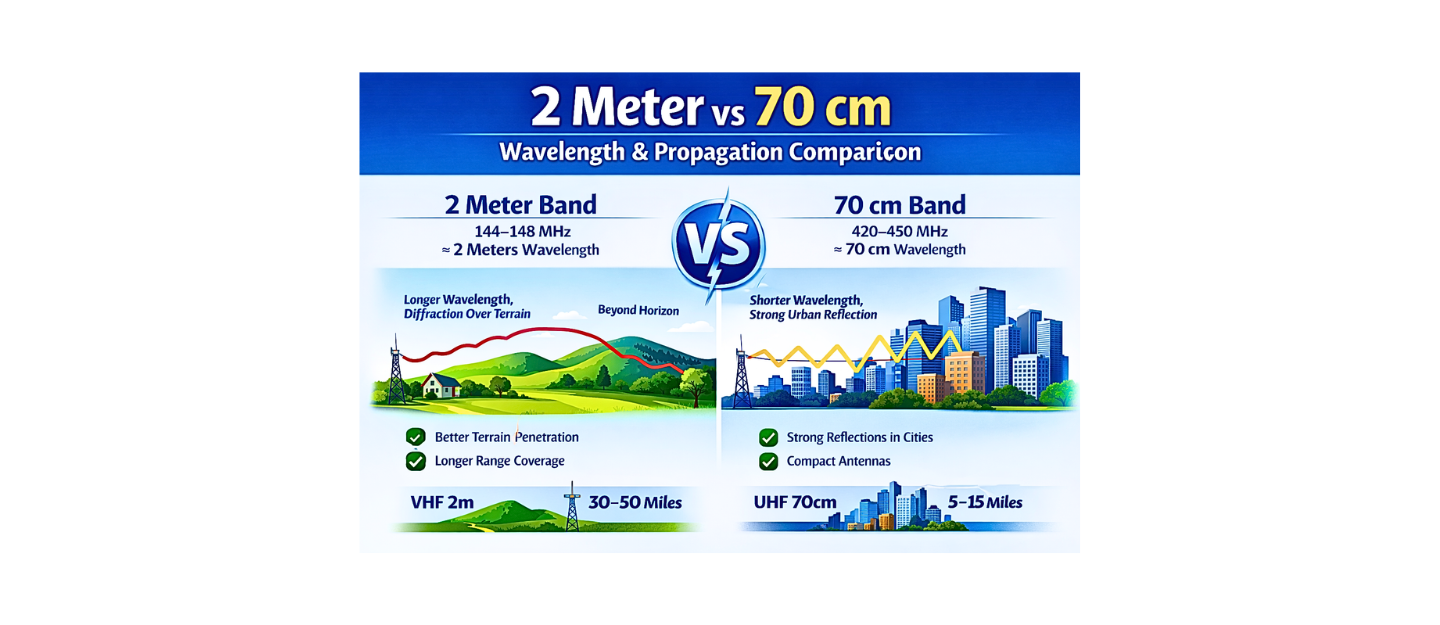
The 2 meter band operates around 144–148 MHz, producing a wavelength of approximately 2 meters (about 6.5 feet). The 70 cm band operates around 420–450 MHz, producing a wavelength near 70 centimeters (about 2.3 feet).
Longer wavelengths bend more effectively around obstacles and interact more strongly with terrain. Shorter wavelengths behave more like straight-line energy paths, which increases precision but reduces natural coverage beyond obstructions.
This fundamental difference explains most operational differences between the two bands.
Propagation Characteristics of the 2 Meter Band
The 2 meter band provides excellent coverage across moderate to long local distances. Its longer wavelength allows signals to diffract around buildings, hills, and terrain features more effectively than UHF signals.
This makes it particularly effective in suburban and rural environments where terrain variation would otherwise block line-of-sight communication. Signals often travel beyond the visual horizon due to diffraction and partial ground interaction.
The band is also relatively stable under varied weather conditions and maintains consistent performance even with imperfect antenna placement.
Propagation Characteristics of the 70 cm Band
The 70 cm band behaves more like true line-of-sight communication. Signals travel in straighter paths and experience greater attenuation when blocked by structures or terrain.
However, shorter wavelengths reflect more effectively from hard surfaces such as buildings. This allows signals to bounce and scatter through dense urban areas, sometimes providing surprisingly strong coverage in city environments.
Because of its higher frequency, the band also supports wider bandwidth and more advanced digital communication modes.
Real-World Range Expectations
Range depends heavily on antenna height, terrain, and power, but typical handheld-to-handheld performance shows clear differences.
| Environment | 2 Meter Range | 70 cm Range |
|---|---|---|
| Open terrain | 5–10 miles | 3–7 miles |
| Suburban | 3–7 miles | 2–5 miles |
| Dense urban | 2–5 miles | 2–6 miles (reflection advantage) |
| Repeater assisted | 25–100+ miles | 20–80+ miles |
Repeaters greatly extend range on both bands.
Obstacle Penetration and Building Performance
Lower frequencies penetrate materials more effectively. The 2 meter band generally performs better through foliage, hills, and dense terrain.
However, 70 cm signals can reflect more strongly off steel, concrete, and glass surfaces, which sometimes improves coverage inside buildings and urban canyons.
This creates a practical rule:
Natural terrain → 2 meters often better
Dense city structures → 70 cm may compete or win
Antenna Size and Installation Requirements
Antenna size is directly related to wavelength.
Quarter-wave antenna length:
2 meter band ≈ 19 inches
70 cm band ≈ 6.5 inches
Smaller antennas make 70 cm ideal for handheld radios, mobile installations, and portable operation. Larger 2 meter antennas provide broader radiation patterns and often improved efficiency when properly installed.
Repeater Network Coverage
The 2 meter band has historically supported the largest repeater networks. Many regions provide extensive 2 meter repeater coverage, especially for emergency communication and public service operation.
Additionally, the 70 cm repeaters are also common but may be more concentrated in urban areas. Because UHF equipment is compact and flexible, many modern digital repeaters operate on 70 cm.
Digital Communication Performance
The 70 cm band excels in digital operation due to wider available bandwidth and reduced electrical noise. Common uses include:
Digital voice systems
Hotspot access
Data transmission
Satellite uplinks
Mesh networking
While 2 meters supports digital modes, 70 cm often provides cleaner performance and greater data capacity.
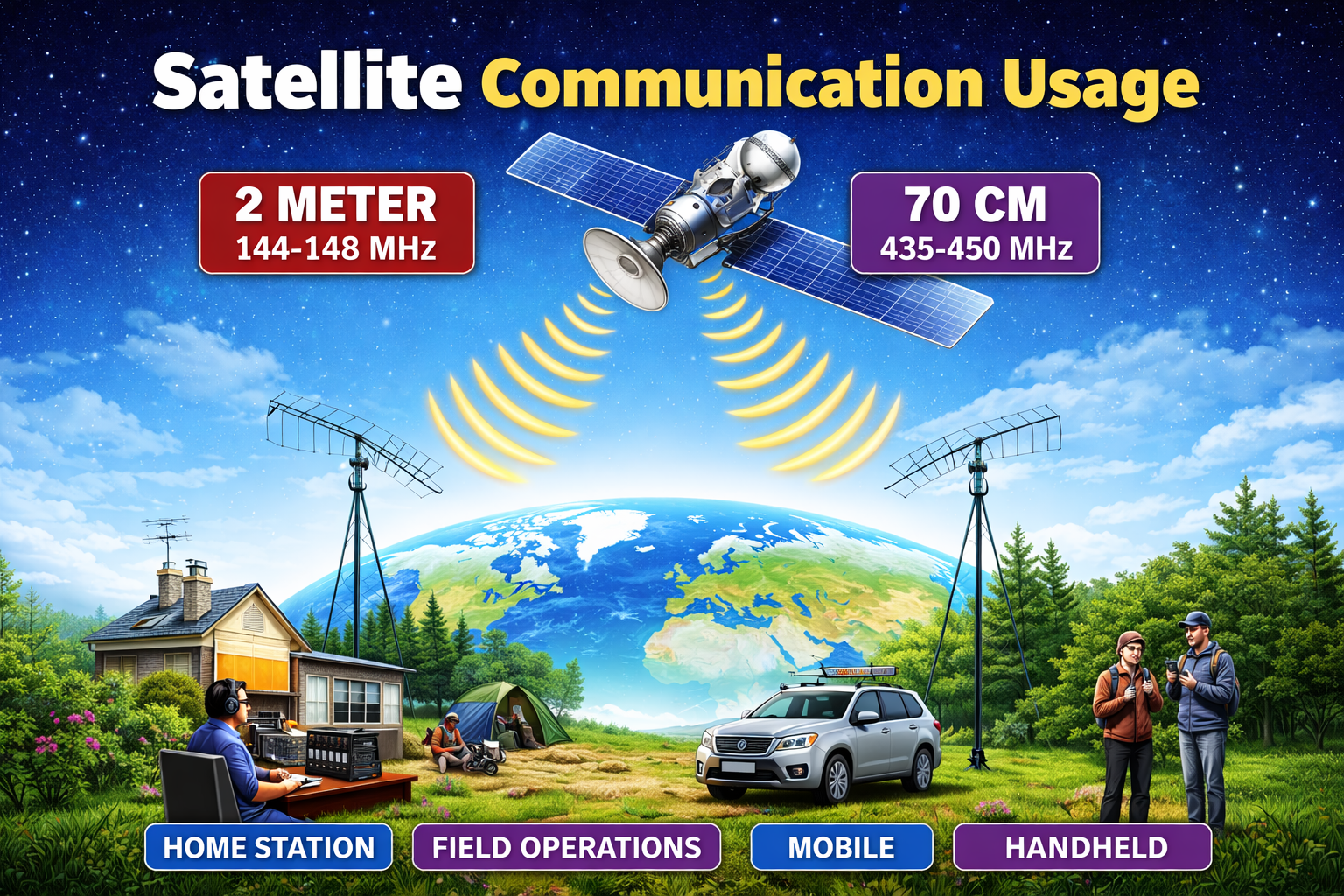
Satellite communication using 2 meter (downlink) and 70 cm (uplink) bands with directional antennas and line-of-sight signal paths.
Satellite Communication Usage
Many amateur satellites use 70 cm uplinks because shorter wavelengths support compact directional antennas and precise signal targeting. Operators often transmit on 70 cm and receive on 2 meters.
This dual-band arrangement takes advantage of both propagation characteristics.
Satellite Communication Usage in Real-World Locations
Amateur satellite communication performance can vary significantly depending on geographic location, terrain, and surrounding interference levels. Operators in dense urban areas often rely on precise antenna positioning to overcome signal blockage, while rural operators benefit from clearer horizons and fewer obstructions.
In the United States, both the 2 meter and 70 cm bands are widely used for satellite communication, with 70 cm commonly used for uplink and 2 meter for downlink. Local conditions such as building density, elevation, and nearby RF noise sources directly impact signal strength, tracking accuracy, and overall communication success.
Emergency Communication Reliability
Emergency operators frequently rely on the 2 meter band because of its broad coverage and dependable propagation. Longer wavelength signals remain stable in varied terrain and require less precise antenna alignment.
However, 70 cm plays an important role in dense urban response and digital coordination systems.
Power Efficiency and Signal Stability
Lower frequency signals generally maintain stability over longer paths with modest power. Higher frequency signals may require clearer paths or higher antenna gain to achieve comparable coverage.
In practice, both bands perform well with typical handheld or mobile transmitter power, but terrain plays a larger role at UHF.
Step-By-Step Method for Choosing the Right Band
Step 1 — Identify terrain and environment
Step 2 — Determine required communication range
Step 3 — Consider repeater availability
Step 4 — Evaluate need for digital or satellite operation
Step 5 — Assess antenna size limitations
Step 6 — Select band that best fits conditions
This process ensures reliable band selection.
Best Use Cases for the 2 Meter Band
Long-distance local communication
Rural and suburban coverage
Emergency response networks
Terrain-obstructed environments
Wide repeater coverage
Best Use Cases for the 70 cm Band
Urban operation
Portable equipment
Digital voice and data
Satellite communication
Compact antenna installations
Performance Comparison Summary
| Feature | 2 Meter | 70 cm |
|---|---|---|
| Range | Longer | Shorter |
| Obstacle penetration | Better | Moderate |
| Equipment size | Larger | Smaller |
| Digital capability | Good | Excellent |
| Urban reflection | Moderate | Strong |
| Terrain coverage | Strong | Limited |
| Satellite work | Common receive | Common transmit |
Common Operator Mistakes
Using 70 cm for long rural paths without height
Ignoring building reflection advantages
Using oversized antennas for portable use
Selecting band without checking repeaters
Expecting identical propagation behavior
Operator Experience and Practical Insight
Experienced operators commonly use both bands depending on environment. Many mobile radios support dual-band operation because switching bands often solves communication challenges immediately.
Operators in rural areas rely heavily on 2 meters, while dense urban users frequently depend on 70 cm reflection paths and digital repeaters.
Frequently Asked Questions About 2 Meter vs 70 cm
Which band is better for beginners?
Both are beginner friendly, but 2 meters often provides simpler setup and wider repeater access.
Can one antenna operate both bands?
Yes, dual-band antennas are common and widely used.
Which band is quieter?
70 cm often has a lower noise floor but may fade more quickly.
2 Meter and 70 CM Bands
The 2 meter and 70 cm bands serve different but complementary roles. The 2 meter band provides broader coverage, stronger terrain penetration, and dependable emergency communication performance. The 70 cm band offers compact equipment, advanced digital capability, and strong line-of-sight precision in dense environments.
Understanding how wavelength influences propagation, equipment design, and signal behavior allows operators to choose the most effective band for any communication scenario. By selecting the right band for the environment and operating goal, amateur radio users can achieve reliable, efficient communication under a wide range of conditions. Choosing between 2 meter and 70 cm ultimately depends on your environment, but most operators achieve the best results by using both bands together.
About the Author
Vince, W2KU, is a licensed Extra class amateur radio operator and the founder of Ham Shack Reviews. The club committee named him Amateur of the Year in 2026 for his contributions to amateur radio education and equipment evaluation.
He primarily operates HF, knows propagation very well, operates mobile and handhelds daily. Vince exchanges QSL cards for DXCC, contest confirmation, and award tracking and is the club QSL manager. His guidance focuses on practical operating procedures, accurate logging, and real-world amateur radio practices. He actively operates on VHF and UHF bands, including satellite communication, repeater networks, and portable field operations.
Please consider Donating to help support this channel