
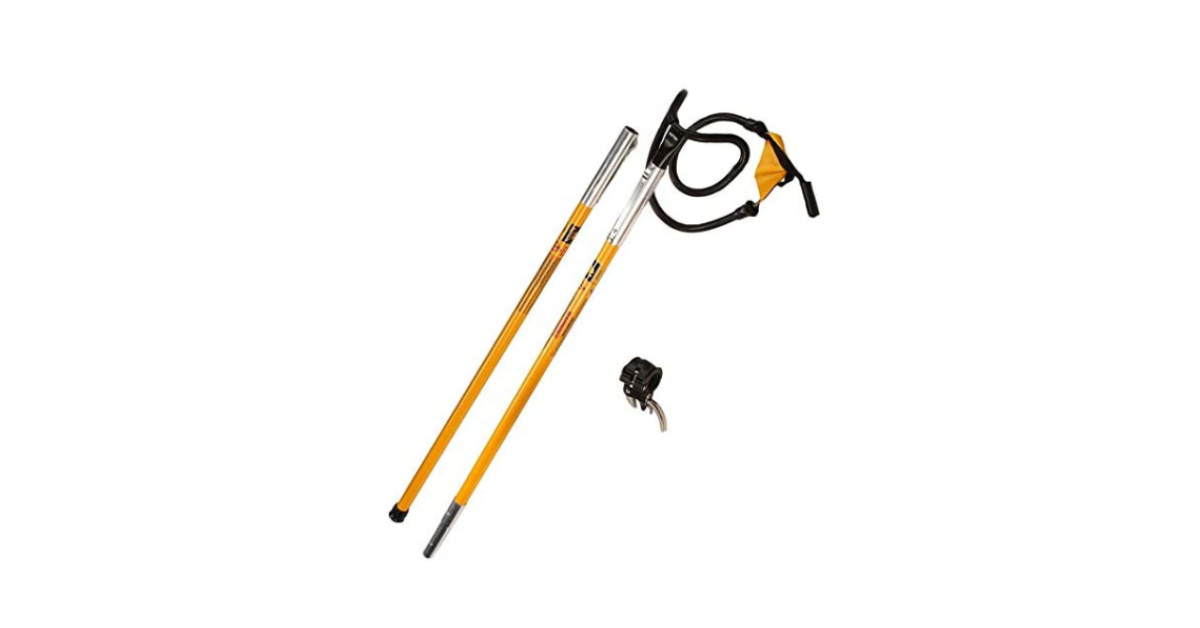
The Big shot line launcher is an arborist’s slingshot that makes an accurate and lightweight antenna launching system. You can reach a particular branch, or clear 150′ trees with ease. To prevent over shooting, a wide range of projectiles can be used with varying weights.

The Big Shot line launcher consists of two 4 ft. hollow fiberglass poles for a total of 8′ ft. This allows a long stretch to clear the tallest trees while maintaining accuracy. A Big Shot head with long stretch rubber launcher and projectile holder ensures accuracy.
A launching trigger is included and improves accuracy while reduceing arm fatigue. The trigger mounts to the pole and has an integrated safety latch to prevent accidental discharge.
This launcher has changed the way we install antennas by giving us a simple, and accurate tool for the job.
Why Operators Use Mechanical Line Launchers
Placing antenna support lines by hand becomes difficult as tree height increases. Even experienced operators struggle to achieve consistent placement when throwing lines over tall branches or wide spans. Mechanical line launchers solve this problem by providing controlled, repeatable force that allows the throw weight to travel higher and more accurately than manual methods.
This consistency makes antenna installation faster and more predictable. Instead of repeated attempts to reach the correct branch, the operator can place the line precisely where it is needed. Accurate placement is especially important when installing full-size HF antennas, where height and support spacing directly influence performance.
Other Ways to Raise Antenna Lines
Operators use several different methods to install antenna supports depending on height, terrain, and available equipment.
Common alternatives include:
- Hand throwing a weighted line
- Arborist throw bags and throw line
- Slingshot launchers
- Pneumatic line launchers
- Drone-assisted line placement
- Telescoping fiberglass poles
- Fishing rod and weight method
Each method offers different advantages in cost, portability, maximum height, and placement accuracy. Some operators prefer simple manual methods, while others choose mechanical launchers for precision and repeatability.
Safety Considerations When Using a Line Launcher
Line launchers store significant elastic energy and must be handled carefully. Always treat the equipment as high-tension gear and operate with full control.
Follow these safety practices:
- Wear eye protection during every launch
- Keep people and pets clear of the launch direction
- Never aim toward buildings, vehicles, or power lines
- Maintain a firm grip when stretching the launcher tubing
- Inspect elastic tubing regularly for cracks, wear, or fatigue
- Use only recommended throw weights and line sizes
- Keep the launch area clear of obstacles and trip hazards
- Release smoothly to prevent snapback or uncontrolled movement
Proper safety habits protect both the operator and nearby equipment.
Real-World Antenna Installation Results
Using a line launcher allows antennas to be installed higher and with greater precision than most manual methods. Even modest increases in height can noticeably improve performance.
Operators commonly experience:
- Lower received noise levels
- Improved radiation efficiency
- Better long-distance signal performance
- Stronger and more consistent signal reports
- More predictable antenna tuning
- Faster installation time
- Easier repositioning of antenna supports
Accurate placement also makes experimentation easier when adjusting antenna height or orientation.
Typical Launch Height and Capability
With proper technique and correct throw weight, line launchers of this type can place a line well above normal throwing height. Operators commonly reach heights suitable for full-size HF antennas and long support spans.
Actual height depends on:
- Elastic tension
- Throw weight mass
- Launch angle
- Line drag
- Operator technique
Vertical launch angles produce maximum height, while angled shots produce longer horizontal distance.
Why Operators Use the Big Shot Line Launcher
The Big Shot launcher is designed for controlled, repeatable line placement at significant height. It allows operators to reach branches that are far beyond normal throwing range.
This makes it especially useful for:
- Installing wire antennas in tall trees
- Portable and field day setups
- Raising dipoles and end-fed wires
- Adjusting antenna height without climbing
- Working in dense wooded areas
Because accurate placement is possible, setup time is reduced and antenna positioning becomes much more precise.
What an Antenna Line Launcher Is Used For
An antenna line launcher is a tool used to place a lightweight line over tall trees or supports so antenna wire can be raised safely and accurately. Instead of throwing a rope by hand, the launcher propels a weighted throw bag attached to a thin line high into the air.
Once the line passes over a branch, it can be used to pull up heavier rope and finally the antenna wire. This allows antennas to be installed at heights that would otherwise be difficult or unsafe to reach.
High antenna placement improves radiation efficiency, lowers ground losses, and often produces stronger signals.
Basic Steps to Launch an Antenna Line
- Attach throw line securely to throw weight
- Lay line out loosely to prevent tangles
- Pull launcher tubing to full tension
- Aim near vertical for maximum height
- Release smoothly
- Allow weight to fall back down
- Use line to pull support rope into position
Careful line management prevents tangles and improves shot consistency.
Who the Big Shot Line Launcher Is Best For
This type of launcher is most useful for operators who need reliable, repeatable line placement at significant height.
It is especially helpful for:
- Installing antennas in tall trees
- Portable and field day operators
- Stations without towers or permanent supports
- Operators who frequently adjust antenna height
- Installations requiring precise placement
- Dense wooded environments
- Long wire or full-size HF antenna setups
It may be less necessary for low installations, short masts, or locations where supports are easily accessible from ground level.
My Big Shot Line Launcher Experience
I have used this Line launcher to install many antennas and each time I become more confident in it’s ability. I chose to use a 12 oz. brite neon green projectile weight for a little extra height. The neon green makes it easy to find in the woods. I have never failed to get the rope high enough or the branch I wanted.
The projectile holder secures the weight well, and the 8′ pole is just right for the long pull down. The fiberglass poles have minimum bending during use while feeling stable enough to complete any job. The rubber launching band has held up well, and still looks new after 2 years.
The trigger adds control by allowing you to aim better while not holding the stretched launcher down. The trigger safety is a nice feature, but I feel I have not needed it because I pull down, lock it into the trigger, aim, and fire without moving the pole around much.
I use masonary string line which is #18 braided nylon twine in neon green because it is light and comes in 1000′ rolls. I find it to be tangle resistent, and wraps up nicely. This is my go to antenna launcher set up for most occasions, I was able to install my Loop antenna higher then I imagined.
How a Line Launcher Improves Antenna Performance
Higher antenna placement directly improves efficiency by reducing ground interaction and lowering signal absorption. When support lines can be placed at greater height, wire antennas operate with more effective radiation and often produce stronger signal reports. Increased height can also improve takeoff angle characteristics, which helps long-distance communication on many HF bands.
Precise line placement also allows more consistent antenna geometry. When supports are positioned accurately, the antenna maintains its intended shape and tension. This stability improves tuning predictability and makes adjustments easier when experimenting with different configurations.
Safe Operation and Equipment Control
Line launchers store significant elastic energy, which requires controlled handling during operation. Maintaining steady tension, smooth release, and clear launch direction prevents unpredictable movement of the throw weight. Careful preparation of the throw line also reduces the chance of tangles that can affect launch trajectory.
Consistent operating habits help protect both equipment and surroundings. A controlled launch produces more reliable results and allows the operator to focus on accurate placement rather than repeated corrections.
When a Line Launcher Provides the Greatest Advantage
A mechanical launcher provides the most benefit when antenna supports are tall, widely spaced, or difficult to access from ground level. Installations involving mature trees, large property spans, or portable setups in wooded areas often require precise placement that cannot be achieved reliably by hand.
Operators who frequently adjust antenna height or experiment with different wire configurations also benefit from repeatable placement capability. In situations where accurate positioning improves antenna geometry, the launcher becomes a practical installation tool rather than simply a convenience.