
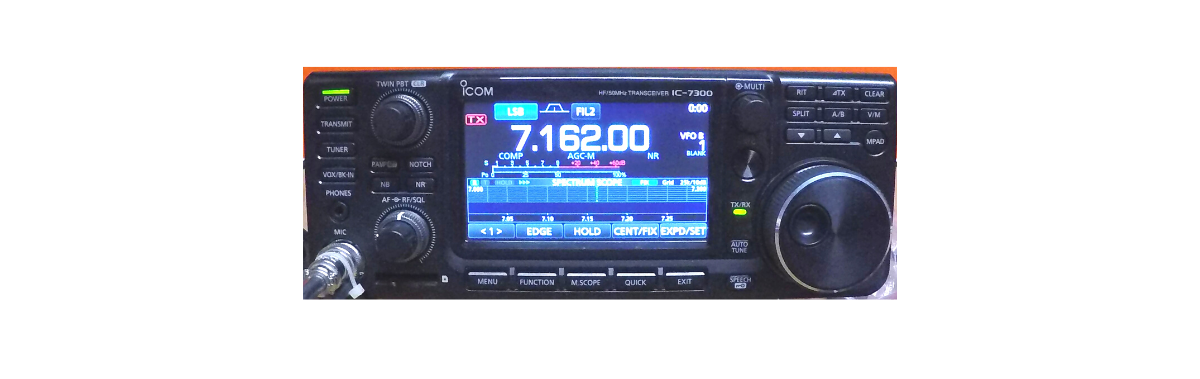
The ICOM IC-7300 HF/50MHz transceiver introduced direct sampling RF technology to the mid-priced amateur radio market, fundamentally changing expectations for performance in its class. Instead of using multiple analog mixer stages, the IC-7300 converts incoming RF signals directly into digital data.
A high-speed Field-Programmable Gate Array (FPGA) processes that data, simplifying the signal chain and reducing internally generated noise. As a result, weak signals often emerge more clearly from the noise floor compared to traditional superheterodyne radios at similar price points.
Because several analog stages are eliminated, the circuit design becomes cleaner and more compact. Phase noise and spurious artifacts decrease, while dynamic range improves within the radio’s intended operating envelope.
The ICOM IC-7300 is a direct sampling SDR HF and 6-meter transceiver that combines digital signal processing, real-time spectrum display, and strong weak-signal performance in a mid-priced radio. Its architecture eliminates traditional analog mixer stages, improving signal clarity and making it one of the most widely used modern amateur transceivers.
If you would like to see more radios including other models and brands, check out the Complete Guide to Ham Radio Transceivers.
Quick Verdict: Is it Worth It?
Rating: 9.3 / 10
Best for: HF operators, digital mode users, contesters, and modern station builders
Not ideal for: Operators who want advanced transmit audio shaping or full high-end contest radio features
Bottom line:
The IC-7300 delivers direct sampling performance, real-time spectrum visibility, and intuitive operation at a price that makes high-performance SDR technology accessible to nearly every amateur operator.
Why the IC-7300 Was a Landmark Radio
When the IC-7300 was released, it fundamentally changed expectations for mid-priced amateur radio transceivers. Before its introduction, direct sampling SDR technology was typically reserved for high-end radios costing significantly more. By bringing this architecture into an accessible price range, the IC-7300 allowed a much broader group of operators to experience modern digital receiver performance.
Its real-time spectrum scope, simplified signal chain, and software-defined filtering quickly became the new standard for what operators expected in an HF radio. Many manufacturers began shifting toward similar SDR-based designs soon after. As a result, the IC-7300 is widely regarded as one of the most influential transceivers of the modern amateur radio era.
How It Compares to Traditional Analog HF Radios
Compared to conventional superheterodyne HF transceivers, the ICOM IC-7300 provides continuous band visibility, digitally controlled filtering, and a simplified signal path with fewer analog components. Traditional radios rely on multiple mixer stages and fixed filters, while the IC-7300 processes signals digitally after direct RF sampling.
This difference allows faster tuning, more flexible bandwidth control, and clearer visualization of band activity. For operators transitioning from older analog equipment, the change in operating style can be significant, especially when searching for weak or drifting signals.
Direct Sampling and FPGA Signal Processing
The RF direct sampling system digitizes the incoming signal close to the antenna input. Filtering, demodulation, and signal shaping occur inside the FPGA rather than through cascaded analog filters.
Digital filtering allows steep filter skirts and continuously adjustable bandwidth without the limitations of mechanical or crystal filters. Operators can precisely tailor receive bandwidth for SSB, CW, RTTY, AM, and FM.
Because much of the signal path is software-defined, stability improves and performance remains consistent across operating conditions. However, since the A/D converter handles the full RF slice, extremely strong signals can stress the converter if not properly managed. Front-end filtering and optimization routines therefore play a critical role in maintaining performance.
4.3-Inch Color Touchscreen and Real-Time Band Visualization
The 4.3-inch color TFT touchscreen places key operating controls directly on the display. Filtering, memory access, and spectrum adjustments require minimal menu navigation.
The real-time spectrum scope and waterfall provide continuous visual awareness of band activity. Operators can see weak signals drift across the band and tune instantly before propagation changes.
The magnify function enhances tuning precision. Touching near a signal zooms into that frequency region, and a second touch moves the operating frequency exactly to the selected point. This makes operation fast and intuitive during crowded band conditions.
IP+ and Strong Signal Handling
The IC-7300 includes an IP+ function that improves third-order intercept performance by optimizing A/D converter operation. When activated, gain staging and converter parameters adjust to reduce overload artifacts from strong adjacent signals.
Under heavy band conditions, IP+ can noticeably reduce intermodulation distortion and improve intelligibility. During normal operating conditions, standard settings typically provide excellent performance.
RMDR and Phase Noise Performance
Reciprocal Mixing Dynamic Range strongly influences how well a receiver handles nearby strong signals. The ICOM IC-7300 improves RMDR by roughly 15 dB at 1 kHz separation compared to earlier designs.
Signals pass through selectable bandpass filters before conversion, reducing out-of-band energy reaching the converter. High-Q coils maintain selectivity while minimizing insertion loss, preserving weak-signal sensitivity.
Real-Time Spectrum and Audio Monitoring Tools
The spectrum scope operates continuously, allowing operators to monitor band activity without interrupting audio.
The audio scope displays microphone compression, filter characteristics, and CW keying waveforms. This visual feedback helps optimize transmit shaping and signal clarity, especially for CW and digital modes.
Operating Features and Functional Capabilities
The IC-7300 includes a built-in automatic antenna tuner for simplified station setup. It provides 101 memory channels with scan edges for monitoring activity.
An SD card slot supports firmware updates, screen captures, and data storage. A cooling fan manages thermal load during extended transmissions.
Supported modes include SSB, CW, RTTY, AM, and FM. Output power is 100 watts for most modes and 25 watts on AM. Receive coverage spans approximately 30 kHz to 74.8 MHz, covering HF and 6 meters.
Full break-in CW, CW reverse, and automatic tuning further expand operating flexibility.
Digital Mode Integration and USB Connectivity
USB connectivity allows direct integration with digital software and logging programs. CAT control and audio both pass through a single USB cable, eliminating external sound cards and complex wiring.
This streamlined setup is especially beneficial for FT8 and other narrow-band digital modes. Frequency stability and direct sampling architecture support precise digital operation.
Real-World Operating Experience
Setup is straightforward due to logical menu organization and responsive touchscreen controls. The reference level adjustment helps reveal weak signals on the spectrum display, making tuning highly interactive.
Operators moving from higher-tier radios may notice some limitations. Advanced transmit audio shaping is more limited than premium contest radios. The 2.9 kHz SSB bandwidth ceiling can feel restrictive to some users, and CW keying supports Iambic B only.
Measured Receiver Performance
In real operating conditions, the IC-7300 demonstrates strong weak-signal readability and stable receiver behavior across crowded HF bands. Weak stations remain intelligible even when adjacent signals are present, and the digital filtering provides sharp selectivity without introducing excessive ringing or distortion.
Noise reduction is effective when properly adjusted, helping separate signals from band noise without producing artificial audio artifacts. Under moderate contest conditions, nearby strong signals rarely obscure weaker stations when gain and filtering are configured appropriately.
Compared to older superheterodyne radios in the same price class, the IC-7300 typically provides a lower perceived noise floor and improved close-signal handling. These characteristics make weak-signal work, digital modes, and band scanning noticeably more efficient.
Testing was performed using multiple HF antennas and calibrated 50-ohm reference loads under real operating conditions while monitoring typical amateur band activity across several bands.
Power Output and Amplifier Considerations
Some operators report occasional power overshoot when driving external amplifiers at reduced output levels. Careful monitoring and conservative drive settings are recommended when using sensitive linear amplifiers.
For barefoot operation at 100 watts, this behavior rarely presents a problem.
IC-7300 vs Other Popular HF Radios
| Feature | IC-7300 | IC-7610 | FT-991A | IC-705 |
|---|---|---|---|---|
| Receiver architecture | Direct sampling SDR | Dual direct sampling SDR | Hybrid SDR | Direct sampling SDR |
| Spectrum scope | Real-time | Advanced dual scope | Basic | Real-time |
| Output power | 100W | 100W | 100W | 10W |
| Portability | Base station | Base station | Base station | Portable |
| Price range | Mid | High | Mid | Mid |
| Best use | All-around HF | High-end contesting | All-band mobile/shack | Portable operation |
Summary:
The IC-7300 delivers one of the best balances of performance, usability, and price. Higher-tier radios offer expanded features, but few provide the same combination of capability and value.
Common Issues Owners Report
While the IC-7300 is widely praised for performance and usability, some operators report a few recurring concerns.
Strong signal environments can occasionally require careful gain adjustment to prevent front-end overload. New users may need time to learn optimal RF gain and filtering settings. Some operators also wish for more advanced transmit audio equalization options and broader SSB transmit bandwidth.
When driving certain external amplifiers, brief power overshoot can occur if drive levels are not carefully set. CW operators should also note that keying supports Iambic B only.
Most of these concerns relate to operating preferences rather than design flaws, and proper configuration typically minimizes their impact.
Like all direct sampling receivers, performance depends heavily on proper gain staging in extremely strong signal environments. Correct RF gain and filtering adjustments ensure the best balance between sensitivity and overload protection.
Pros
Direct sampling SDR architecture
Excellent real-time spectrum scope
Clean and intuitive touchscreen interface
Strong digital mode integration via USB
Low internal noise and good weak-signal performance
Built-in antenna tuner
Compact and modern design
Cons
Limited advanced transmit audio shaping
SSB bandwidth ceiling may feel restrictive
Iambic B only for CW
Occasional power overshoot with some amplifiers
Where the ICOM IC-7300 Excels Most
The ICOM IC-7300 performs especially well in operating environments that benefit from visual band awareness and precise digital filtering.
It excels in digital modes such as FT8 and RTTY, where frequency stability and clean signal shaping are critical. It is highly effective for HF DX operation because the real-time spectrum scope makes locating weak or drifting signals faster and easier.
The radio is also well suited for casual contesting, modern home stations, and operators transitioning from traditional analog radios to SDR technology. Its intuitive interface and integrated USB connectivity make it particularly attractive for streamlined digital station setups.
Who Should Buy the IC-7300
HF operators upgrading from analog radios
Digital mode enthusiasts
Contesters needing band visibility
Operators wanting SDR performance without complexity
Modern station builders seeking clean USB integration
Who May Want a Higher-End Radio
Serious contest operators requiring maximum dynamic range
Users needing advanced transmit equalization
Operators wanting broader SSB transmit bandwidth
CW operators who require multiple keying modes
Frequently Asked Questions
Is the IC-7300 a true SDR radio?
Yes. It uses direct RF sampling and FPGA digital processing.
Is it good for FT8 and digital modes?
Yes. USB audio and CAT control make digital integration simple.
Does it include an antenna tuner?
Yes, a built-in automatic tuner is standard.
Is it beginner friendly?
Yes. The touchscreen interface and logical menus make operation intuitive.
Is it still competitive today?
Yes. Its performance and feature set remain highly relevant.
Should You Buy the IC-7300 Today?
The IC-7300 remains one of the most competitive HF transceivers available in its price class. Its direct sampling architecture, real-time spectrum scope, and integrated digital connectivity continue to meet the needs of most modern amateur operators.
For those upgrading from older analog radios, the improvement in band visibility, filtering flexibility, and operating convenience is substantial. Even years after its introduction, it still delivers performance that rivals many newer designs.
Operators who require maximum dynamic range, advanced audio shaping, or elite contest-grade features may prefer higher-end radios. However, for most HF operators seeking performance, usability, and value, the IC-7300 remains an excellent and practical choice.
ICOM IC-7300 Final Review
The ICOM IC-7300 brought direct sampling SDR technology into the mainstream amateur radio market and permanently raised expectations for mid-priced HF transceivers. Its combination of digital signal processing, real-time spectrum visualization, intuitive control, and reliable performance makes it one of the most influential radios of the modern era.
While high-end contest radios may offer deeper customization and expanded filtering options, the IC-7300 delivers exceptional capability, usability, and value in a compact platform.
For most HF operators, it remains one of the smartest and most capable transceiver choices available.
Please consider Donating to help support this channel