
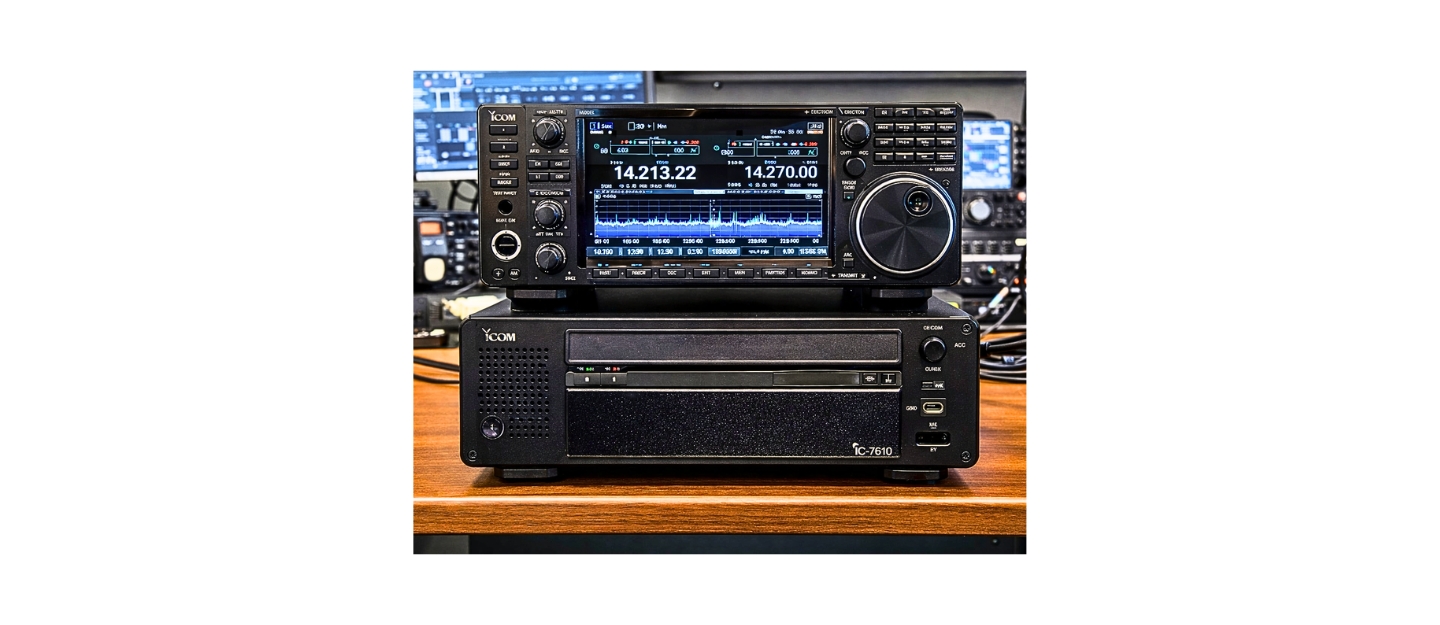
The Icom IC-7760 represents one of the most advanced amateur radio transceivers ever produced by Icom. Designed to celebrate the company’s 60th anniversary, this high-end HF and 6-meter transceiver combines modern software-defined radio architecture with a modular hardware design intended for demanding operators.
Unlike many conventional transceivers that integrate all electronics into a single chassis, the IC-7760 separates the control head from the RF deck. This modular approach provides significant installation flexibility and helps reduce electrical noise near the operating position.
For amateur radio operators engaged in contesting, DX chasing, and digital mode operation, the IC-7760 provides exceptional receiver performance, strong transmit capability, and a highly sophisticated signal processing system. Its design emphasizes clean signal handling, precise filtering, and user-friendly operation through touchscreen displays and advanced spectrum monitoring tools.
The IC-7760 is built for serious operators who demand high dynamic range, strong interference rejection, and the ability to monitor multiple signals simultaneously across the HF spectrum.
If you would like to see more radios including other models and brands, check out the Complete Guide to Ham Radio Transceivers.
Icom IC-7760 Modular Architecture and Remote RF Deck Design
One of the most distinctive features of the IC-7760 is its split architecture. The system consists of two primary components:
- Control head
- RF deck
The control head contains the displays, operating controls, and user interface. The RF deck contains the transmitter, receiver hardware, power amplifier, and filtering systems.
These two components connect through a standard LAN cable, allowing the RF deck to be placed in a different location from the operator’s desk.
This architecture provides several advantages.
First, placing the RF deck closer to the antenna feed point reduces feedline losses and improves overall RF efficiency. Shorter coax runs between the transmitter and antenna often lead to better signal strength and lower system loss.
Second, relocating the RF deck away from the operating desk helps reduce mechanical noise from cooling fans and switching power supplies.
Finally, the LAN-based connection allows flexible station layout options. Operators can place the RF deck in equipment racks, basements, or other remote locations while maintaining full control from the operating position.
Dual Display Operating System
The IC-7760 incorporates a dual-display interface designed to improve operational awareness.
The primary display is a 7-inch touchscreen with a resolution of 800 × 480 pixels. This display provides access to nearly all major operating functions.
The main screen displays:
- operating frequency
- spectrum scope
- waterfall display
- S-meter readings
- filter settings
- digital mode decoding information
This large display allows operators to quickly monitor band activity and locate signals visually.
Complementing the main display is a secondary 2.4-inch touchscreen. This smaller display provides quick access to frequently used functions.
Typical information shown on the secondary display includes:
- filter bandwidth
- meter readings
- band stacking registers
- quick function access
By distributing information across two displays, the IC-7760 reduces menu navigation and allows operators to access important controls more quickly.
Receiver Architecture and Signal Processing
The IC-7760 employs a direct RF sampling architecture combined with advanced digital signal processing.
In a direct sampling system, incoming RF signals are converted directly into digital data using high-speed analog-to-digital converters. Once digitized, powerful FPGA processors analyze the signals and perform filtering, demodulation, and signal enhancement.
This architecture offers several advantages compared with traditional superheterodyne receivers.
Benefits include:
- extremely high dynamic range
- improved signal clarity
- flexible digital filtering
- reduced analog distortion
The com IC-7760 also features dual independent receivers. This allows the operator to monitor two frequencies or bands simultaneously.
Dual receiver capability is particularly valuable during contests or DX operations. Operators can listen for new stations on one band while maintaining a QSO on another frequency.
Digital Preselector and Front-End Protection
Strong nearby signals can overload sensitive receivers, particularly in environments with many transmitters operating simultaneously.
To prevent this, the com IC-7760 incorporates a Digital Preselector system known as DIGI-SEL.
DIGI-SEL filters incoming signals before they reach the main receiver circuitry. By limiting out-of-band signals, the preselector protects the receiver from overload and improves selectivity.
Additionally, the receiver includes a high-performance preamplifier that enhances weak-signal sensitivity.
Because the preselector and preamplifier can operate simultaneously, the IC-7760 achieves excellent weak-signal reception while maintaining strong interference rejection.
Transmitter Performance and Digital Pre-Distortion
The com IC-7760 delivers up to 200 watts of transmit power on HF and 50 MHz.
This output level provides strong signal performance for both DX communication and contest operation. The transmitter supports a wide range of operating modes including:
To maintain signal purity at high output power, the radio uses Digital Pre-Distortion (DPD) technology.
DPD compensates for nonlinear distortion within the transmitter’s power amplifier. By correcting these distortions digitally before transmission, the radio produces cleaner signals with reduced intermodulation products.
Clean signal output is especially important in crowded band conditions, where poor transmitter linearity can interfere with nearby operators.
Built-In Automatic Antenna Tuner
The IC-7760 includes an internal automatic antenna tuner designed for rapid band switching. Unlike many conventional tuners that use variable capacitors and inductors, the IC-7760 uses a relay-based tuning network.
Relay-based tuners offer several advantages:
- faster tuning time
- improved reliability
- ability to store tuning presets
Once the tuner has matched an antenna on a specific frequency, the radio remembers that tuning configuration. When the operator returns to that frequency, the tuner recalls the stored settings instantly. This feature allows rapid band changes during contest operation.
Spectrum Scope and Waterfall Analysis
Modern transceivers increasingly rely on visual signal monitoring tools, and the IC-7760 includes a highly advanced spectrum scope and waterfall display system. The radio features dual spectrum scopes capable of monitoring two separate frequency ranges simultaneously.
Operators can observe:
- band activity
- signal strength
- interference sources
- weak signals hidden in noise
The waterfall display shows signal intensity over time, allowing operators to identify digital transmissions and narrowband signals. These visual tools dramatically improve operating efficiency, particularly during busy contest periods.
Connectivity and Station Integration
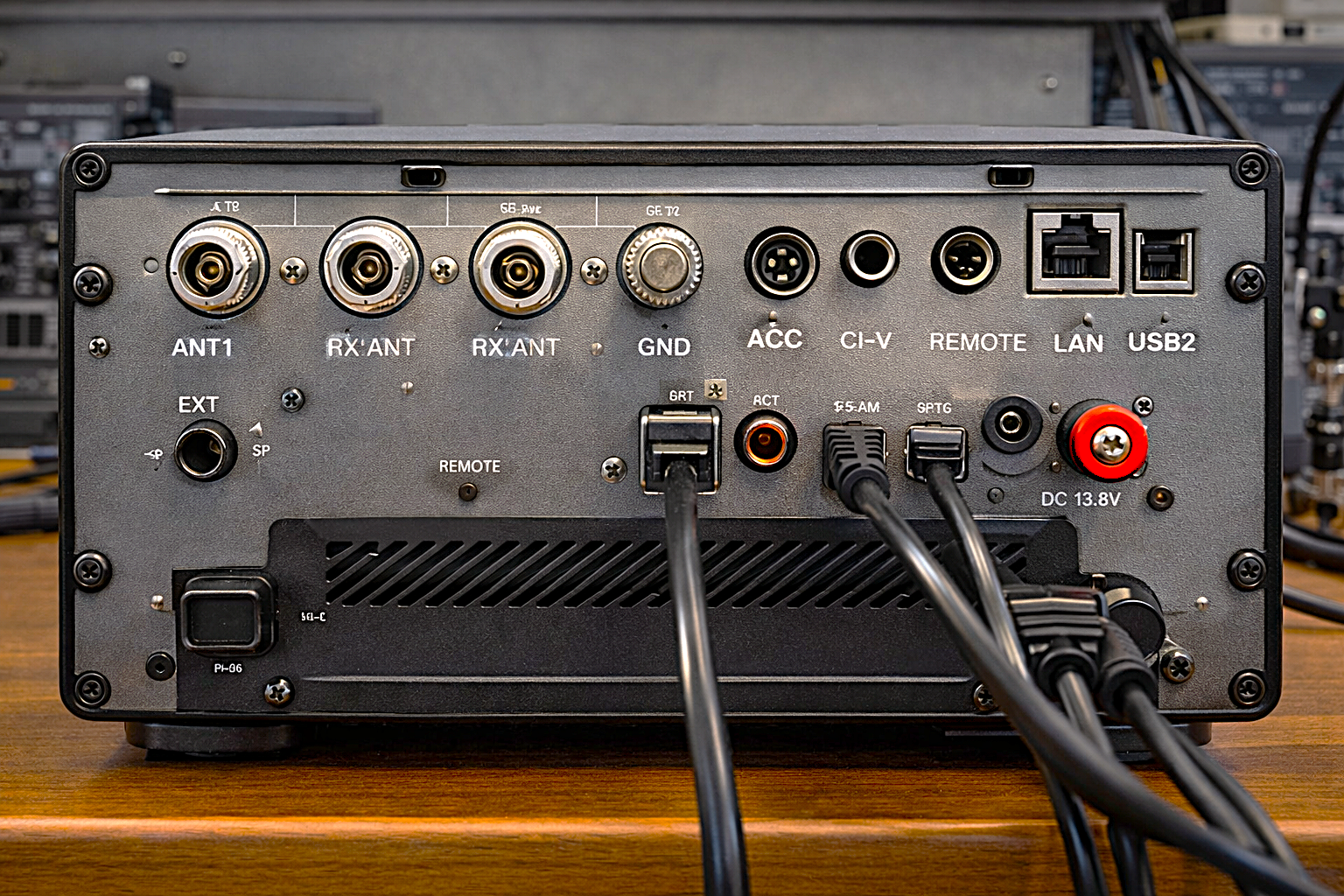
The IC-7760 offers extensive connectivity options for integration with modern amateur radio stations.
Key connectivity features include:
- four SO-239 antenna connectors
- two receive-only antenna inputs
- LAN network connection
- USB interface
- SD card slot
- external monitor output
- transverter port
The LAN interface supports remote operation and integration with network-based station control systems. The USB interface allows connection to digital mode software without requiring external audio interfaces.
Technical Specifications Summary
| Specification | Valus |
|---|---|
| Frequency Coverage | HF + 50 MHz |
| Output Power | Up to 200 W |
| Receiver Architecture | Direct RF Sampling |
| Receivers | Dual independent receivers |
| Displays | 7-inch main display + 2.4-inch secondary display |
| Modes | SSB, CW, RTTY, PSK, AM, FM |
| Antenna Ports | 4 transmit, 2 receive |
| Frequency Stability | ±0.5 ppm |
| Frequency Resolution | 1 Hz |
Operating Applications
The IC-7760 is designed to perform well in several demanding amateur radio environments.
DX Hunting
Weak signal detection combined with high receiver dynamic range makes the radio highly effective for DX communication.
Contest Operation
Dual receivers, fast band switching, and spectrum monitoring allow operators to manage multiple signals efficiently during contests.
Digital Mode Operation
Integrated USB connectivity and clean transmitter design make the radio well suited for FT8 and other digital modes.
Remote Operation
LAN connectivity allows flexible station design and in-home remote operation.
Why the IC-7760 Stands Out
Several factors distinguish the IC-7760 from other modern transceivers.
These include:
- modular RF deck design
- advanced direct sampling receiver
- dual receiver architecture
- digital pre-distortion transmitter technology
- advanced spectrum monitoring tools
Together, these features create a highly capable radio platform designed for operators who require exceptional performance.
Icom IC-7760 Review and Complete Operating Guide
The Icom IC-7760 represents a major advancement in modern amateur radio transceiver design. By combining modular hardware architecture with powerful digital signal processing, the radio delivers outstanding receiver performance, clean transmitter output, and exceptional operational flexibility.
For operators engaged in contesting, DX chasing, or advanced digital mode communication, the IC-7760 offers a level of capability that places it among the most sophisticated amateur radio transceivers currently available.
Its modular design, advanced receiver architecture, and extensive connectivity make it a powerful centerpiece for both modern home stations and advanced contest installations.
Frequently Asked Questions
What type of radio is the Icom IC-7760
The IC-7760 is a high-performance HF and 6-meter amateur radio transceiver designed for advanced operation including contesting and DX communication.
How much transmit power does the IC-7760 produce
The radio delivers up to 200 watts of output power on HF and 50 MHz bands.
Does the IC-7760 support digital modes
Yes. The radio supports digital modes through USB connectivity and can operate with software such as FT8, RTTY, and PSK31.
What makes the IC-7760 different from other HF radios
Its modular architecture separates the control head from the RF deck, allowing flexible installation and reduced operating noise.
Is the IC-7760 suitable for contesting
Yes. Dual receivers, advanced DSP filtering, and spectrum monitoring make it well suited for contest operation.
Does the IC-7760 support remote operation
Yes. The radio supports remote control through a LAN network connection.
About the Author
Vince, W2KU, is a licensed Extra class amateur radio operator and the founder of Ham Shack Reviews. He was named Amateur of the Year in 2026 for contributions to practical amateur radio education and equipment evaluation.
He knows propagation very well, operates mobile and handhelds daily. Vince exchanges QSL cards for DXCC, contest confirmation, and award tracking and is the club QSL manager. His guidance focuses on practical operating procedures, accurate logging, and real-world amateur radio practices.
Please consider Donating to help support this channel