
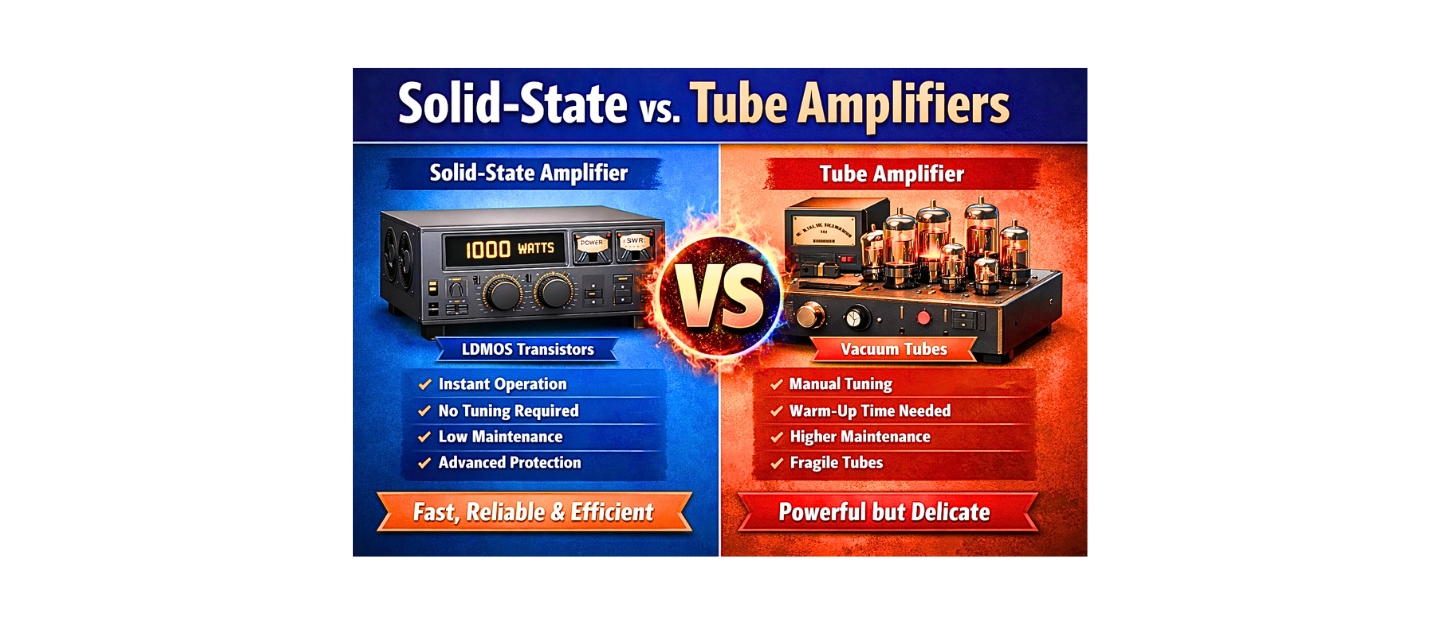
Solid-State vs Tube Amplifiers represents two fundamentally different approaches to RF power amplification in amateur radio. Operators often compare these technologies when selecting an HF amplifier for their station. While both designs increase transmit power and improve signal reach, they rely on very different electronic components and engineering principles. Consequently, understanding how each amplifier type operates helps operators choose equipment that matches their operating style, technical skill, and station requirements.
Amateur radio amplifiers must deliver clean RF power while maintaining stability, efficiency, and reliability across multiple bands. Therefore, the choice between solid-state and tube technology involves more than simply comparing output power ratings. Instead, the comparison includes device physics, impedance characteristics, drive requirements, thermal behavior, protection systems, and long-term service considerations.
Because each amplifier design has distinct strengths and limitations, experienced operators evaluate both technologies carefully before committing to one platform.
High-power amplifiers like the Palstar LA-1K are part of a larger category of RF amplification equipment used to increase transmitted signal strength across the amateur bands. Operators comparing different amplifier designs, technologies, and power levels may want to explore the
Complete Guide to Ham Radio Amplifiers, which explains how solid-state and tube amplifiers work, how to choose the right amplifier for a station, and what factors affect real-world performance.
Solid-State vs Tube Amplifier Comparison
| Feature | Solid-State Amplifier | Tube Amplifier |
|---|---|---|
| Active Device | LDMOS or MOSFET transistor | Vacuum tube |
| Typical Output Power | 500–1500 W | 500–1500 W |
| Operating Voltage | Low voltage, high current | High voltage, lower current |
| Tuning | Automatic band switching | Manual plate/load tuning |
| SWR Tolerance | Lower, requires protection circuits | Higher tolerance |
| Warm-Up Time | None | Requires warm-up |
| Maintenance | Minimal | Tube replacement over time |
| Efficiency | Typically 55–70% | Typically 50–65% |
| Size and Weight | Smaller and lighter | Larger and heavier |
| Operating Complexity | Simple operation | Requires tuning knowledge |
How RF Power Amplifiers Work in Amateur Radio
Both Solid-State vs Tube amplifiers increase the power level of a transceiver’s output signal so it can travel farther through the ionosphere. Most modern transceivers deliver around 100 watts of RF power. However, a linear amplifier can raise that level to 500 watts, 1000 watts, or even the legal limit depending on design and regulatory limits.
The amplifier accepts a low-power RF signal from the transceiver and increases its amplitude without altering the signal’s modulation characteristics. Therefore, a properly designed amplifier must maintain linearity so that the transmitted signal remains clean and free from distortion.
Both solid-state and tube amplifiers perform this task, yet they accomplish it using different active devices. Solid-state amplifiers use semiconductor transistors. Meanwhile, tube amplifiers rely on vacuum tube devices such as triodes or tetrodes.
Although the goal remains identical, the electronic behavior of these devices differs significantly.
Solid-State Amplifier Technology
Solid-state amplifiers use semiconductor devices to generate RF gain. Modern amateur radio amplifiers typically rely on LDMOS or MOSFET transistors designed specifically for RF power applications.
These transistors operate by controlling current flow through semiconductor junctions. When RF drive from the transceiver enters the amplifier stage, the transistor modulates current through the device. As a result, the amplifier produces a higher-power RF output signal.
Solid-state designs often employ push-pull amplifier stages that combine multiple transistors. Engineers combine the output of these devices using broadband transformers or power combiners.
Because transistors operate efficiently over a wide frequency range, solid-state amplifiers frequently provide automatic band switching and minimal tuning requirements.
Additionally, modern solid-state amplifiers integrate digital control systems that monitor voltage, current, temperature, and reflected power. These protections allow the amplifier to shut down automatically if unsafe operating conditions occur.
Tube Amplifier Technology
Tube amplifiers like the Ameritron AL 811, rely on vacuum tube devices to produce RF gain. In these amplifiers, electrons travel through a vacuum between electrodes inside a sealed glass or ceramic envelope.
A heated cathode releases electrons, which move toward the plate under the influence of high voltage. Meanwhile, control grids regulate this electron flow and modulate the RF signal passing through the amplifier stage.
Because tubes operate at high voltages and relatively low currents, they can deliver substantial power levels with fewer active devices. Many amateur radio tube amplifiers use triode or tetrode tubes such as the 3-500Z or similar RF power tubes.
Unlike solid-state designs, tube amplifiers usually require manual tuning. Operators adjust plate tuning and load controls to match the amplifier output network to the antenna system. This tuning process ensures efficient energy transfer and maximum power output.
Device Physics and Electrical Behavior
Semiconductor devices and vacuum tubes behave differently under load conditions. Therefore, their operating characteristics influence amplifier design and performance.
Solid-state transistors operate at relatively low voltages but high currents. Consequently, designers must carefully manage heat dissipation and current handling.
Tube devices operate at much higher voltages, often several thousand volts, but lower currents. As a result, tube amplifiers rely on high-voltage power supplies and robust insulation systems.
Another important difference involves impedance matching. Transistors typically require low impedance loads. Therefore, solid-state amplifiers incorporate complex impedance transformation networks.
Tube amplifiers, however, naturally tolerate higher impedance loads and can match a wider range of antenna conditions.
Engineering Metrics and Measurable Performance
Solid-state and tube amplifiers differ not only in design but also in measurable electrical performance. Therefore, examining real operating metrics helps clarify how each amplifier behaves under load.
Typical LDMOS solid-state devices operate with efficiencies between roughly 55 and 70 percent depending on bias class and cooling design.
Meanwhile, tube amplifiers often operate with efficiencies around 50 to 65 percent in common grounded-grid configurations.
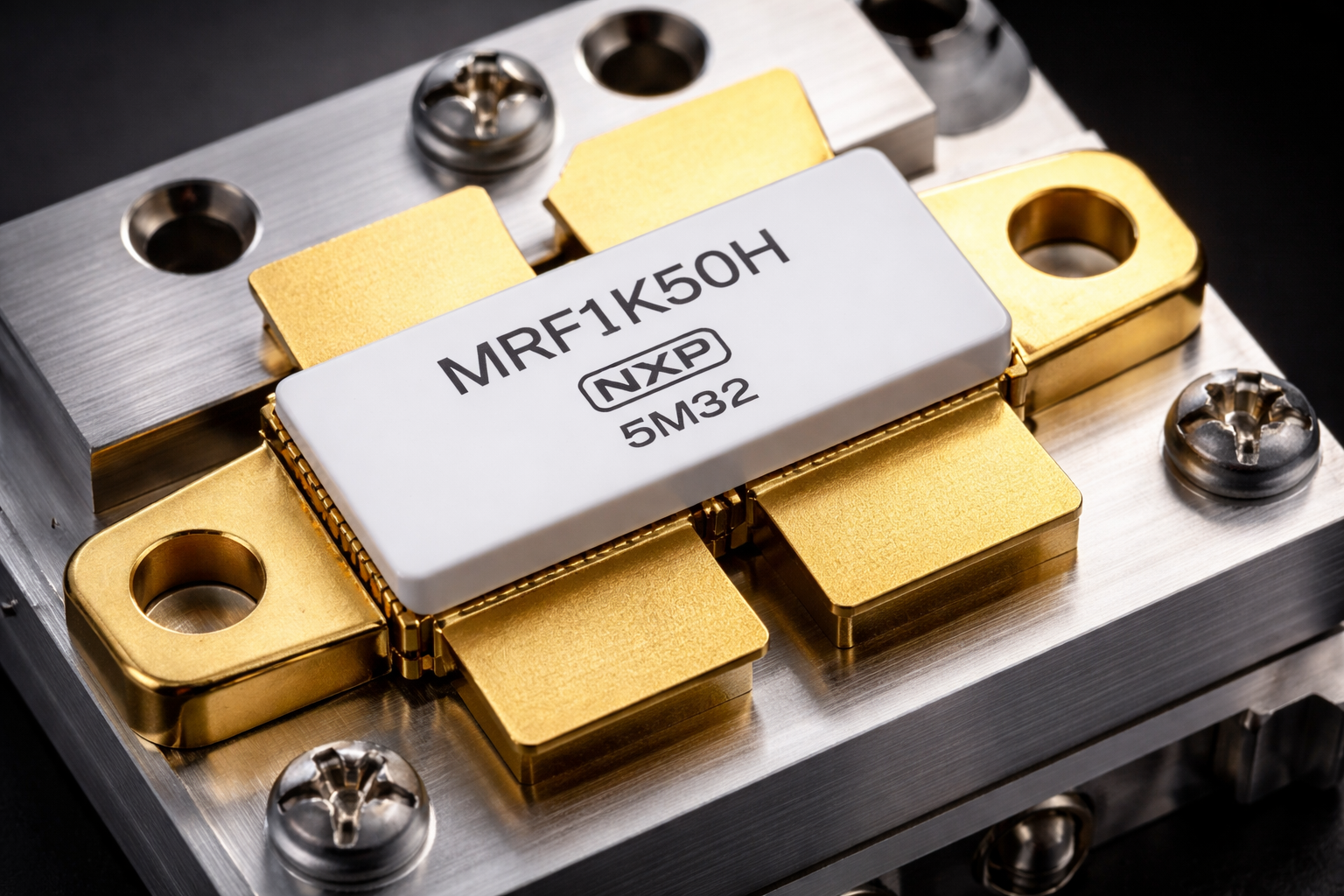
Drive requirements also differ significantly. Many solid-state amplifiers reach full output with only 30 to 50 watts of drive from a modern transceiver. In contrast, tube amplifiers commonly require between 70 and 100 watts of drive to achieve rated output power.
Voltage levels represent another major distinction. Solid-state devices typically operate with supply voltages between 40 and 65 volts. However, tube amplifiers frequently use plate voltages ranging from approximately 2000 to 3500 volts.
These engineering differences explain why the physical design, cooling systems, and protection circuitry vary widely between amplifier types.
Power Output Capability
Solid-state and tube amplifiers can both reach the legal limit for amateur radio operation. However, the path to achieving that power level differs. Many modern solid-state amplifiers combine multiple LDMOS transistors to achieve output levels of 1000 watts or more.
Tube amplifiers often achieve similar output power with a single tube or a pair of tubes operating at high voltage. Because tubes tolerate higher voltage swings, they can produce large RF outputs with relatively simple circuitry.
However, semiconductor technology continues to advance. Consequently, high-power LDMOS devices now allow compact solid-state amplifiers to rival traditional tube amplifiers in power output.
Efficiency and Heat Management
Efficiency plays a critical role in amplifier design. When an amplifier converts electrical power into RF energy, some energy inevitably becomes heat.
Solid-state amplifiers often achieve high efficiency through advanced transistor designs and switching techniques.
Nevertheless, semiconductor devices remain sensitive to excessive heat. Therefore, solid-state amplifiers rely heavily on forced-air cooling and thermal monitoring systems. Tube amplifiers also produce heat, but vacuum tubes tolerate higher temperatures without immediate damage.
Because tubes dissipate heat through radiation and conduction, they can operate safely at temperatures that would destroy semiconductor devices. However, tube amplifiers still require large cooling systems to remove heat from the plate structure.
Real Operating Scenarios
Different operating environments highlight the strengths of each amplifier technology. Consequently, understanding real-world scenarios helps operators select the most appropriate equipment.
During contest operation, solid-state amplifiers provide significant advantages. Because they require no manual tuning, operators can change bands instantly without interrupting operating rhythm. Additionally, automatic protection systems help prevent accidental overloads during fast-paced contests.
However, tube amplifiers often perform exceptionally well in stations with imperfect antennas. Since tube output circuits tolerate higher impedance mismatch, operators can continue transmitting even when antenna tuning is not ideal.
Portable and field stations often favor solid-state amplifiers because of their compact size and lighter weight. Conversely, permanent base stations sometimes use tube amplifiers due to their durability and serviceability.
Therefore, the best amplifier type frequently depends on the specific operating environment rather than raw performance specifications.
Impedance Tolerance and SWR Handling
Antenna impedance rarely remains perfectly matched across all frequencies. Consequently, amplifiers must tolerate some level of standing wave ratio mismatch.
Tube amplifiers generally handle impedance mismatch more gracefully than solid-state designs.
Because tube output circuits use pi-network matching systems, they can accommodate moderate antenna mismatch without immediate failure.
Solid-state amplifiers, on the other hand, operate within narrower impedance limits. Therefore, modern solid-state designs include protective circuits that monitor reflected power.
If the amplifier detects excessive SWR, it reduces output power or shuts down to protect the transistors. Although this protection improves reliability, it can limit operation with poorly matched antennas.
Tuning and Operating Complexity
Operating complexity differs significantly between amplifier types. Solid-state amplifiers usually require little or no tuning. Operators simply select the band and begin transmitting.
Internal control systems automatically adjust bias, matching networks, and drive levels. Tube amplifiers require manual tuning adjustments whenever the operating frequency changes significantly.
Operators must adjust plate tuning and load controls to achieve proper output and avoid excessive current. Although experienced operators often appreciate this manual control, beginners may find the process less convenient.
Reliability and Component Lifespan
Reliability represents another key factor in amplifier selection. Solid-state amplifiers contain no filaments and generally require minimal warm-up time. Therefore, they can begin operating almost immediately. However, semiconductor devices can fail instantly if exposed to excessive voltage, current, or heat.
Tube amplifiers require a warm-up period so the cathode can reach operating temperature. While tubes eventually wear out, they typically fail gradually rather than catastrophically.
When a tube reaches the end of its life, operators simply replace it. Because replacement tubes remain available for many popular amplifier models, tube amplifiers can remain operational for decades.
Size, Weight, and Physical Design
Physical design also differs between the two technologies. Solid-state amplifiers typically use compact circuit boards and switching power supplies. Consequently, they often weigh less and occupy less space.
Tube amplifiers require large transformers and high-voltage power supplies. Therefore, they tend to be larger and heavier. However, many operators appreciate the mechanical simplicity of tube amplifiers. Because tube designs use fewer active components, they can be easier to repair and maintain.
Cost and Ownership Considerations
Initial purchase price and long-term operating cost both influence amplifier selection. Solid-state amplifiers often cost more initially because they incorporate advanced semiconductor devices and digital control systems.
Tube amplifiers sometimes offer lower initial cost, particularly when using established tube designs. However, tubes eventually require replacement, which adds maintenance cost over time. Therefore, the total cost of ownership depends on operating hours, maintenance practices, and component availability.
Which Amplifier Type Performs Better
Performance comparisons between solid-state and tube amplifiers often depend on operating conditions. Solid-state amplifiers excel in convenience, automation, and integration with modern transceivers.
Operators who prefer simple operation often choose solid-state designs because they require minimal tuning and provide extensive protection systems. Tube amplifiers offer advantages in robustness and impedance tolerance.
Many experienced operators appreciate their ability to tolerate antenna mismatch and brief overdrive conditions without catastrophic failure. Therefore, neither technology universally outperforms the other. Instead, each amplifier type excels in different operating environments.
Choosing Between Solid-State and Tube Amplifiers
Operators who value convenience and automation usually prefer solid-state amplifiers. Because these amplifiers require minimal tuning, they allow operators to change bands quickly and maintain a fast operating pace.
Additionally, solid-state amplifiers integrate well with modern transceivers. Automatic band switching and built-in protection circuits simplify operation and reduce the risk of equipment damage.
However, many experienced operators still choose tube amplifiers. These amplifiers tolerate antenna mismatch better and often survive brief operating mistakes that could damage semiconductor devices.
Tube amplifiers also appeal to technically inclined operators who appreciate manual tuning control and straightforward circuit design.
Therefore, the best amplifier choice ultimately depends on the operator’s experience level, station design, and preferred operating style.
Solid-State vs Tube Amplifiers: Which Is Better?
When choosing between solid-state and tube amplifiers, the “better” option depends entirely on how you operate your station. Both technologies are widely used in amateur radio, and each has clear advantages that make it better suited for specific operating styles.
Solid-state amplifiers use modern transistor technology and are designed for convenience and efficiency. They require no warm-up time, offer automatic band switching, and eliminate the need for manual tuning. This makes them especially appealing for operators who want a simple, plug-and-play experience. They also perform exceptionally well with digital modes like FT8 and FT4, where continuous duty cycles demand stable and efficient performance.
Tube amplifiers, on the other hand, are built around vacuum tube technology and are known for their durability and tolerance. They can handle higher SWR conditions more gracefully and are generally more forgiving of operator mistakes. Many operators appreciate their ruggedness and the ability to repair them more easily compared to solid-state units. However, they require manual tuning and a short warm-up period before operation, which adds an extra step to the process.
In real-world use, solid-state amplifiers are ideal for operators who prioritize ease of use, automation, and digital mode performance. Tube amplifiers are better suited for those who operate primarily in voice modes like SSB or participate in contesting, where durability and flexibility under varying conditions are important.
Ultimately, neither option is universally better. Solid-state amplifiers offer modern convenience and efficiency, while tube amplifiers provide rugged reliability and forgiving operation. The best choice comes down to your operating style, technical comfort level, and the type of communication you plan to focus on.
Choosing the Right Amplifier for Your Station
Selecting the correct amplifier requires evaluating station requirements, operating style, and technical comfort level. Operators who value simplicity and automation may prefer solid-state amplifiers.
Those who enjoy manual tuning and rugged RF designs often favor tube amplifiers. Station power availability, antenna systems, and operating goals should also influence the decision. Consequently, the best amplifier depends on how the operator plans to use the station.
Solid-State vs Tube Amplifiers
Solid-State vs Tube Amplifiers represent two distinct engineering approaches to RF power amplification. Although semiconductor technology continues to advance, vacuum tube designs remain viable and effective in amateur radio applications.
Solid-state amplifiers deliver convenience, automation, and compact design. Meanwhile, tube amplifiers provide durability, impedance tolerance, and proven long-term serviceability.
Because both technologies can achieve excellent on-air performance, the optimal choice depends on operator preference and station design.
Ultimately, understanding the engineering principles behind Solid-State vs Tube Amplifiers types allows amateur radio operators to make informed decisions and build stations that deliver reliable high-power communication across the amateur bands.
Are tube amplifiers more powerful than solid-state amplifiers?
No. Both amplifier types can reach similar output levels, including legal limit power in many amateur radio jurisdictions.
Why do many operators still use tube amplifiers?
Tube amplifiers tolerate impedance mismatch better and often remain operational for decades with simple maintenance.
Do solid-state amplifiers require tuning?
Most modern solid-state amplifiers include automatic band switching and require little or no manual tuning.
Which amplifier type is better for beginners?
Solid-state amplifiers are usually easier for beginners because they require less manual adjustment.
Which amplifier handles high SWR better?
Tube amplifiers generally tolerate higher SWR levels due to their output network design.
About the Author
Vince, W2KU, is a licensed Extra class amateur radio operator and the founder of Ham Shack Reviews. He was named Amateur of the Year in 2026 for contributions to practical amateur radio education and equipment evaluation.
He primarily operates HF, knows propagation very well, operates mobile and handhelds daily. Vince exchanges QSL cards for DXCC, contest confirmation, and award tracking and is the club QSL manager. His guidance focuses on practical operating procedures, accurate logging, and real-world amateur radio practices.
Please consider Donating to help support this channel