
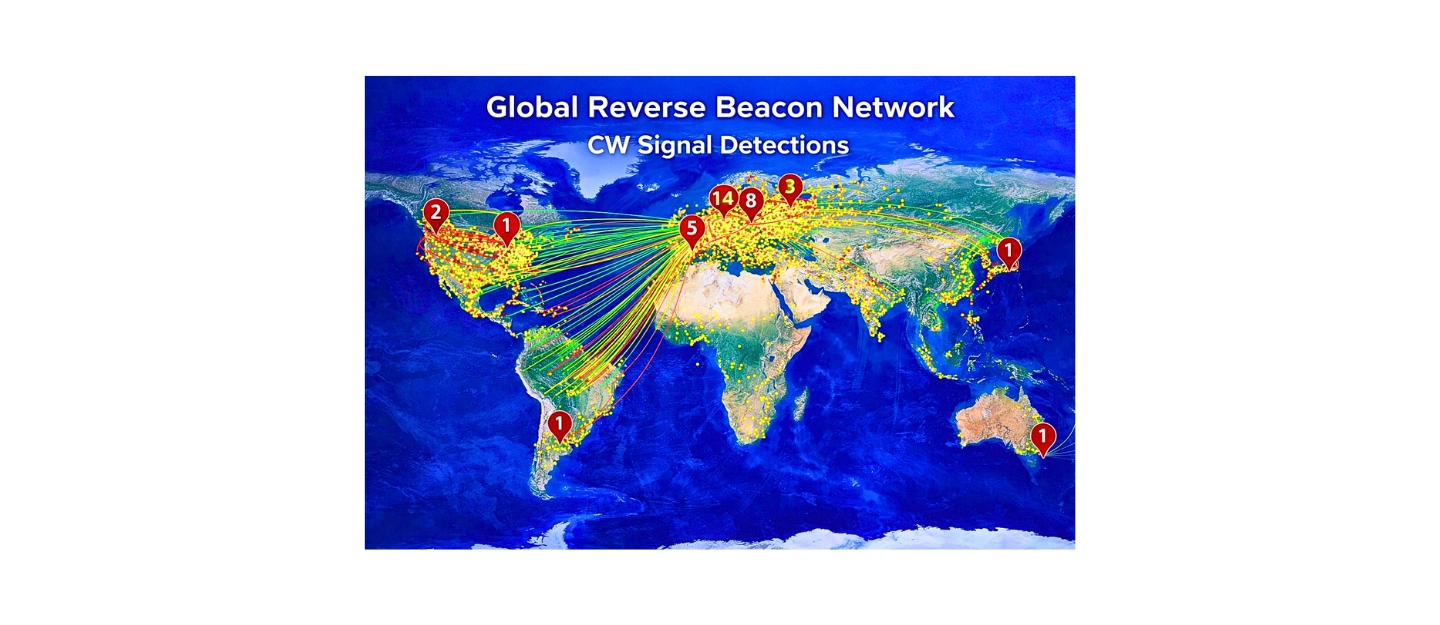
Test Propagation Using the RBN is one of the most useful skills an HF operator can develop. When you understand how signals are traveling through the ionosphere, you can choose better bands, adjust antennas more effectively, and work more stations with less wasted time.
Many operators rely on propagation predictions, solar flux numbers, or band condition reports. While those tools are useful, they only provide estimates of what the ionosphere might be doing. The most accurate information always comes from real RF signals traveling through the air at that moment.
The RBN (Reverse Beacon Network) provides exactly that. It allows operators to test propagation using real transmissions and see where their signals are being received across the world. By transmitting a short CW signal, you can instantly discover which bands are open, which regions are reachable, and how strong your signal appears to distant receivers.
This guide explains everything needed to test propagation using the RBN, including equipment requirements, step-by-step testing procedures, signal interpretation, and advanced techniques used by experienced operators.
For a deeper look at logging programs, digital mode software, contest tools, and station control applications, see the Complete Guide to Ham Radio Software.
Test Propagation Using the RBN Is Ideal
Propagation predictions rely on models of the ionosphere based on solar conditions. While these models are useful, they cannot account for many real-world variables such as localized ionospheric disturbances, geomagnetic activity, or short-term changes in the F layer.
The Reverse Beacon Network measures actual signal paths, which makes it one of the most accurate tools available for testing propagation.
Key advantages include:
- Real-time signal measurements
- Global receiver coverage
- Objective signal strength data
- Instant feedback on transmissions
- Ability to evaluate antenna performance
Because the network constantly monitors the bands, operators can conduct propagation tests at any time without needing coordinated receiving stations.
What the RBN Is
The RBN (Reverse Beacon Network) is a global system of automated listening stations that continuously monitor amateur radio bands. These stations run software called CW Skimmer, which automatically decodes Morse code signals across wide sections of the HF spectrum.
Whenever a CW signal is detected, the skimmer station uploads a spot to the Reverse Beacon Network database. Each spot contains several pieces of information that are useful for propagation analysis.
Typical RBN spot data includes:
- Callsign of the transmitting station
- Frequency of the transmission
- Signal-to-noise ratio (SNR) in decibels
- Callsign of the receiving skimmer station
- Timestamp of the reception
- Mode (usually CW)
Because skimmer stations are located all over the world, the network provides an immediate picture of how signals are propagating globally. Instead of guessing which bands might be open, operators can observe exactly where their signal is reaching in real time.
Equipment Needed to Test Propagation with RBN
One of the best aspects of RBN testing is that almost any CW-capable station can use it.
Basic equipment requirements include:
- HF transceiver capable of CW operation
- CW key, paddle, or electronic keyer
- HF antenna
- Internet access to view Reverse Beacon Network results
Additional tools can make testing easier but are not required.
Optional equipment and software:
- Logging software with RBN integration
- CW macros for consistent transmissions
- Band map or spotting software
- Propagation visualization tools
Even a simple station running low power can generate useful propagation data.
Choosing the Right CW Speed for Reliable Detection
CW Skimmer software performs best when signals are transmitted at a predictable speed. Extremely slow or extremely fast Morse code may not decode reliably.
For propagation testing, the most reliable speeds are typically between 18 and 25 words per minute.
This range provides several advantages:
- Consistent decoding by skimmer stations
- Reduced chance of decoding errors
- Better detection of weak signals
If you normally operate slower or faster than this range, consider using a keyer macro set to a standard testing speed.
Step-by-Step Method for Testing Propagation with RBN
Testing propagation with the Reverse Beacon Network only takes a few minutes. By following a consistent procedure, you can quickly determine which bands are open and where your signal is traveling.
First, select a clear frequency in the CW portion of the band you want to test. It is important to avoid interfering with ongoing contacts.
Common CW test frequencies include:
| Band | Typical CW Test Range |
|---|---|
| 160 meters | 1.830–1.840 MHz |
| 80 meters | 3.510–3.530 MHz |
| 40 meters | 7.010–7.040 MHz |
| 30 meters | 10.110–10.120 MHz |
| 20 meters | 14.020–14.040 MHz |
| 17 meters | 18.080–18.100 MHz |
| 15 meters | 21.020–21.040 MHz |
| 12 meters | 24.890–24.910 MHz |
| 10 meters | 28.020–28.060 MHz |
After confirming the frequency is clear, transmit a short CQ call using CW.
Example test call:
CQ CQ CQ DE W2XX W2XX W2XX K
Transmit for approximately 10 to 20 seconds. This gives multiple skimmer stations enough time to decode your signal. Once the transmission is complete, wait about 30 seconds for spots to appear in the Reverse Beacon Network database. Then check the RBN website or a spotting interface and search for your callsign.
Understanding Reverse Beacon Network Signal Reports
The RBN measures signal strength using signal-to-noise ratio (SNR) in decibels. This value indicates how strong your signal is compared to the background noise at the receiving station.
Typical signal interpretations are:
| SNR (dB) | Signal Quality |
|---|---|
| 3–5 dB | Barely readable |
| 6–10 dB | Weak but usable |
| 10–20 dB | Good signal |
| 20–30 dB | Strong |
| 30+ dB | Very strong |
Even low readings can still represent a usable propagation path. A signal reported at 5 dB SNR may still be perfectly readable for experienced CW operators.
Mapping Propagation Paths from RBN Data
Each RBN spot represents a real signal path between the transmitting station and the receiving skimmer station. By examining where your signal is detected, you can identify propagation patterns.
Some common patterns include:
Short-range propagation typically appears within 200 to 800 miles. This is common on 80 meters and 40 meters during nighttime hours.
Medium-distance propagation usually occurs between 800 and 2000 miles. This range is frequently observed on 20 meters and 30 meters.
Long-distance propagation often spans 3000 miles or more and typically indicates strong F-layer propagation conditions.
When you see multiple stations across a continent detecting your signal, it usually means the band is fully open.
Testing Multiple Bands to Identify Openings
Experienced operators rarely test only one band. Instead, they quickly sample several bands to see which ones are producing the strongest results.
A typical propagation check might look like this:
- Send a CQ on 20 meters
- Check Reverse Beacon Network spots
- Send a CQ on 17 meters
- Check spots again
- Test 15 meters and 10 meters
Within just a few minutes, the results reveal which bands are open.
Example propagation test results:
| Band | Number of Spots | Interpretation |
|---|---|---|
| 20 meters | 18 | Fully open |
| 17 meters | 7 | Moderate opening |
| 15 meters | 3 | Weak propagation |
| 12 meters | 0 | Closed |
This type of testing is much more reliable than relying only on solar data.
Using the RBN to Evaluate Antennas
RBN is extremely useful when testing antenna performance. Because signal reports include objective strength measurements, you can compare different antenna configurations.
Example testing procedure:
Transmit a CQ using antenna A and record the RBN spots. Then switch to antenna B and repeat the test under similar conditions.
Example comparison:
| Antenna | Average SNR | Stations Reporting |
|---|---|---|
| Dipole | 11 dB | 7 |
| Vertical | 16 dB | 12 |
In this case, the vertical antenna produced stronger signals and was detected by more skimmer stations.
Testing Directional Antennas
Directional antennas such as Yagis can also be analyzed using RBN. A simple method is to rotate the antenna in different directions while transmitting test signals.
For example:
- Point antenna north and transmit
- Rotate east and transmit again
- Rotate south and repeat
- Rotate west and repeat
By comparing which stations report the strongest signals, you can confirm the antenna’s directional pattern.
Best Times Test Propagation Using the RBN
Propagation conditions change constantly throughout the day. Certain times are especially useful for testing.
Ideal testing periods include:
- Sunrise
- Sunset
- Grayline propagation periods
- Before major contests
- During solar disturbances
During these times, band openings may appear quickly and disappear just as fast. Using the Reverse Beacon Network allows operators to detect these changes immediately.
Advanced Propagation Analysis with RBN
More advanced operators combine Reverse Beacon Network data with other propagation tools.
Examples include comparing RBN results with solar indices such as:
- Solar Flux Index (SFI)
- K index
- A index
- Maximum Usable Frequency (MUF)
If solar data predicts good propagation but RBN shows weak signal paths, it may indicate ionospheric disturbances or localized absorption.
Common Mistakes When
Some operators misunderstand how to test propagation using the RBN effectively. One common mistake is transmitting too briefly. CW Skimmer software needs enough signal duration to decode Morse code correctly.
Another mistake is using irregular keying or inconsistent spacing. Clean CW improves detection reliability.
Operators also sometimes test on extremely crowded frequencies where interference prevents accurate decoding.
Finally, extremely low power levels may limit the number of stations that detect the signal.
Using the RBN as a Propagation Laboratory
When used properly, a becomes much more than a spotting system. It allows operators to study the behavior of HF propagation in real time.
By sending short CW transmissions and analyzing skimmer reports, operators can determine:
- Which bands are open
- Which geographic regions are reachable
- How antenna changes affect signal strength
- When propagation conditions improve or decline
For operators who want to understand HF propagation at a deeper level, RBN effectively turns a normal amateur radio station into a propagation research tool.
FAQ – Test Propagation Using the RBN
How do I test propagation using the Reverse Beacon Network?
Transmit a short CW CQ call on the band you want to test, then check the Reverse Beacon Network for stations that detected your signal.
What signal strength on RBN indicates good propagation?
Signals above about 10 dB SNR are generally solid, while values above 20 dB indicate strong propagation.
Do I need special software to use the Reverse Beacon Network?
No special software is required. Any CW transmission can be detected by skimmer stations connected to the network.
Why does my signal appear far away but not nearby?
This is caused by HF skip zones, where signals pass over nearby areas before returning to Earth at greater distances.
Can RBN help test antennas?
Yes. By comparing signal reports from different antenna setups, you can measure which antenna performs better.
Does the Reverse Beacon Network detect SSB or digital modes?
The network primarily monitors CW signals, although some skimmers can decode limited digital signals.
About the Author
Vince, W2KU, is a licensed Extra class amateur radio operator and the founder of Ham Shack Reviews. The organization named him Amateur of the Year in 2026 for his contributions to practical amateur radio education and equipment evaluation.
He primarily operates HF, knows propagation very well, operates mobile and handhelds daily. Vince exchanges QSL cards for DXCC, contest confirmation, and award tracking and is the club QSL manager. His guidance focuses on practical operating procedures, accurate logging, and real-world amateur radio practices.
Please consider Donating to help support this channel