
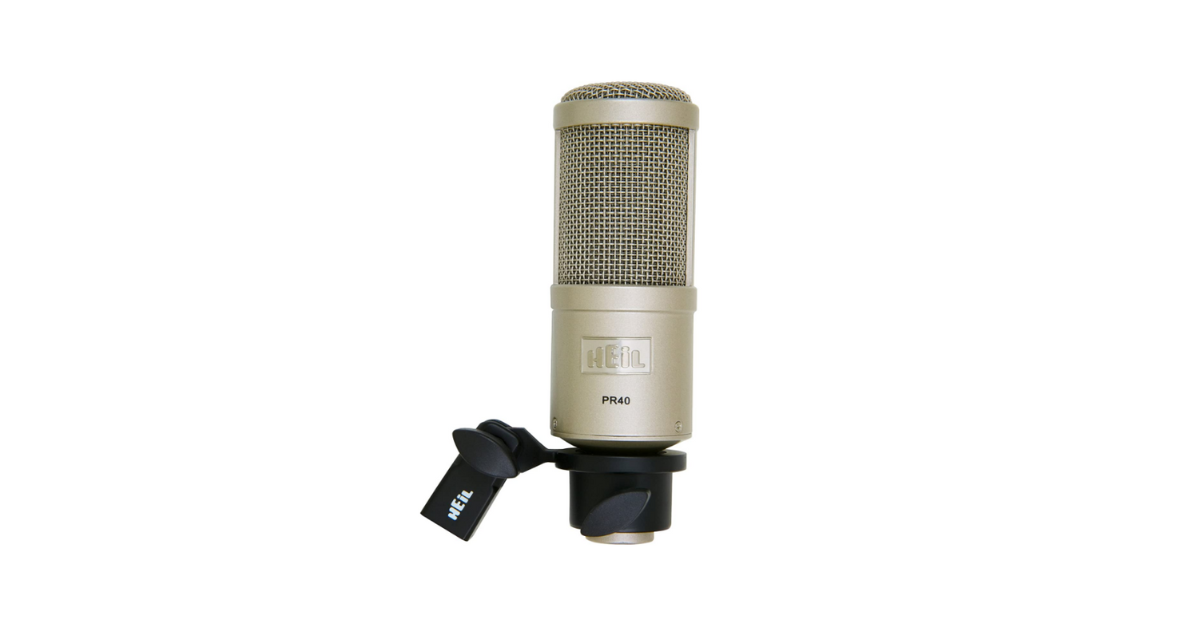
The PR40 is a large diameter dynamic studio microphone built for serious voice The Heil PR40 is a professional dynamic microphone that has become a popular choice for broadcasters, podcasters, recording engineers, and amateur radio operators who want full, natural-sounding voice reproduction. For ham radio, the PR40 is particularly interesting because its wide frequency response, cardioid pickup pattern, strong rear rejection, and close-range design give operators considerable control over the character of their transmitted audio.
Unlike a conventional communications microphone that is primarily designed to emphasize the portions of the voice most important for intelligibility, the PR40 is a full-range microphone. Its specified response extends from 28 Hz to 18 kHz, allowing it to capture substantially more of the voice than a typical narrow communications microphone. Of course, the microphone cannot make an amateur radio transmitter transmit frequencies outside the bandwidth selected by the radio, but the broader source response gives the operator more flexibility when shaping the final signal.
The PR40 is not automatically the right microphone for every amateur radio station. Its strong low-frequency response can sound excellent with some voices and excessive with others, while its close-talk design makes microphone position particularly important. After considering its design, specifications, practical setup requirements, audio characteristics, and competition, the PR40 stands out as a serious microphone for operators who want more than basic communications audio.
Heil PR40 Review at a Glance
The Heil PR40 is a dynamic, end-fire microphone with a cardioid pickup pattern and a 1-inch dynamic element. It is designed to deliver a warm, natural sound while maintaining strong articulation and rejecting unwanted sound from the rear of the microphone.
For amateur radio, the biggest attraction is its combination of broad frequency response and directional control. The microphone can produce substantial low-frequency voice energy, while its cardioid pattern helps reduce unwanted sound from behind the microphone. That makes it particularly useful in a typical home ham shack where computers, fans, radios, power supplies, and other equipment can create background noise.
The PR40 also has a professional XLR output and is designed for close-range operation. Heil recommends placing the audio source approximately two inches from the end grille for best results. Because it is an end-fire microphone, the operator must speak into the end of the microphone rather than the side.
Technical Specifications
| Specification | Heil PR40 |
|---|---|
| Microphone Type | Dynamic |
| Element | 1-inch dynamic element |
| Frequency Response | 28 Hz–18 kHz |
| Polar Pattern | Cardioid |
| Rear Rejection | -40 dB at 180° off-axis |
| Impedance | 600 ohms balanced |
| Output Level | -53.9 dB at 1 kHz |
| Maximum SPL | 148 dB |
| Output | 3-pin XLR |
| Weight | 13.5 ounces |
| Recommended Working Distance | Approximately 2 inches |
These specifications explain much of the PR40’s reputation. The 28 Hz–18 kHz response is unusually broad for a dynamic microphone, while the cardioid pattern and specified rear rejection make the microphone useful when controlling unwanted ambient sound is important.
The 148 dB maximum SPL rating is far beyond what normal speech requires, so acoustic overload is not a practical concern for normal amateur radio voice operation. For a ham station, microphone positioning, gain structure, transmit bandwidth, EQ, and RF control are considerably more important.
What Makes the Heil PR40 Different?
The biggest difference between the PR40 and many communications microphones is its approach to voice reproduction. A typical communications microphone is often designed to concentrate on the portion of the voice that provides maximum intelligibility through a restricted radio bandwidth. The PR40 instead begins with a much broader source response.
That broader response gives the operator more freedom. If the transceiver provides adjustable transmit equalization and bandwidth, the operator can shape the audio for a fuller sound or tighten the response when operating conditions call for maximum speech articulation.
This flexibility also means the PR40 requires more attention to setup. A microphone that captures substantial low-frequency energy can sound excellent when properly adjusted, but the same microphone can sound muddy if the operator uses excessive bass, speaks too closely, or drives the transmitter with inappropriate EQ.
The PR40 should therefore be viewed as part of the entire station audio chain rather than as a microphone that automatically produces perfect audio the moment it is connected.
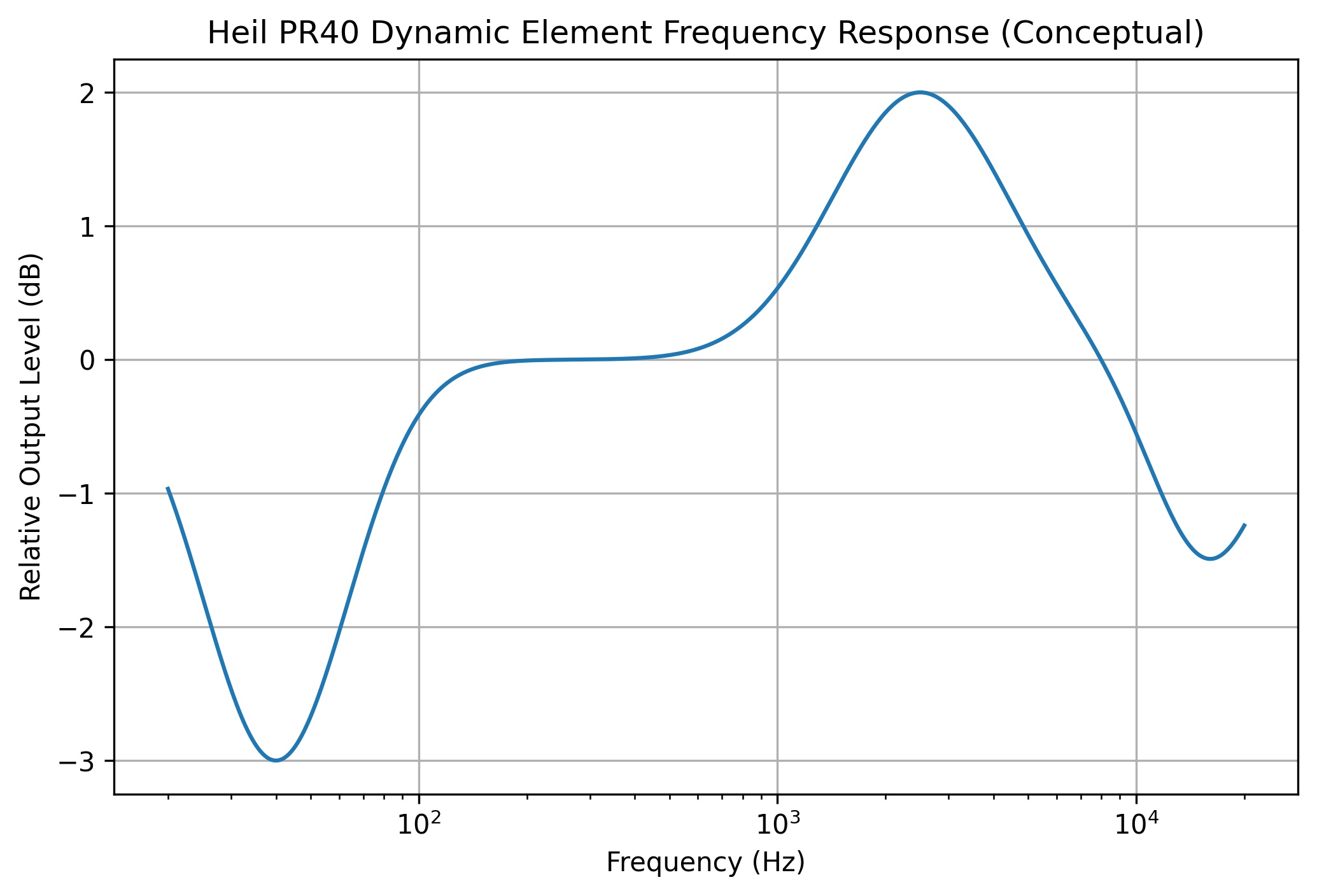
PR40 Dynamic Element and Frequency Response
The PR40 uses a 1-inch dynamic element and has a specified frequency response extending from 28 Hz to 18 kHz. That wide response is one of the microphone’s defining characteristics.
The extended low-frequency response gives voices additional depth and weight. For operators with naturally deep or midrange-heavy voices, this can create a strong, authoritative sound. However, the same characteristic can become excessive when the microphone is positioned extremely close or when the transmitter’s low-frequency EQ is boosted unnecessarily.
The upper part of the response is equally important because a full sound is not useful if speech articulation disappears. The PR40’s response is designed to retain articulation while providing the broad tonal range associated with professional broadcast microphones.
For amateur radio, the practical advantage is flexibility. The microphone can provide a full source signal while the transceiver determines how much of that information actually becomes part of the transmitted signal.
Internal Pop Filtering and Breath Control
Close microphone operation introduces another challenge: breath blasts and plosive sounds. Speaking directly into a microphone from a short distance can produce large bursts of air from consonants such as “P” and “B.”
The PR40 incorporates a double-layer internal pop-filtering system designed to break up and redirect these breath blasts before they reach the diaphragm. An acoustically transparent foam layer also helps control unwanted air movement around the element.
This internal filtering is particularly useful for amateur radio because close-talk operation is one of the PR40’s intended uses. The operator can work near the microphone without necessarily requiring a large external pop filter.
Proper technique still matters. Speaking slightly across the end of the microphone rather than forcing every breath directly into the grille can further reduce plosive sounds while maintaining the desired voice character.
Heil PR40 Proximity Effect
The proximity effect is one of the most important characteristics to understand before buying a PR40. As the operator moves closer to a directional microphone, low-frequency response generally increases. With the PR40’s already broad low-end capability, that effect can have a noticeable impact on the transmitted voice.
Used correctly, proximity effect can give a voice additional body and authority. This is one reason the PR40 can produce the rich broadcast-style sound that attracts many operators.
However, more bass is not always better. A naturally deep voice can become overly heavy when the operator is extremely close to the microphone and the transmitter’s low-frequency EQ is also boosted.
The solution is not necessarily to abandon the microphone. Start with positioning. Move slightly farther away, return the transmitter’s EQ toward a neutral setting, and listen to the result before making more aggressive changes.
How to Position the Heil PR40
The PR40 is an end-fire microphone, meaning that it picks up sound from the end rather than the side. This is an important point because positioning it incorrectly can make the microphone appear to perform poorly when the real problem is simply microphone orientation.
Heil recommends approximately two inches between the audio source and the end grille for best results. That close distance helps the microphone produce the intended full voice response while also allowing the cardioid pickup pattern to work effectively.
Consistency is just as important as distance. If the operator moves from two inches away to six inches away during a transmission, the tonal balance and signal level can change. Keeping a consistent mouth-to-microphone distance produces much more predictable audio.
Speaking slightly across the grille rather than directly into it can also help control breath blasts. Once the correct position is established, adjust the radio’s microphone gain around that normal operating position rather than constantly changing the gain to compensate for inconsistent microphone technique.
Background Noise Rejection
Background noise is a major concern in many amateur radio stations. Computers, cooling fans, power supplies, amplifiers, air conditioning systems, keyboards, and other equipment can all contribute unwanted sound.
The PR40’s cardioid pattern is useful because it concentrates sensitivity toward the front while reducing sensitivity from other directions. Heil specifies approximately -40 dB rear rejection at 180 degrees off-axis.
This makes microphone orientation part of the station setup. If a noisy computer fan is located behind the microphone, for example, positioning the rear of the PR40 toward that noise source can help reduce how much of it reaches the microphone.
This does not eliminate the need for good shack design. A directional microphone cannot correct every acoustic problem. Good positioning, reasonable microphone gain, and sensible station layout remain important.
PR40 Build Quality and Mounting
The PR40 has the substantial construction expected from a professional broadcast microphone. Its metal body and 13.5-ounce weight give it a solid feel, but that also means it deserves a suitable microphone stand or boom arm.
The microphone is supplied with an SM-3 microphone holder that mounts to a standard 5/8-27 microphone thread. This allows it to be used with many conventional microphone stands and boom systems.
A shock mount can also be useful in an amateur radio station. Desk vibration, keyboard activity, equipment movement, and physical contact with the operating desk can be transferred into a microphone if it is mounted directly to a rigid stand.
For a station where the microphone remains in one position, a sturdy boom arm is an especially practical solution. It allows the operator to maintain consistent microphone distance without placing the microphone directly in front of the radio controls.
Does the Heil PR40 Need a Preamp?
The PR40 is a dynamic microphone and does not require phantom power simply to operate. When additional gain is necessary depends on the radio, interface, mixer, or other equipment connected to the microphone.
The important issue is clean gain. The operator needs enough microphone level to properly drive the transmitter without excessive noise or distortion.
Do not automatically assume that a separate preamp is required because the PR40 is a dynamic microphone. Determine how much gain the particular transceiver or interface provides and adjust the microphone level accordingly.
If additional gain is required, the preamp should be used to solve a real gain requirement rather than being added simply because it is commonly used with professional microphones.
Heil PR40 and Amateur Radio Transmit Audio
The PR40 makes the most sense in a station where the operator has control over transmit audio. Modern HF transceivers commonly provide some combination of transmit bandwidth adjustment, microphone equalization, compression, and other audio controls.
Those controls allow the operator to take advantage of the microphone’s broad source response.
For example, an operator may want a fuller sound during normal ragchews when band conditions are good. During difficult conditions, reducing excessive low-frequency energy and emphasizing the portion of the voice that carries intelligibility can produce a more effective communications signal.
The objective should never be to make the audio as wide or as bass-heavy as possible. The objective is to produce a clean, intelligible signal that fits the selected transmit bandwidth.
Recommended PR40 EQ Approach for Ham Radio
There is no universal EQ setting for the PR40 because every voice and every radio is different. The best starting point is generally a relatively neutral setting followed by small adjustments based on actual transmitted audio.
If the voice sounds muddy or excessively bass-heavy, begin by reducing low-frequency energy. A high-pass or low-cut adjustment somewhere around 80–120 Hz can be a useful starting point when the transceiver provides that type of control.
If the voice remains overly heavy, a modest reduction in the 120–200 Hz region may help. The goal is to remove unnecessary low-frequency energy rather than eliminate the natural depth that makes the PR40 attractive.
For speech that lacks articulation, a modest adjustment in the 2–4 kHz region can help emphasize intelligibility. Avoid large boosts because excessive presence can make the audio harsh or fatiguing.
Compression should also be used conservatively. Light compression can help maintain a consistent level, but excessive compression can increase background noise and make the transmitted audio sound unnatural.
The final test should be performed using a separate receiver or reliable off-air monitoring. Listening only through the transmitting radio’s internal monitor does not necessarily provide the same perspective as a distant receiver.
Heil PR40 vs Communications Microphones
The PR40 is not necessarily better than every communications microphone. It is designed for a different purpose.
A traditional communications microphone may intentionally limit or shape frequency response to emphasize speech intelligibility. That approach can work extremely well for amateur radio, especially when the operator’s primary goal is strong communications performance under poor band conditions.
The PR40 offers a broader source response and a more natural voice character. This makes it attractive to operators who want a richer transmit sound or who also use the microphone for recording, podcasting, streaming, or other voice applications.
The right choice depends on the operator’s objective. If the station is built around broadcast-style audio and the transceiver provides adequate audio controls, the PR40 is an excellent fit. If the operator simply wants straightforward communications audio with minimal adjustment, a dedicated communications microphone may make more sense.
Heil PR40 vs Heil PR-781
The Heil PR40 and PR-781 are both serious microphone choices for amateur radio, but they appeal to somewhat different preferences.
The PR40 is the stronger choice for an operator who specifically wants a broad, full-range microphone capable of producing a rich broadcast-style voice. Its extended low-frequency response and professional construction also make it useful outside amateur radio.
The PR-781 is designed with amateur radio voice communication more directly in mind. Operators who prioritize communications-oriented articulation may prefer its overall approach.
Neither microphone should be selected solely because one has a particular reputation. The operator’s voice, radio, transmit bandwidth, microphone distance, and desired audio character matter more than the name on the grille.
For operators who want one microphone that can serve amateur radio as well as recording and broadcast applications, the PR40 has a strong advantage in versatility.
Real-World Station Considerations
A microphone should never be evaluated independently of the radio connected to it. The same PR40 can produce noticeably different results when connected to different transceivers because microphone inputs, transmit bandwidth, equalization controls, compression, and audio processing vary from radio to radio.
The operator’s voice also matters. A naturally deep voice may require less bass from the transmitter, while a lighter voice may benefit from retaining more of the PR40’s low-frequency character.
The operating environment matters as well. In a quiet room, the PR40 can take advantage of its broad response without as much concern about ambient sound. In a noisy shack, microphone orientation and gain become more important.
This is why there is no single PR40 setup that should be copied by every operator. The microphone is capable of producing a wide range of results, and the best setup is the one that complements the individual voice and station.
RF Considerations With the PR40
Amateur radio introduces another consideration that is less important in ordinary studio use: RF.
A high-power transmitter can create a strong RF environment around the operating position. If RF gets into the audio system, the resulting symptoms can include distortion, buzzing, hum, audio feedback, or other unwanted effects.
The PR40 uses a balanced XLR output, but proper cable routing and station construction remain important. Keep microphone cables away from RF feed lines and high-current power wiring where practical.
If RF problems occur, do not assume the microphone itself is defective. Investigate the entire audio path, including cables, connectors, grounding, feed-line routing, common-mode current, and other station-level causes.
A properly installed microphone should be part of a properly constructed RF station.
Heil PR40 Audio Troubleshooting
If the PR40 sounds too bass-heavy, first check microphone distance and transmit EQ. Moving slightly farther away and reducing excessive low-frequency boost can often produce a cleaner signal.
If the audio sounds thin, check whether the microphone is too far away or whether too much low-frequency EQ has been removed. Return the transmitter closer to a neutral setting and establish the correct microphone position before making further changes.
If the transmitted audio contains too much background noise, reduce unnecessary microphone gain and take advantage of the cardioid pickup pattern. Position the microphone so major noise sources are toward the rear rather than directly in front of it.
If the audio contains hum or buzz, inspect the audio cables, connectors, power equipment, grounding, and cable routing. Should problems appears only during transmission, investigate RF-related causes rather than attempting to correct the problem with EQ.
If the microphone produces plosive sounds, check the speaking angle and distance. Speaking slightly across the grille and maintaining the recommended close-working position can reduce breath blasts.
Heil PR40 Pros and Cons
Advantages
- Wide 28 Hz–18 kHz frequency response
- Natural, full-range voice reproduction
- Cardioid pickup pattern
- Approximately -40 dB rear rejection
- Excellent close-range capability
- Internal pop and breath filtering
- High maximum SPL capability
- Professional metal construction
- Standard 3-pin XLR output
- Useful for both amateur radio and other voice applications
- Works particularly well with radios offering adjustable transmit audio
Disadvantages
- Strong low-frequency response can be excessive for some voices
- Correct microphone positioning is important
- Transmit EQ may require adjustment for the best result
- More microphone than some operators need for basic communications
- Requires suitable XLR connectivity or an appropriate radio interface
The advantages make the PR40 particularly compelling for operators who care about transmit audio quality. The disadvantages are mostly setup considerations rather than fundamental design problems.
Who Should Buy the Heil PR40?
The PR40 is best suited to amateur radio operators who want a full, natural voice and have a transceiver capable of taking advantage of that microphone’s broad response.
It is particularly attractive for operators who also use their station for recording, streaming, podcasting, or other voice applications. Having one professional dynamic microphone serve multiple purposes can make the additional capability worthwhile.
It is also a strong choice for operators working in a shack where rear noise rejection matters. The cardioid pattern and specified rear rejection can help reduce unwanted sound when the microphone is positioned correctly.
Who Should Not Buy the Heil PR40?
The PR40 may be unnecessary for an operator who simply wants a basic communications microphone and has no interest in broadcast-style audio.
It may also require more setup attention than an operator wants to give. If the microphone is going to be connected to a radio, operated from several different distances, and used without any adjustment to transmit audio, much of its potential will be wasted.
Operators with very bass-heavy voices should also understand the proximity effect before buying. The PR40 can deliver substantial low-frequency energy, and achieving the best result may require careful microphone placement and modest EQ.
Heil PR40 Frequently Asked Questions
Is the Heil PR40 good for ham radio?
Yes. The PR40 is particularly well suited to amateur radio operators who want full, natural transmit audio and have a transceiver with adjustable transmit audio controls. Its cardioid pattern and rear rejection also make it useful in typical operating environments where background noise can be an issue.
Is the Heil PR40 a dynamic microphone?
Yes. The PR40 uses a dynamic element. Its design provides a wide frequency response while retaining the practical advantages associated with dynamic microphones.
How close should you speak to a Heil PR40?
Heil recommends an audio source approximately two inches from the end grille for best results. Consistent distance is important because moving closer or farther away changes both signal level and low-frequency response.
Does the Heil PR40 pick up background noise?
The PR40 uses a cardioid pickup pattern and is specified for approximately -40 dB rear rejection at 180 degrees off-axis. Proper positioning can therefore reduce unwanted sound from behind the microphone, although no microphone can eliminate all room noise.
Does the PR40 need phantom power?
No. The PR40 is a passive dynamic microphone and does not require phantom power to operate.
Does the Heil PR40 need a preamp?
Not automatically. Whether additional gain is required depends on the microphone input or interface connected to the PR40. The important requirement is sufficient clean gain without introducing unnecessary noise or distortion.
Is the Heil PR40 good for a deep voice?
It can be, but microphone position and EQ become particularly important. Because the PR40 has strong low-frequency capability and is intended for close operation, a naturally deep voice may require less bass or slightly greater microphone distance to maintain clarity.
Is the Heil PR40 better than the PR-781?
Neither microphone is universally better. The PR40 is particularly attractive for operators who want broad frequency response, full voice reproduction, and versatility beyond amateur radio. The PR-781 may be preferable for operators whose priorities are more specifically centered on communications-oriented voice performance.
Is the Heil PR40 worth the money?
For an operator who wants a professional dynamic microphone that can serve amateur radio, recording, broadcasting, and other voice applications, the PR40 can justify its price through its versatility and performance. For someone who only needs basic communications audio, a less expensive microphone may be a more practical choice.
Heil PR40 Final Verdict
The Heil PR40 remains an impressive microphone for amateur radio because it approaches transmit audio from a professional broadcast perspective rather than simply providing another narrow communications microphone.
Its 28 Hz–18 kHz response, cardioid pattern, rear rejection, close-range design, internal pop filtering, and professional construction give operators substantial control over the character of their audio. The microphone can produce a rich and natural voice, but achieving the best result depends on using the microphone correctly and configuring the transceiver appropriately.
The most important lesson with the PR40 is that microphone quality alone does not create great transmit audio. Position, voice characteristics, microphone gain, transmit bandwidth, EQ, compression, station noise, and RF control all contribute to the final signal.
For the amateur radio operator who wants a serious microphone with capabilities extending beyond the ham shack, the PR40 is a strong choice. Its biggest strength is not simply that it sounds good; it is that it gives the operator enough range and control to build the audio character that best suits the station.
Bottom line: The Heil PR40 is best for amateur radio operators who want full, natural, broadcast-style voice audio and the flexibility to shape that audio properly through their transceiver and operating technique. It is more microphone than many operators need, but for a serious station where transmit audio is an important part of the operating experience, it is a microphone worth considering.
Please consider Donating to help support this channel